The Science of Recallable Learning: Neurobiology Principles Applied to Workplace Systems
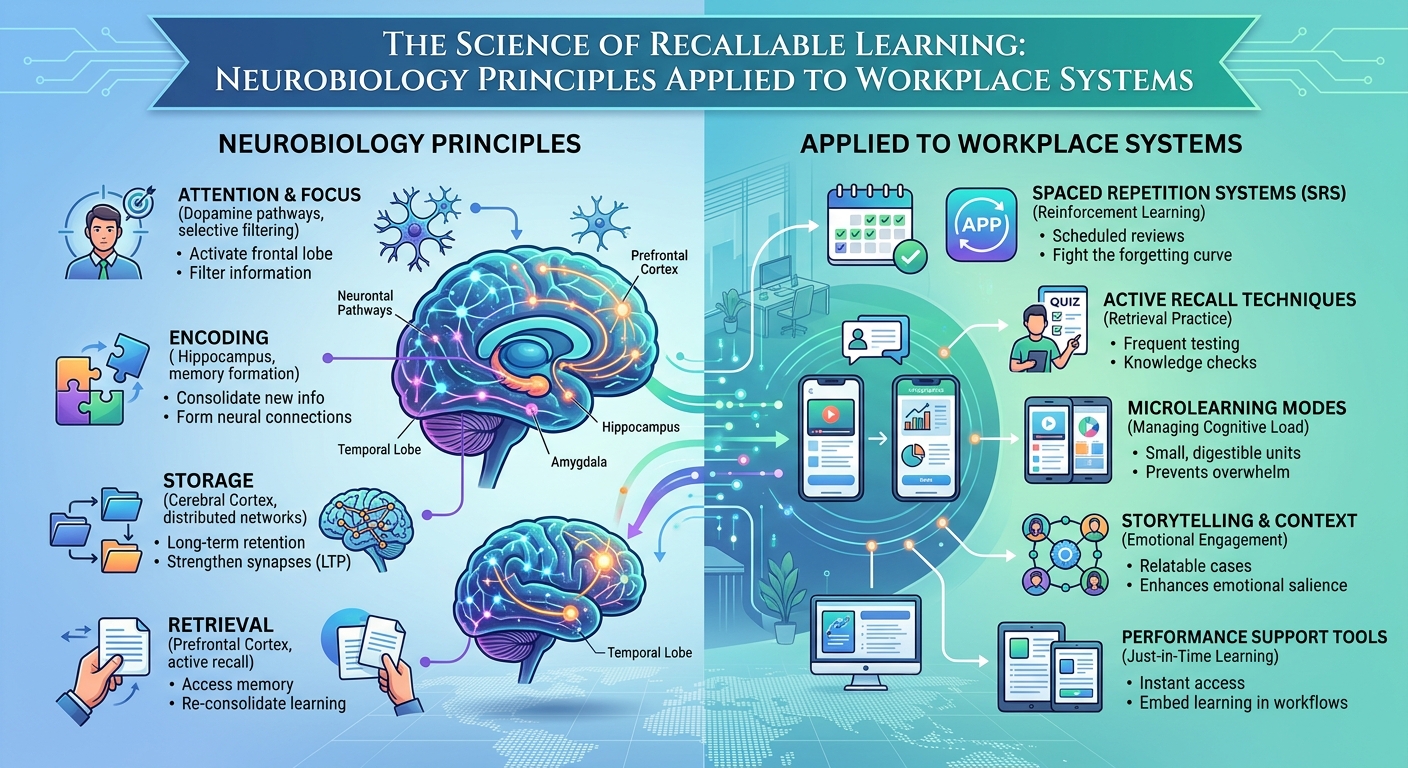
The Science of Recallable Learning: Neurobiology Principles Applied to Workplace Systems
As leaders in Learning & Development, your mission transcends mere content delivery; it’s about fostering lasting knowledge, driving performance, and cultivating a truly capable workforce. In today’s rapidly evolving professional landscape, the traditional ‘learn it and forget it’ model simply won't suffice. The challenge is clear: how do we design learning experiences that stick? The answer lies not just in pedagogical innovation, but in understanding the very organ of learning itself: the human brain. By applying neurobiology principles, we can engineer workplace systems that don't just teach, but create truly recallable learning.
This article delves into the fascinating world where neuroscience meets enterprise training, exploring how fundamental brain mechanisms can inform the design of more effective, efficient, and impactful learning solutions. For L&D Vice Presidents, Directors, and Managers across sectors like Compliance, Sales, Banking, Finance, Insurance, Retail, Pharma, Healthcare, Hospitality, Oil and Gas, and Mining, this isn't just theory; it's a strategic imperative for competitive advantage.
The Neurobiological Foundation of Learning
Our brains are complex marvels, constantly forming and strengthening neural connections. To make learning stick, we must align our methods with these natural processes.
Spaced Repetition and the Forgetting Curve
Hermann Ebbinghaus’s groundbreaking work on the forgetting curve revealed a stark truth: we rapidly forget new information unless reinforced. Neurobiology explains this: repeated exposure strengthens synapses, making memories more robust and accessible. Applying this in the workplace means moving away from one-off training sessions towards spaced, iterative learning modules. A well-designed Microlearning LMS can deliver short, focused bursts of information at optimal intervals, significantly improving retention rates and helping to combat the natural decay of memory.
Active Recall: Strengthening Neural Pathways
Passive review (re-reading notes) is far less effective than active recall (trying to retrieve information from memory). When we actively retrieve a memory, we engage the hippocampus and prefrontal cortex, strengthening the neural pathways associated with that information. This effortful retrieval not only tests knowledge but also enhances learning. Incorporating quizzes, flashcards, and scenario-based questions into an LMS forces learners to actively engage their brains, cementing understanding.
Cognitive Load Theory: Less is More
Our working memory has a limited capacity. Overloading it with too much new information, complex instructions, or irrelevant distractions leads to cognitive overload, hindering long-term memory formation. By breaking down complex topics into digestible chunks, reducing extraneous information, and presenting content in clear, concise ways, we respect the brain’s processing limits. This principle is at the heart of effective learning content management system design, ensuring information is presented efficiently.
Emotional Engagement and Memory Consolidation
Emotions play a powerful role in memory. The amygdala, a region involved in emotional processing, interacts with the hippocampus, influencing memory consolidation. Learning that elicits curiosity, challenge, or even mild stress (like solving a complex problem) is often better remembered. Incorporating storytelling, real-world case studies, and engaging interactive elements can tap into this emotional dimension, making learning more memorable and impactful.
Neuroplasticity: The Brain's Capacity for Change
The brain isn't static; it constantly reorganizes itself based on new experiences. This neuroplasticity means that with consistent, targeted practice, new skills and knowledge can be effectively integrated and sustained. Creating opportunities for ongoing practice, feedback, and application within the workplace is crucial for solidifying new learning. A robust enterprise learning management system facilitates this continuous development.
Translating Neuroscience into Workplace Systems
How do these principles translate into tangible strategies for your organization's learning management software?
Designing Microlearning for Optimal Retention
Microlearning, by its very nature, aligns with cognitive load theory and facilitates spaced repetition. Short, focused modules (2-7 minutes) prevent cognitive overload and are ideal for delivering information at optimal intervals. MaxLearn LMS solutions are engineered for this, ensuring content is concise and easily digestible.
- Deliver bite-sized content addressing one learning objective.
- Use multimedia to enhance engagement without increasing cognitive load.
- Schedule automated refreshers to leverage spaced repetition.
The Power of Gamification and Scenario-Based Training
Gamification taps into our innate desire for achievement, competition, and reward, boosting emotional engagement. Scenario-based training provides a safe space for active recall and skill application, mimicking real-world challenges. A Gamified LMS can integrate points, badges, leaderboards, and interactive simulations, making learning more enjoyable and effective, particularly for critical skills in Sales or Compliance.
- Design interactive scenarios that require learners to apply knowledge.
- Provide immediate, constructive feedback to reinforce correct responses.
- Use leaderboards and rewards to motivate consistent engagement.
Personalizing Learning Paths with Intelligent Systems
Every learner is unique, with different prior knowledge, learning styles, and paces. Neuroplasticity suggests that tailored learning experiences can be profoundly effective. Adaptive Learning platforms, powered by data and artificial intelligence, can analyze a learner's performance and knowledge gaps, dynamically adjusting the content and pace. This ensures each individual receives precisely the training they need, optimizing cognitive resources and maximizing retention.
- Assess prior knowledge to avoid redundant content.
- Offer different content formats (video, text, interactive) to suit preferences.
- Adjust difficulty based on real-time performance.
Ensuring Compliance and Reducing Risk
In highly regulated industries like Banking, Pharma, and Healthcare, recallable learning is paramount for compliance and mitigating risk. Training on complex regulations or safety protocols must stick. A Risk-focused Training approach, leveraging neurobiological principles, ensures that critical information is not just understood but deeply embedded and easily recalled when needed. This is where a robust lms learning management system truly shines, providing audit trails and demonstrable competence.
The Role of Advanced Learning Technologies
The convergence of neuroscience and technology is transforming the capabilities of modern learning management solutions. Leveraging sophisticated analytics and algorithms within a cloud based learning management system can create unparalleled learning experiences.
How do intelligent systems personalize learning paths for diverse teams?
Through advanced algorithms, learning platforms can assess individual proficiency levels, preferred learning styles, and even engagement patterns. This data then informs the system to recommend specific content, adjust the pace, or offer alternative explanations, creating a truly tailored journey for each employee. This ensures that a global team, regardless of their background or current role, receives the most effective training, leading to better outcomes in areas like Sales, IT, or customer service.
Where can advanced algorithms help us predict training needs and optimize content delivery across global operations?
By analyzing performance data, skill gaps, and industry trends, these algorithms can forecast future training requirements for entire departments or even the whole enterprise. This proactive approach allows organizations to develop and deploy relevant content before needs become critical, optimizing resource allocation. For example, in a multinational retail chain, such systems can pinpoint emerging skill requirements in different regions and suggest targeted learning interventions, ensuring consistent service quality and compliance everywhere.
What ethical considerations should we keep in mind when employing sophisticated analytics to enhance learning outcomes?
While powerful, the use of advanced data analytics in learning requires careful consideration of privacy and fairness. Ensuring transparency about data collection, providing clear consent mechanisms, and guarding against algorithmic bias are paramount. The goal is to enhance, not dictate, the learning experience, respecting individual autonomy and fostering trust within the organization. A responsible LCMS implementation prioritizes learner privacy and data security.
An AI Powered Authoring Tool further streamlines this process, enabling L&D teams to quickly generate neurobiologically optimized content, making it easier to implement these principles at scale.
Building a Recallable Learning Culture
Integrating neurobiology into your learning strategy is not a one-time project; it’s about cultivating a culture of continuous, brain-friendly learning. This means:
- Prioritizing ongoing reinforcement over episodic training.
- Empowering learners with active retrieval strategies.
- Designing content with cognitive load in mind.
- Leveraging technology to personalize and engage.
- Continuously measuring retention and applying insights.
By investing in a modern learning management system that incorporates these principles, such as MaxLearn LMS, you empower your workforce to not just learn, but to truly master and retain critical knowledge and skills. This strategic shift moves L&D from a cost center to a critical driver of organizational performance and resilience.
The future of workplace learning is recallable, rooted in the elegant science of the brain. Are your systems designed to remember?


Comments
Post a Comment