Risk-Specific Learning Assignment Models: Eliminating Operational Vulnerabilities at Scale
Risk-Specific Learning Assignment Models: Eliminating Operational Vulnerabilities at Scale
In today's dynamic business landscape, organizations across every sector – from Banking and Finance to Pharma and Oil and Gas – face an ever-growing array of operational risks. These risks, whether related to compliance, security, ethical conduct, or efficiency, can lead to significant financial losses, reputational damage, and even legal repercussions. For Vice Presidents, Directors, and Managers of Learning & Development, the challenge isn't just delivering training; it's delivering the right training to the right people at the right time, in a way that genuinely mitigates these vulnerabilities at scale.
Traditional, one-size-fits-all training approaches are increasingly obsolete. They are inefficient, often miss critical knowledge gaps, and fail to adapt to the unique risk profiles of individual roles, departments, or geographical locations. The solution lies in embracing Risk-Specific Learning Assignment Models – a sophisticated approach that leverages data, technology, and strategic insights to target training precisely where it's needed most.
The Challenge of Generic Training
Imagine a global financial institution where a single compliance course is assigned to every employee, from front-line tellers to algorithmic traders. Or a healthcare system where IT security protocols are taught identically to doctors, nurses, and administrative staff. While foundational knowledge is important, this broad-brush approach often leads to:
- Information Overload: Employees are inundated with irrelevant content, diminishing engagement and retention.
- Critical Gaps: Specific, high-risk scenarios pertinent to a particular role or location are overlooked.
- Wasted Resources: Time and budget are spent on training that doesn't directly address an individual's unique risk exposure.
- Compliance Blind Spots: Organizations mistakenly believe they are covered, while significant vulnerabilities persist.
Why Traditional Approaches Fail
The core issue is a lack of granularity and adaptability. Conventional learning management software often struggles to move beyond basic course assignments. Without robust data analytics and intelligent automation, identifying precise risk exposure and tailoring a relevant learning path becomes an insurmountable manual task for even the most dedicated L&D teams. A modern learning management system (LMS) is essential to overcome these limitations.
Introducing Risk-Specific Learning Assignment Models
Risk-Specific Learning Assignment Models represent a paradigm shift in corporate training. Instead of a uniform curriculum, they create personalized learning journeys based on an individual's role, historical performance, departmental function, geographic location, regulatory environment, and identified areas of potential vulnerability. This approach is rooted in understanding that not all risks are created equal, and not all employees contribute to or mitigate risks in the same way.
How it Works
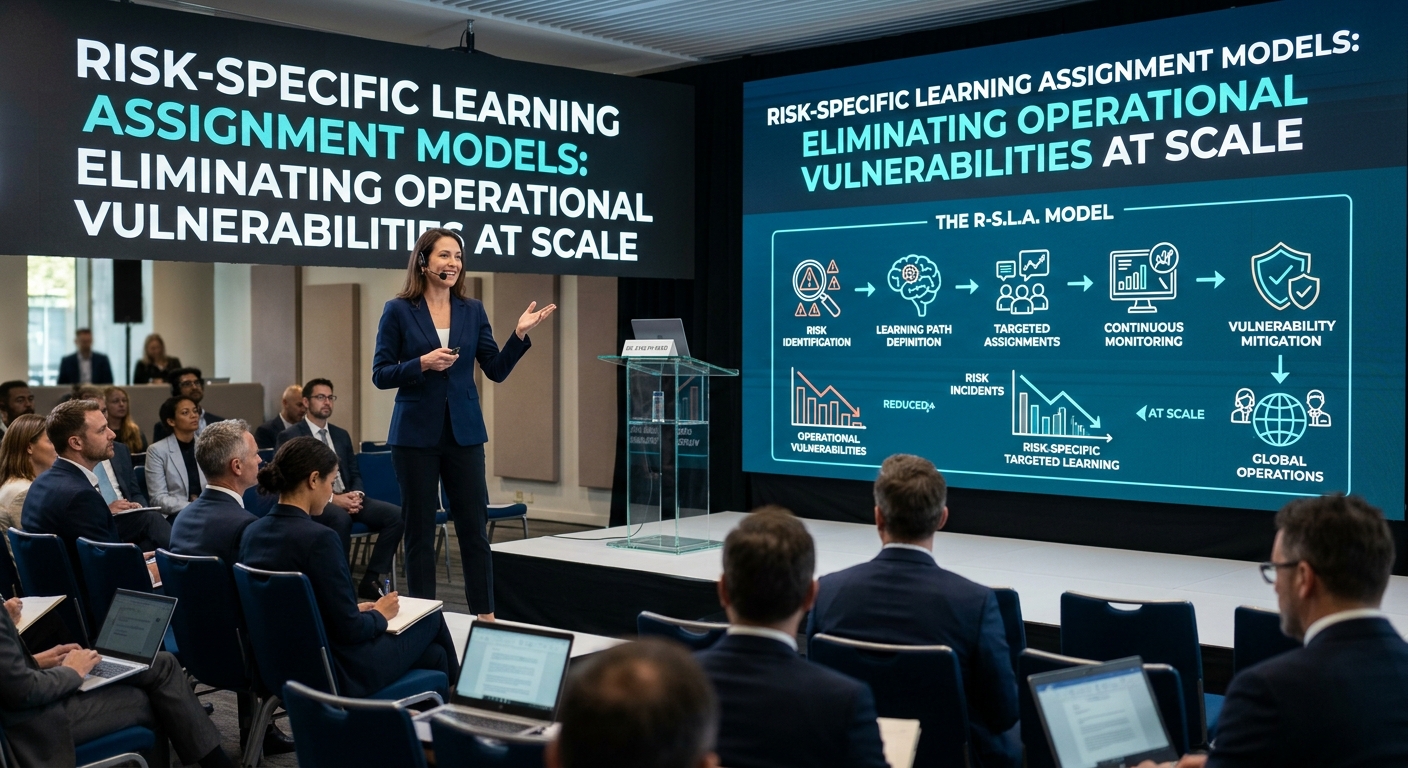
At its heart, this model involves:
- Comprehensive Risk Assessment: Identifying and categorizing operational vulnerabilities across the organization. This might involve looking at audit reports, incident logs, regulatory changes, and industry best practices.
- Role and Contextual Mapping: Linking specific roles, teams, and locations to relevant risk categories. For instance, a sales team in a highly regulated market needs different training than an R&D team in a manufacturing plant.
- Personalized Learning Paths: Leveraging a sophisticated LMS to assign only the most critical and relevant learning modules to each individual or group. This can be delivered via Microlearning LMS for better retention.
- Continuous Monitoring & Adaptation: Regularly assessing training effectiveness, tracking emerging risks, and dynamically updating learning assignments.
Key Benefits for L&D Leaders
Adopting Risk-Specific Learning Assignment Models empowers L&D professionals to move beyond administrative tasks and become strategic partners in risk mitigation and business growth.
- Improved Compliance & Reduced Risk: By directly addressing identified vulnerabilities, organizations significantly reduce their exposure to regulatory penalties, security breaches, and operational failures. Risk-focused Training ensures resources are optimized.
- Enhanced Operational Efficiency: Employees spend less time on irrelevant training, allowing them to focus on their core responsibilities. This boosts productivity across the board.
- Optimized Resource Allocation: L&D budgets are spent more effectively, targeting high-impact areas rather than broad, often ineffectual, campaigns. A powerful learning content management system (LCMS) helps manage these targeted resources.
- Data-Driven Decision Making: Advanced analytics from an enterprise learning management system provide L&D leaders with actionable insights into skill gaps, training effectiveness, and emerging risk areas.
Leveraging AI for Precision Training
Artificial intelligence is not just a buzzword; it's the engine that drives the efficacy and scalability of risk-specific learning. Its capabilities transform how L&D identifies needs, delivers content, and measures impact.
How can AI optimize training effectiveness on a global scale?
AI's ability to process vast datasets allows for unparalleled optimization. It can analyze employee performance data, compliance records, industry trends, and even individual learning styles to recommend highly personalized content. This translates into Adaptive Learning paths that evolve with the learner, ensuring maximum engagement and knowledge transfer. An AI Powered Authoring Tool further streamlines content creation, making it faster and more responsive to identified needs.
In what ways does location intelligence enhance risk training?
Location intelligence, powered by AI, allows L&D teams to tailor training based on specific geographical contexts. This is crucial for industries like Banking, Oil and Gas, or Retail with global operations. It means delivering modules on local regulatory compliance, regional environmental risks, specific cultural sensitivities, or even physical security protocols unique to a particular site. This granular approach ensures relevance and immediate applicability.
How do intelligent automation systems revolutionize learning assignment?
Intelligent automation, driven by AI algorithms, automates the previously manual and time-consuming process of assigning training. It can automatically detect changes in an employee's role, identify new compliance mandates, flag areas of risk based on audit results, or even assess knowledge gaps through pre-assessments, then instantly assign the most appropriate learning modules. This ensures that training is always current, proactive, and perfectly aligned with an individual's evolving risk profile. A sophisticated MaxLearn LMS facilitates such automation, transforming your lms learning management system into a truly dynamic tool.
The Role of a Modern LMS
Implementing a robust Risk-Specific Learning Assignment Model necessitates a sophisticated LMS. This isn't just about housing courses; it's about a comprehensive learning management software that acts as an intelligent ecosystem. Look for features such as:
- Advanced Analytics & Reporting: To track progress, identify trends, and measure the impact of training on risk reduction.
- Personalization Engines: To deliver bespoke learning paths based on individual profiles and real-time data.
- Integration Capabilities: Seamlessly connect with HRIS, compliance systems, and risk management platforms.
- Flexible Content Delivery: Support for Microlearning LMS, video, simulations, and interactive formats, often enhanced by an Gamified LMS approach for increased engagement.
- Scalability: A cloud based learning management system is crucial for global enterprises, ensuring accessibility and performance across all locations.
These advanced learning management solutions empower L&D teams to create proactive, impactful training strategies.
Implementing Risk-Specific Models: A Strategic Approach
For L&D leaders looking to deploy these models, consider the following steps:
- Assess Existing Vulnerabilities: Work with risk management, compliance, and departmental heads to conduct a thorough audit of current operational risks.
- Define Risk Profiles: Create detailed profiles for various roles, departments, and geographic locations, mapping them to specific training needs.
- Curate Targeted Content: Develop or acquire specific, relevant learning modules. Leverage an AI Powered Authoring Tool to accelerate this.
- Deploy with an Advanced LMS: Utilize a modern LMS with strong analytics and automation capabilities to assign and deliver training.
- Monitor and Refine: Continuously collect data, analyze feedback, and adapt your training programs to emerging risks and changing operational needs. This iterative process is key to long-term success.
Conclusion
The era of generic corporate training is over. For L&D leaders in industries where operational vulnerabilities can have catastrophic consequences, embracing Risk-Specific Learning Assignment Models is not just an option—it's a strategic imperative. By leveraging the power of data, intelligent automation, and a sophisticated learning management system, organizations can move from reactive damage control to proactive risk mitigation, ensuring a more resilient, compliant, and ultimately, more successful future. Invest in solutions that truly eliminate operational vulnerabilities at scale, transforming your L&D function into a powerful engine for business protection and growth.


Comments
Post a Comment