Reskilling vs. Upskilling in the Era of Automation: Enterprise Talent Development Strategies
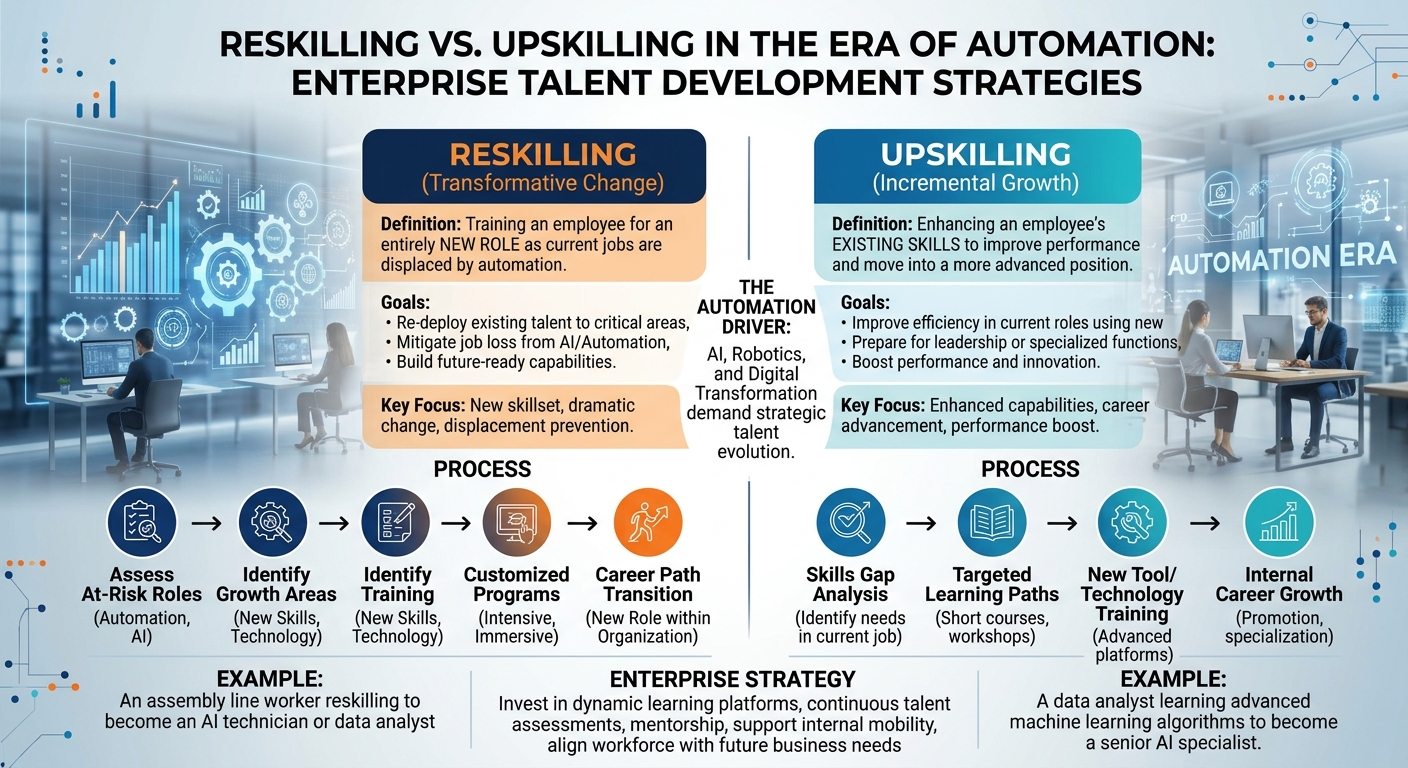
Reskilling vs. Upskilling in the Era of Automation: Enterprise Talent Development Strategies
The relentless march of automation and artificial intelligence is fundamentally reshaping the global workforce. For Vice Presidents, Directors, and Managers of Learning & Development, this transformation presents both a profound challenge and an unparalleled opportunity. As algorithms increasingly automate routine tasks and create demand for new competencies, organizations across sectors like Compliance, Sales, Banking, Finance, Insurance, Retail, Pharma, Health care, Hospitality, Oil and Gas, and Mining are grappling with a critical question: how do we prepare our talent for tomorrow? The answer lies in a strategic, integrated approach to talent development, centered around the twin pillars of reskilling and upskilling.
Understanding the Landscape: Automation's Impact
Automation is not just about robots on assembly lines; it's about intelligent systems augmenting human capabilities and, in some cases, entirely replacing job functions. This shift necessitates a proactive stance on human capital. Roles that once demanded repetitive data entry or manual processing are evolving, requiring employees to engage in more analytical, creative, and problem-solving tasks. In banking, for instance, traditional teller roles are transforming into customer relationship management positions requiring digital literacy and empathy. In healthcare, administrative functions are being streamlined, freeing up professionals for more complex patient care. This evolution underscores the urgency for enterprises to foster a culture of continuous learning.
Defining Reskilling
Reskilling refers to the process of training employees for entirely new roles within the organization, often necessitated by job displacement due to automation or a strategic shift in business focus. It’s about equipping individuals with a completely new set of skills to move into a different career path. For example, a data entry clerk might be reskilled as a data analyst, or a factory worker might learn to operate and maintain robotic systems. This approach is vital for retaining valuable institutional knowledge and experience while preventing workforce redundancy. Enterprises benefit by avoiding the high costs of layoffs and new hires, fostering employee loyalty, and building a more agile workforce capable of adapting to market demands.
Defining Upskilling
Upskilling, conversely, involves enhancing an employee’s existing skill set to improve performance in their current role or prepare them for more advanced responsibilities within the same career path. It's about deepening expertise and adding new, complementary capabilities. Think of a sales professional learning advanced CRM tools and consultative selling techniques, or an IT specialist mastering new cybersecurity protocols. Upskilling ensures that employees remain competitive and relevant as their roles evolve. It strengthens current teams, boosts productivity, and creates clearer pathways for internal promotion, contributing to higher employee engagement and retention.
The Strategic Imperative: Why Both Matter
In the era of automation, the choice isn't between reskilling and upskilling; it's about strategically leveraging both. A robust talent development strategy integrates both approaches to create a resilient, future-ready workforce. Reskilling addresses potential skill gaps at an organizational level, while upskilling empowers individuals to grow within their current trajectories. Implementing these initiatives effectively requires the right technological infrastructure, such as a flexible Microlearning LMS that can deliver targeted, bite-sized content adaptable to diverse learning needs. Such a system is crucial for managing the breadth of new skills required across an enterprise.
Key Talent Development Strategies
Personalized Learning Paths
One-size-fits-all training is no longer effective. Enterprises need to move towards highly personalized learning journeys that cater to individual roles, skill gaps, and career aspirations. Utilizing Adaptive Learning technologies allows organizations to create dynamic curricula that adjust based on a learner's progress, strengths, and weaknesses. This ensures that employees receive the most relevant training, whether they are reskilling for a completely new role or upskilling to master advanced competencies in their current position.
Leveraging Technology for Efficiency
The speed at which skills are evolving demands agile content creation and delivery. An AI Powered Authoring Tool can dramatically reduce the time and effort required to develop high-quality learning content, making it easier to rapidly deploy new modules for both reskilling and upskilling initiatives. Furthermore, a Gamified LMS can significantly boost engagement and retention by transforming learning into an interactive and rewarding experience, particularly important for complex topics or extended training programs.
Focus on Future-Proof Skills
Beyond technical competencies, organizations must prioritize "human skills" that automation cannot easily replicate. These include critical thinking, complex problem-solving, creativity, emotional intelligence, collaboration, and adaptability. Training programs should embed these skills within both reskilling and upskilling frameworks, ensuring employees are not just technically proficient but also possess the cognitive and interpersonal abilities to thrive in an evolving workplace.
Measuring Impact and ROI
For any talent development strategy, demonstrating clear return on investment is paramount. Implementing Risk-focused Training allows L&D leaders to align learning outcomes directly with business objectives, such as reducing compliance breaches, improving sales performance, or enhancing customer satisfaction. Robust analytics within your learning platform can track completion rates, skill attainment, and performance improvements, providing data-driven insights into the effectiveness of reskilling and upskilling initiatives.
AI-Related Questions and Answers for Enterprise Talent Development
Question: How can enterprises accurately anticipate the precise skills their workforce will require in the next three to five years, especially with rapid technological advancements?
Answer: Leveraging advanced data analytics and predictive modeling is crucial. By analyzing industry trends, market demands, internal performance data, and emerging technology roadmaps, organizations can use intelligent algorithms to forecast future skill needs. A sophisticated Microlearning LMS can be instrumental here, tracking existing skill inventories against projected requirements and identifying potential gaps long before they become critical. This foresight enables proactive talent development rather than reactive crisis management.
Question: Given the varied pace of automation and skill needs across different regions and business units, how can a large organization ensure its talent development strategies are consistently effective globally while remaining relevant locally?
Answer: The key lies in designing a modular and flexible learning content management system that supports centralized strategic oversight yet allows for localized adaptation. A modern cloud based learning management system facilitates the creation of core global curricula while empowering local L&D teams to contextualize content, incorporate regional regulations (critical for Compliance and Banking), and address specific market nuances. This ensures universal adherence to core objectives while maximizing local engagement and relevance.
Question: What is the most efficient method to implement and scale highly personalized learning initiatives across a vast, diverse enterprise, minimizing administrative overhead?
Answer: Automation and intelligent systems are essential for scaling personalization. An AI Powered Authoring Tool, coupled with Adaptive Learning capabilities within an enterprise learning management system, can automate content recommendations, assess proficiency, and dynamically adjust learning paths for each individual. This significantly reduces manual curriculum design and administrative tasks, allowing L&D teams to focus on strategy and content quality, making personalized learning a scalable reality.
Choosing the Right Learning Management System
The success of your reskilling and upskilling initiatives hinges on the capabilities of your learning technology. A comprehensive learning management system (LMS) is not just a platform for content delivery; it's the backbone of your talent development ecosystem. Look for an LMS that offers robust features for tracking, reporting, and personalization. A modern learning management software should support various content formats, from microlearning modules to immersive simulations, and integrate seamlessly with other HR systems. Consider a learning management solutions provider like MaxLearn LMS, known for its intuitive user experience and powerful features. An advanced learning management system, often referred to as an LCMS for its content management capabilities, empowers your organization to efficiently manage the entire learning lifecycle, ensuring that your lms learning management system is a strategic asset for growth.
Conclusion
The era of automation demands a proactive and integrated approach to talent development. For L&D leaders, understanding the nuances of reskilling versus upskilling, and strategically deploying both, is paramount to building a resilient, future-ready workforce. By embracing advanced learning technologies, fostering a culture of continuous learning, and focusing on both technical and human-centric skills, enterprises can navigate the complexities of automation not as a threat, but as an unparalleled opportunity to innovate and lead. The investment in your people's capabilities today will define your organization's success tomorrow.


Comments
Post a Comment