Integrating Microlearning with HRIS and Enterprise LMS: API Protocols and Workflow Design
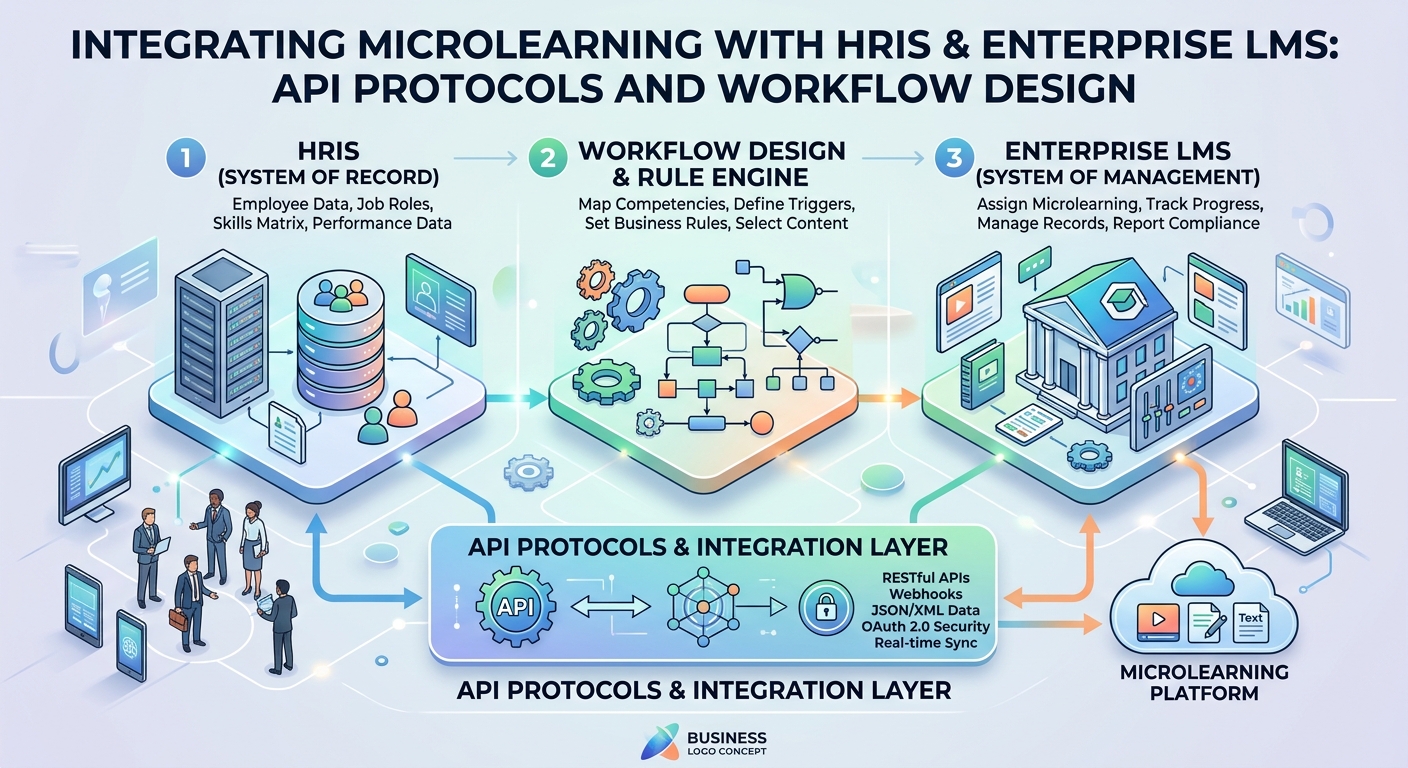
Integrating Microlearning with HRIS and Enterprise LMS: API Protocols and Workflow Design
In today’s rapidly evolving corporate landscape, the efficiency and effectiveness of employee training are paramount. Learning and Development (L&D) leaders, from VPs to senior managers, are constantly seeking innovative ways to deliver impactful education that drives performance and ensures compliance across diverse industries like Banking, Pharma, Retail, and Oil and Gas. The integration of microlearning strategies with existing Human Resources Information Systems (HRIS) and Enterprise Learning Management Systems (LMS) is not just a technological advancement; it's a strategic imperative. This article delves into the critical role of API protocols and thoughtful workflow design in creating a seamless, powerful learning ecosystem.
Why Seamless Integration is the Future of Corporate Learning
The modern workforce demands learning experiences that are flexible, accessible, and directly relevant to their roles. Microlearning, with its bite-sized, focused content, perfectly addresses these needs, offering a quick path to knowledge acquisition and skill application. However, its true power is unlocked when it’s not an isolated initiative but a deeply integrated component of an organization’s broader HR and talent development infrastructure. An integrated system streamlines administration, personalizes learning paths, and provides invaluable data for strategic decision-making.
Driving Efficiency and Reducing Administrative Burden
Imagine a world where employee data flows effortlessly from HRIS to your Microlearning LMS, automatically enrolling new hires in essential compliance training or suggesting relevant courses based on their job role. This level of automation significantly reduces the manual effort for L&D teams, allowing them to focus on content quality and strategic initiatives rather than data entry and reconciliation.
Enhancing Personalization and Engagement
By leveraging comprehensive employee profiles from the HRIS, a robust LMS can deliver truly adaptive learning experiences. It can recommend specific microlearning modules based on an individual's career path, skill gaps, performance reviews, or even geographic location. Coupled with a Gamified LMS, this personalized approach dramatically boosts learner engagement and knowledge retention.
Enabling Data-Driven Decisions
Integration means unified reporting. L&D professionals can gain a holistic view of learning outcomes, correlating training completion rates and assessment scores with performance data from HRIS. This insight is crucial for demonstrating the ROI of training programs, refining content, and identifying broader organizational skill development needs. A sophisticated learning management system can transform raw data into actionable intelligence.
Understanding the Key Players: HRIS, LMS, and Microlearning
Before diving into integration mechanics, it’s essential to clarify the roles of each system:
- HRIS (Human Resources Information System): The central repository for all employee data—demographics, job roles, performance reviews, compensation, and more. It is the single source of truth for employee records.
- Enterprise LMS (Learning Management System): The platform managing all formal learning activities. This includes course catalogs, enrollment, tracking progress, assessments, and certifications. A modern learning content management system or learning management software often serves as the backbone for an organization's entire learning strategy, especially a cloud based learning management system.
- Microlearning Platform: Often a specialized component or feature within an enterprise learning management system, designed to deliver short, focused bursts of content. It can also exist as a standalone system that requires integration.
The Core of Integration: API Protocols
The bridge connecting HRIS, LMS, and microlearning platforms is built on Application Programming Interfaces (APIs). These protocols define the rules for how different software applications communicate and exchange data. Understanding them is crucial for L&D leaders overseeing integration projects.
RESTful APIs
Representational State Transfer (REST) is the most common and flexible API architecture for web services. RESTful APIs are stateless, making them easy to scale and consume. They use standard HTTP methods (GET, POST, PUT, DELETE) to perform operations on resources, making them ideal for synchronizing user data (e.g., new hires, role changes), course enrollments, and completion records between systems. Most modern lms learning management system solutions offer robust REST APIs.
SOAP APIs
Simple Object Access Protocol (SOAP) is an older, more structured protocol that relies on XML for message formatting. While more complex and rigid than REST, SOAP offers built-in security features and robust error handling, making it suitable for complex enterprise environments where data integrity and security are paramount. Some legacy HRIS or learning management solutions may still primarily use SOAP.
Authentication and Authorization
Regardless of the protocol, secure communication is non-negotiable. APIs must implement strong authentication (verifying identity, e.g., OAuth 2.0, API keys) and authorization (determining access rights) mechanisms to protect sensitive HR and learning data.
Data Formats
For efficient data exchange, both systems must agree on data formats. JSON (JavaScript Object Notation) is the preferred format for RESTful APIs due to its lightweight nature and human-readability. XML is typically used with SOAP. Clear data mapping is critical to ensure fields like "Employee ID," "Job Title," and "Course Completion Status" are correctly interpreted across systems.
Designing an Effective Workflow for Integrated Microlearning
Beyond the technical APIs, a well-designed workflow is essential to maximize the benefits of integration.
Strategy and Planning
Begin with a clear understanding of your organizational goals. What business problems are you trying to solve? How will integrating microlearning with your HRIS and LMS help achieve them? Define success metrics early on. Consider the role of Adaptive Learning in personalizing pathways for various employee groups.
Data Synchronization Strategy
- Unidirectional vs. Bidirectional: Decide if data flows one way (e.g., HRIS to learning management system for user profiles) or both ways (e.g., learning completion back to HRIS for performance records).
- Real-time vs. Batch Processing: Determine the frequency of data updates. Real-time updates are ideal for critical data like new hires, while batch processing might suffice for less urgent information.
- Error Handling: Design a robust system for logging and resolving synchronization errors to maintain data integrity.
User Experience (UX) Design
The integrated experience should be seamless for the end-user. Learners should effortlessly transition between their HR portal and the LMS, ideally through Single Sign-On (SSO). Microlearning content should be easily discoverable and accessible within their learning portal, perhaps recommended by an AI Powered Authoring Tool or presented in engaging formats by a Gamified LMS.
Reporting and Analytics
Establish clear reporting requirements. What data points from microlearning modules and the LCMS need to be available in the HRIS, and vice-versa? Design dashboards that provide actionable insights into learner progress, skill development, and compliance status, especially for critical areas like Risk-focused Training in Banking or Pharma.
Addressing Challenges and Best Practices
While the benefits are significant, challenges exist:
- Legacy Systems: Older HRIS or learning management solutions may have limited API capabilities, requiring custom development or middleware.
- Data Security & Privacy: Strict adherence to data protection regulations (e.g., GDPR, CCPA) is essential, especially when integrating sensitive HR data across systems and regions.
- Vendor Lock-in: Choose systems with open API architectures to avoid being overly reliant on a single vendor.
- Ongoing Maintenance: API integrations require continuous monitoring and maintenance to adapt to system updates and evolving business needs.
Best practice dictates starting small, piloting integrations with a subset of users, and iteratively refining the workflow based on feedback. Partner with vendors who prioritize open standards and provide comprehensive API documentation, like MaxLearn LMS.
AI and the Future of Integrated Learning: Key Questions Answered
How can smart algorithms and advanced analytics enhance the efficacy of integrated microlearning platforms?
Smart algorithms, leveraging data from both HRIS and the enterprise learning management system, can create highly personalized and dynamic learning pathways. They can analyze an employee's performance data, job role, career aspirations, and even learning style to recommend the most relevant microlearning modules. This leads to faster skill acquisition, predictive identification of skill gaps, and automated content curation, making learning more efficient and targeted.
What key considerations must global organizations address when deploying integrated microlearning solutions across diverse international teams?
Global deployments require careful attention to several factors. Data residency laws and regulations (e.g., GDPR in Europe, local data sovereignty laws) dictate where sensitive HR and learning data can be stored. Localization of content, including translation and cultural relevance, is crucial for engagement. Furthermore, varying internet infrastructures and device accessibility across different regions must be accounted for to ensure equitable learning opportunities. A robust cloud based learning management system with regional data centers can be beneficial here.
How can L&D professionals leverage these integrations to demonstrably improve employee performance and achieve specific business outcomes?
By integrating microlearning with HRIS and the learning management system, L&D leaders can establish clear links between training and business results. For instance, in sales, a Microlearning LMS linked to CRM data via HRIS can correlate specific training completions with improvements in sales metrics. In compliance-heavy industries like Finance or Healthcare, real-time tracking of Risk-focused Training completion ensures regulatory adherence. This comprehensive data allows L&D to proactively address skill deficiencies, measure the impact of interventions on KPIs, and ultimately prove the strategic value of learning investments to the executive board.
Conclusion
The integration of microlearning with HRIS and enterprise LMS is no longer an aspiration but a critical component of modern talent development strategy. By thoughtfully designing API protocols and workflows, L&D leaders can unlock unprecedented levels of efficiency, personalization, and data-driven insights. This strategic integration fosters a culture of continuous learning, empowering employees and driving measurable business growth across every industry. Embrace this transformation to elevate your organization's learning capabilities with advanced learning management solutions.


Comments
Post a Comment