Enterprise Microlearning Implementation Framework: 30-60-90 Day Deployment Blueprint
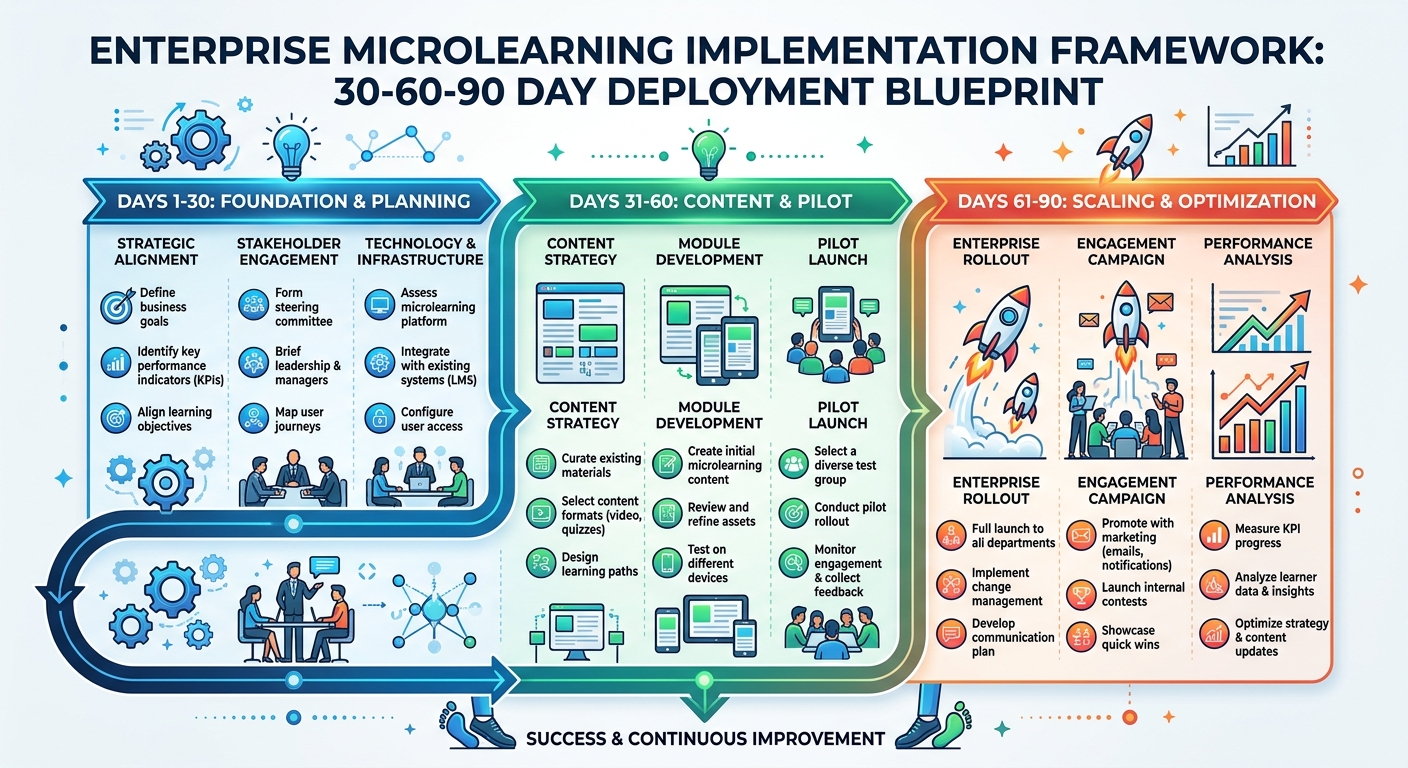
Enterprise Microlearning Implementation Framework: 30-60-90 Day Deployment Blueprint
In today's fast-paced corporate environment, the traditional models of learning and development often struggle to keep pace with the dynamic needs of employees and the ever-evolving business landscape. From compliance in banking to product knowledge in retail, or critical safety protocols in oil and gas, organizations across all segments are seeking more agile, effective, and engaging ways to empower their workforce. This is where microlearning steps in as a transformative solution, offering bite-sized, focused content that fits seamlessly into an employee's workflow.
However, the concept of microlearning, while powerful, requires a strategic approach for successful enterprise-wide implementation. For Vice Presidents, Directors, and Senior Managers of L&D, the challenge isn't just adopting a new methodology but deploying it efficiently and effectively. This article outlines a robust 30-60-90 day deployment blueprint, providing a clear roadmap for integrating microlearning into your organization's learning ecosystem, ensuring a smooth transition and measurable impact.
Phase 1: The First 30 Days – Foundation & Pilot
The initial month is crucial for laying a strong foundation. This phase focuses on strategic planning, identifying immediate needs, and selecting the right technological backbone for your microlearning initiatives.
Define Goals & Scope:
- Identify Business Pain Points: Begin by pinpointing specific organizational challenges that microlearning can address. Are your sales teams struggling with new product adoption in the Pharma sector? Is there a gap in regulatory understanding within Finance or Insurance? Or perhaps new hire onboarding in Hospitality is too lengthy? Clearly define the problem statement.
- Target Audience & Content Area: Select a small, representative segment of your workforce for an initial pilot. For instance, a compliance module for new employees in Banking, or a critical safety procedure for Mining. This focused approach allows for controlled testing and feedback.
- Establish Measurable KPIs: What success metrics will you track? Completion rates, knowledge retention scores, time-to-competency, or even direct business impacts like reduced errors or improved sales figures are vital.
Platform Selection & Setup:
- Choose a Robust Microlearning LMS: The success of your deployment hinges on the right learning content management system. Look for a platform designed specifically for short-form content, mobile accessibility, and intuitive user experience. A powerful Microlearning LMS is essential.
- Essential Features: Prioritize features such as analytics dashboards, easy content authoring, and integration capabilities. A Gamified LMS can significantly boost engagement and adoption, making learning more enjoyable. Ensure the chosen platform can scale as your needs grow, acting as a true enterprise learning management solution.
Content Identification & Curation:
- Inventory Existing Resources: Evaluate your current training materials. Are there lengthy manuals or classroom sessions that can be broken down into micro-modules?
- Pilot Content Development: For your chosen pilot segment, convert one critical piece of training into microlearning modules. Focus on clarity, conciseness, and actionable takeaways. This is where the foundation of your future learning management system content will be built.
Pilot Program Launch:
- Small-Scale Deployment: Roll out the initial microlearning content to your selected pilot group. Gather qualitative feedback through surveys and interviews, alongside quantitative data from the learning management software.
Phase 2: The Next 60 Days (Days 31-90) – Expansion & Optimization
Having gathered initial insights, this phase is about refining your approach and gradually expanding the microlearning footprint within your organization.
Iterate & Refine Based on Feedback:
- Analyze Data: Deep-dive into the analytics provided by your cloud based learning management system. What were the completion rates? Which modules had high engagement? Where did learners struggle?
- Adjust & Optimize: Use this data to fine-tune your content, delivery methods, and even the platform's configuration. This iterative process is key to creating a truly effective learning management solution.
Content Development & Transformation:
- Scale Content Creation: Begin transforming more of your traditional training into microlearning modules. Explore an AI Powered Authoring Tool to accelerate this process, especially for complex or frequently updated content like in Healthcare or Compliance.
- Personalized Learning Paths: Consider incorporating elements of Adaptive Learning. This allows the system to tailor content based on an individual's performance and learning style, ensuring relevance for diverse roles in Retail or Oil and Gas.
Integrate & Promote:
- System Integration: Integrate your enterprise learning management solution with existing HRIS, CRM, or performance management systems to streamline user management and track impact more comprehensively.
- Internal Communication: Develop a communication strategy to promote the benefits of microlearning across the organization. Share success stories from your pilot group to build momentum and enthusiasm.
Expand User Base:
- Phased Rollout: Expand the microlearning initiative to a slightly larger group or another department. This could be a specific team in Manufacturing, or a new product training for Sales across a region.
Phase 3: The Final 90 Days (Days 91-180) – Full-Scale Deployment & Strategic Alignment
By this stage, your microlearning initiative should be gaining traction. The focus shifts to full-scale deployment, continuous improvement, and demonstrating strategic value.
Full-Scale Rollout:
- Wider Deployment: Launch microlearning across targeted departments, regions, or the entire organization as planned. Ensure all stakeholders, including managers and team leads, understand their role in promoting and supporting continuous learning. The full power of your MaxLearn LMS is now unleashed.
- Support & Training: Provide adequate support channels and training for administrators and content creators using the lms learning management system.
Continuous Performance Monitoring & Analytics:
- Deep Dive into Data: Regularly review the extensive analytics available through your learning management system. Track learner engagement, knowledge retention, and its correlation with business outcomes (e.g., reduced incidents, improved customer satisfaction).
- Demonstrate ROI: Quantify the impact of microlearning. For instance, showcase how Risk-focused Training in Compliance or Pharma has led to fewer audit findings or enhanced safety records.
Content Lifecycle Management:
- Establish Review Cycles: Implement a robust process for regularly reviewing, updating, and retiring microlearning content. This is especially crucial for industries with dynamic regulations like compliance, finance, or healthcare. Your learning content management system should facilitate this.
- Keep it Fresh: Ensure your content remains relevant and engaging, utilizing tools within your LCMS to streamline updates.
Strategic Integration:
- Align with Business Strategy: Position microlearning not just as a training tool, but as a strategic asset that supports organizational agility, talent development, and competitive advantage.
- Culture of Learning: Foster a continuous learning culture where employees are empowered to take ownership of their development through readily accessible, bite-sized learning opportunities provided by your learning management software.
Strategic Insights for Modern Learning Deployment
Modern enterprises leverage advanced tools to optimize their learning initiatives. Here are some critical questions and insights for L&D leaders:
- How can intelligent systems assist in tailoring learning content for diverse employee roles and departments across different regions?
Intelligent systems within a modern MaxLearn LMS can analyze individual job roles, skill profiles, and even geographic-specific regulatory requirements. They can then recommend or even dynamically assemble personalized learning paths, ensuring that a sales professional in one region receives content relevant to their market, while a finance manager in another receives specific local compliance updates. This hyper-personalization, powered by the enterprise learning management system, significantly boosts relevance and engagement.
- What role does advanced technology play in optimizing learning experiences for maximum retention and skill transfer?
Advanced technology within a learning management solution, particularly AI algorithms, can track a learner's progress, identify areas where they struggle, and then adapt the learning journey. This might involve recommending supplementary modules, reinforcing concepts through spaced repetition, or suggesting practical application exercises. This adaptive approach, a hallmark of an effective lms learning management system, ensures that knowledge isn't just consumed but effectively retained and applied, bridging the gap between learning and performance.
- In what ways can intelligent automation streamline the creation and update of microlearning modules, especially for dynamic industries like Compliance or Healthcare?
An AI Powered Authoring Tool can dramatically accelerate content development and maintenance. It can assist in converting lengthy documents into concise microlearning formats, generate quiz questions, or even flag content that requires updates based on external data sources (e.g., new regulations). For industries requiring constant updates, such as Compliance, Banking, or Healthcare, this intelligent automation within the learning management system is invaluable for maintaining accuracy and relevance.
Conclusion
Implementing enterprise microlearning is a journey, not a sprint. By following this 30-60-90 day deployment blueprint, L&D leaders can systematically introduce, refine, and scale microlearning across their organization. From the initial pilot to full-scale strategic integration, a structured approach ensures not just adoption, but genuine impact on employee performance and business outcomes. Embrace the future of learning with a strategic framework and watch your workforce thrive.


Comments
Post a Comment