Why Are Traditional Corporate LMS Platforms Failing High-Turnover Teams?
Why Are Traditional Corporate LMS Platforms Failing High-Turnover Teams?
In today's dynamic corporate landscape, high-turnover teams are a reality across numerous industries – from retail and hospitality to healthcare, sales, and even specialized sectors like oil and gas. For Vice Presidents, Directors, and Senior Managers of Learning & Development, this presents a perpetual challenge: how do you ensure consistent training, maintain compliance, and foster skill development when your workforce is constantly evolving? Traditional corporate learning management system (LMS) platforms, once the cornerstone of corporate training, are increasingly proving inadequate for these fast-paced environments, leading to significant inefficiencies and missed opportunities.
The core problem isn't the concept of an LMS itself, but rather the outdated methodologies and technological limitations inherent in many legacy learning content management system platforms. These systems were often built for a different era – one characterized by stable workforces, slower technological change, and a more top-down approach to education. Today's high-turnover teams demand agility, instant access, and highly engaging content, areas where traditional learning management software often falls short.
The Mismatch: Traditional LMS vs. Modern Workforce Needs
The fundamental disconnect between what traditional enterprise learning management solutions offer and what high-turnover teams require is glaring:
Outdated Content and Delivery
-
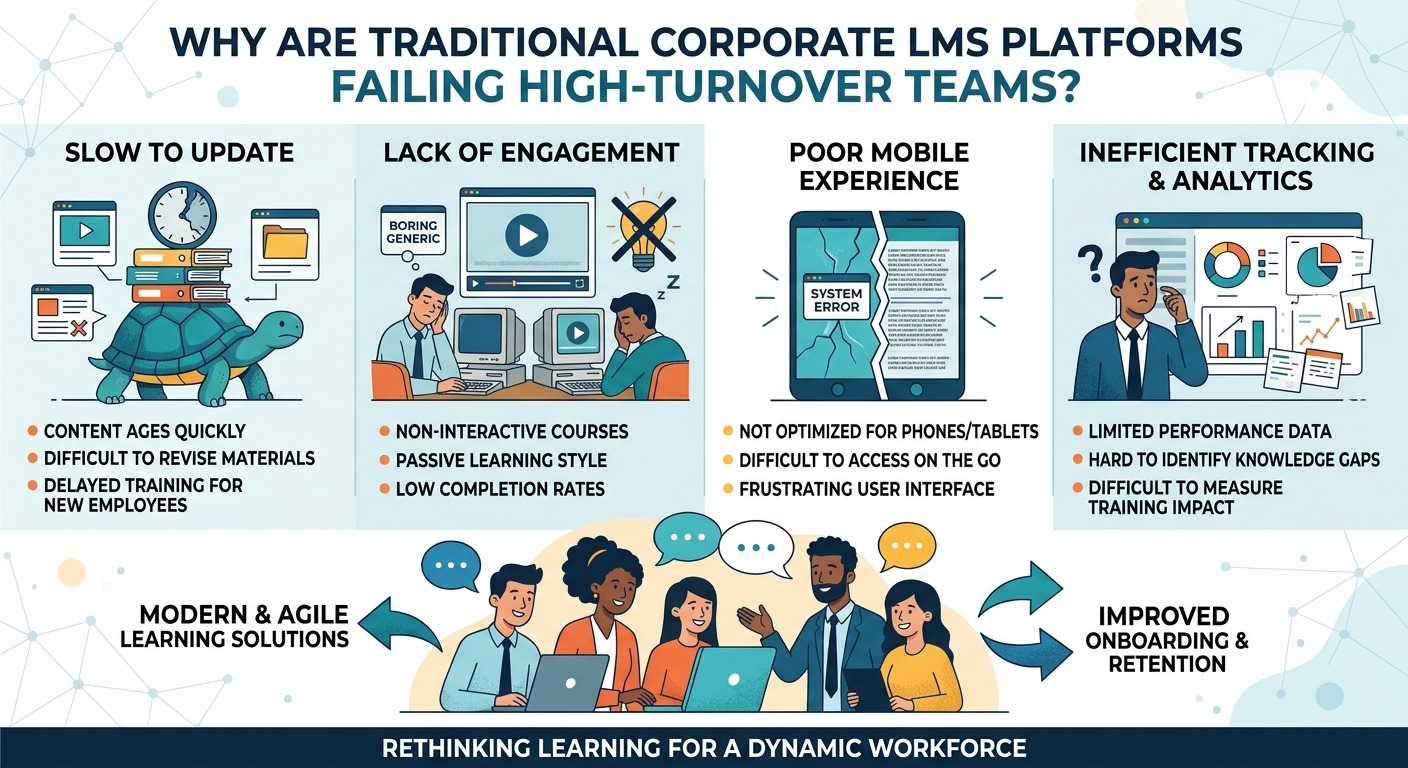
Static, Lengthy Courses: Traditional platforms typically host long-form, often text-heavy modules that demand significant time commitment. For employees in high-turnover roles, who are often stretched for time and need to become productive quickly, these courses are deterrents rather than enablers. The sheer volume of information can be overwhelming, leading to low completion rates and poor knowledge retention.
-
Irrelevant Information Overload: Often, a single course is designed to cover every possible scenario, making much of it irrelevant to an individual’s immediate needs. This "one-size-fits-all" approach slows down learning and diminishes its perceived value.
Lack of Engagement
-
Passive Learning Experiences: Most legacy platforms rely on passive content consumption – reading, watching, and clicking through slides. This lacks the interactivity and dynamism needed to capture the attention of a modern, often digitally native, workforce. For new hires who need to grasp complex information rapidly, passive learning is ineffective.
-
Absence of Gamification and Social Learning: Traditional systems rarely incorporate elements that drive intrinsic motivation, such as points, badges, leaderboards, or collaborative learning spaces. Without these, training can feel like a chore, further disengaging employees and impacting retention.
One-Size-Fits-All Approach
-
Ignoring Diverse Learning Styles: Every individual learns differently. Traditional learning management solutions struggle to adapt to these varied preferences, offering generic pathways that fail to optimize the learning experience for individuals. This is particularly problematic in diverse, rapidly changing teams where backgrounds and prior knowledge vary significantly.
-
No Adaptive Learning Paths: Without personalized pathways, learners are forced to trudge through material they may already know or struggle with concepts without additional support. This leads to frustration for advanced learners and abandonment for those falling behind.
Slow Deployment and Updates
-
Cumbersome Content Creation: Creating and updating content on traditional LMS platforms is often a complex, time-consuming process requiring specialized skills. In industries with frequent regulatory changes or product updates, this means training materials quickly become obsolete, creating compliance risks.
-
Lagging Behind Business Needs: The slow pace of content deployment means that by the time training is ready, the business needs it addresses may have already shifted. This lack of agility directly impacts productivity and competitive edge.
The Unique Challenges of High-Turnover Teams
These inherent weaknesses of traditional learning management systems are amplified when dealing with teams characterized by high churn:
Rapid Onboarding Requirements
New hires in high-turnover roles need to be productive almost immediately. Traditional LMS platforms, with their lengthy courses and slow content delivery, cannot meet this demand. The cost of a prolonged onboarding phase for each new employee quickly escalates.
Constant Re-training and Skill Gaps
When employees leave, so does their acquired knowledge and skills. High-turnover teams face a continuous cycle of retraining new staff on fundamental tasks, compliance protocols, and product knowledge. An inefficient LMS means this cycle is both costly and consistently leaves critical skill gaps.
Maintaining Compliance and Quality
In highly regulated industries like banking, finance, pharma, and healthcare, compliance training is non-negotiable. For high-turnover teams, ensuring every new hire completes mandatory training quickly and effectively, and that existing staff remain updated, is a monumental task that a cumbersome lms learning management system makes even harder. The risk of non-compliance is significant.
Loss of Institutional Knowledge
Beyond formal training, much critical knowledge resides with experienced employees. When they depart, this institutional wisdom is lost. Traditional platforms do little to capture, organize, and transfer this tacit knowledge to incoming staff.
The Shift to Agile, Engaging Learning Solutions
So, how can organizations ensure new hires in fast-paced environments are up-to-speed quickly and effectively? The answer lies in moving beyond the limitations of traditional LMS to embrace modern, agile, and engaging learning management software designed for today’s challenges. What learning approaches are most impactful for reducing churn and improving performance across diverse, rapidly changing teams? Here's where innovative solutions shine:
-
Microlearning LMS: Breaking down complex topics into bite-sized, easily digestible modules. This approach is perfect for busy schedules, allowing employees to learn on the go, exactly when and where they need it. It accelerates onboarding and reinforces critical knowledge efficiently.
-
Gamified LMS: Injecting elements of play, competition, and reward into learning. This drastically boosts engagement, motivation, and knowledge retention, transforming training from a chore into an enjoyable experience. High scores, badges, and leaderboards drive healthy competition and encourage continuous learning.
-
Adaptive Learning: Personalizing the learning journey for each individual. By assessing prior knowledge and learning pace, an adaptive system tailors content delivery, ensuring learners focus only on what they need to master, optimizing their time and improving outcomes. This is critical for diverse teams.
-
AI Powered Authoring Tool: Streamlining the content creation and update process. Tools augmented with artificial intelligence can significantly reduce the time and effort required to develop engaging, relevant content, ensuring training materials are always current and responsive to business needs. This enables rapid deployment of crucial information.
-
Risk-focused Training: Prioritizing learning content that directly addresses high-impact areas, particularly compliance and critical skill gaps. By focusing efforts on mitigating the biggest risks, organizations ensure essential knowledge is disseminated effectively and efficiently, even with constant staff changes.
Where can innovative learning solutions be found to address the unique challenges of industries like retail, healthcare, or sales? A modern cloud based learning management system, built with these features, transforms the learning experience. It empowers L&D leaders to proactively address the challenges of high-turnover, turning what was once a liability into a competitive advantage.
Embrace the Future of Learning with MaxLearn LMS
For L&D leaders grappling with the complexities of high-turnover teams, the time to reconsider your learning strategy is now. Sticking with a traditional LCMS or an outdated learning management system is a disservice to your employees and a drag on your organization's performance. By adopting a modern approach that leverages microlearning, gamification, and adaptive intelligence, you can build a resilient, engaged, and highly skilled workforce, no matter the pace of change.
Explore how advanced learning management solutions like MaxLearn LMS can revolutionize your corporate training, drive engagement, ensure compliance, and empower your high-turnover teams to excel. Invest in a learning platform that’s as dynamic as your business, and watch your teams thrive.


Comments
Post a Comment