Which of Gardner’s 9 Intelligences Matter Most in Modern Workplace Upskilling?
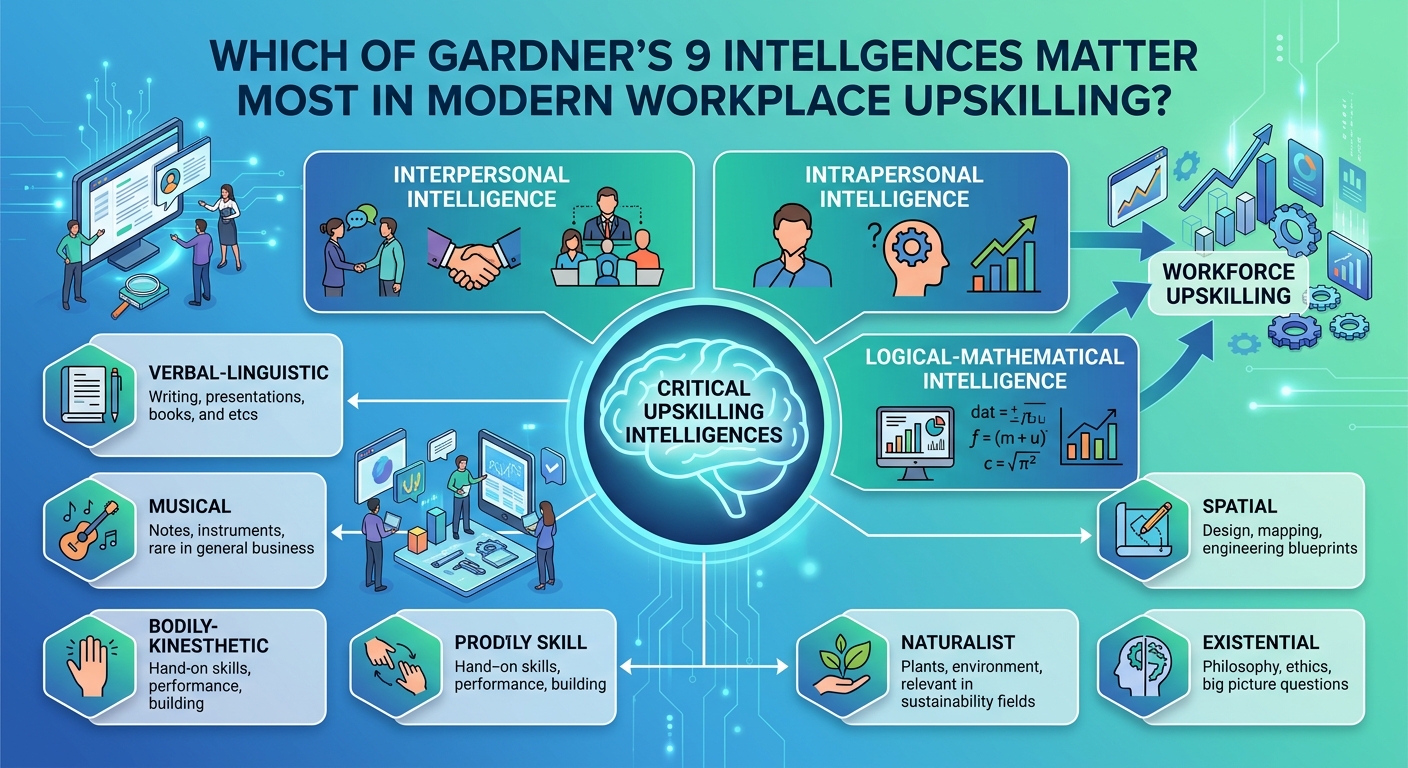
Which of Gardner’s 9 Intelligences Matter Most in Modern Workplace Upskilling?
The modern workplace is a dynamic crucible of constant change, driven by rapid technological advancements, evolving market demands, and a globalized talent pool. For Vice Presidents, Directors, and Managers in Learning & Development across industries like Compliance, Sales, Banking, Finance, Insurance, Retail, Pharma, Healthcare, Hospitality, Oil & Gas, and Mining, the challenge of upskilling workforces is more critical than ever. Skill gaps are widening, and traditional "one-size-fits-all" training methods often fall short.
Enter Howard Gardner's Theory of Multiple Intelligences. While not a new concept, its application in understanding and addressing modern upskilling needs offers a powerful lens. Gardner proposed that intelligence isn't a single, monolithic entity but rather a collection of distinct capabilities. Recognizing these diverse intelligences can revolutionize how organizations approach talent development, fostering more effective, engaging, and personalized learning experiences. But among the nine intelligences, which ones rise to prominence when considering the demands of today's complex roles and the imperative for continuous upskilling?
Understanding Gardner's Nine Intelligences
Originally seven, Gardner's theory now encompasses nine distinct intelligences, each representing a different way individuals interact with the world and process information:
- Linguistic Intelligence: The ability to think in words and use language to express meaning.
- Logical-Mathematical Intelligence: The ability to carry out mathematical operations and critically analyze problems.
- Spatial Intelligence: The ability to think in three dimensions, visualize, and mentally manipulate objects.
- Bodily-Kinesthetic Intelligence: The ability to manipulate objects and use one's body skillfully.
- Musical Intelligence: The capacity to discern pitch, rhythm, timbre, and tone.
- Interpersonal Intelligence: The ability to understand and interact effectively with others.
- Intrapersonal Intelligence: The ability to understand oneself and one's thoughts and feelings.
- Naturalistic Intelligence: The ability to recognize and categorize elements of the natural world.
- Existential Intelligence: The capacity to tackle deep questions about human existence, such as the meaning of life, why we die, and how we got here.
For L&D professionals, the key is not to label individuals but to appreciate the spectrum of strengths within their teams. This understanding paves the way for a more nuanced approach to training. But which of these are truly indispensable for navigating the current and future landscape of work?
The Critical Intelligences for Modern Upskilling
While all intelligences hold value, certain ones are undeniably foundational for success across diverse roles and industries in the modern era. These are the intelligences that empower adaptability, critical thinking, effective communication, and human-centric collaboration – qualities that even advanced artificial intelligence cannot fully replicate.
Logical-Mathematical Intelligence: The Bedrock of Analytical Prowess
In an age dominated by data, algorithms, and digital transformation, Logical-Mathematical Intelligence is paramount. From financial analysts in Banking and Insurance deciphering market trends, to healthcare professionals interpreting diagnostic data, to engineers in Oil & Gas optimizing processes, the ability to think critically, solve complex problems, and understand quantitative information is non-negotiable.
- Data Literacy: Understanding and interpreting vast datasets.
- Problem-Solving: Applying logical reasoning to troubleshoot and innovate.
- Algorithm Comprehension: Grasping the principles behind new technologies, including AI.
Upskilling in this area ensures that employees can not only use new tools but also understand the underlying logic, leading to better decision-making and innovation.
Linguistic Intelligence: Crafting Clarity and Influence
Effective communication remains the linchpin of every successful organization. Linguistic Intelligence, encompassing strong verbal and written communication, persuasion, and comprehension, is vital. Sales professionals require it to articulate value propositions; Compliance officers to convey complex regulations; and managers in Hospitality to train staff and address guest concerns. In a remote or hybrid work environment, the clarity of written communication becomes even more critical.
- Clear Communication: Articulating complex ideas simply and effectively.
- Persuasion and Negotiation: Essential for sales, client relations, and leadership.
- Content Creation: Developing engaging training materials or marketing copy.
How can organizations foster superior linguistic skills across a globally dispersed workforce, ensuring consistent understanding and impactful messaging regardless of regional nuances?
Interpersonal Intelligence: The Art of Collaboration and Leadership
The modern workplace thrives on collaboration, teamwork, and strong leadership. Interpersonal Intelligence—the ability to understand and interact effectively with others—is critical for building cohesive teams, managing client relationships, and navigating organizational dynamics. This intelligence is crucial for managers seeking to inspire and motivate, for project teams spanning multiple departments, and for customer-facing roles in Retail and Pharma.
- Teamwork and Collaboration: Working effectively in diverse groups.
- Empathy and Emotional Intelligence: Understanding others' perspectives and feelings.
- Conflict Resolution: Mediating disputes and fostering harmonious relationships.
As L&D leaders, a key question for us today is identifying which intelligences yield the highest ROI in different sectors. Does the optimal mix of skills differ significantly for a sales professional in New York versus a healthcare worker in London, for instance?
Intrapersonal Intelligence: Self-Mastery in a Changing World
Perhaps the most undervalued yet profoundly impactful intelligence for upskilling is Intrapersonal Intelligence. This refers to self-awareness, introspection, understanding one's own motivations, strengths, and weaknesses, and the ability to manage one's emotions. In a world of constant change and uncertainty, resilience, adaptability, and a growth mindset stem directly from this intelligence. It underpins continuous learning and personal development.
- Self-Awareness: Understanding one's own learning style, biases, and emotional triggers.
- Resilience: Bouncing back from setbacks and adapting to new challenges.
- Motivation and Self-Regulation: Driving one's own learning journey and managing time effectively.
This intelligence is the engine behind all other upskilling efforts, enabling individuals to proactively seek knowledge and adapt to new demands, making it a cornerstone for anyone in a demanding role requiring continuous adaptation.
Leveraging eLearning for Holistic Intelligence Development
Understanding these critical intelligences isn't enough; L&D must design upskilling programs that intentionally cultivate them. Modern eLearning technologies provide the perfect ecosystem for this personalized approach.
- A robust learning content management system or learning management software can host diverse content formats catering to different intelligences.
- Microlearning LMS platforms deliver focused, bite-sized modules, ideal for reinforcing specific logical concepts or communication techniques. This approach is highly effective in industries like Pharma, where complex information needs to be absorbed quickly.
- A Gamified LMS can boost engagement for all intelligences, especially logical-mathematical (problem-solving challenges), interpersonal (team-based quests), and even intrapersonal (self-reflection within narrative journeys).
- Adaptive Learning paths, powered by artificial intelligence, can tailor content and pace to individual learner needs, allowing someone strong in linguistic intelligence to dive deep into case studies, while another with strong logical-mathematical intelligence focuses on data exercises. This is invaluable in sectors like Finance, where specialized skills are critical.
- An AI Powered Authoring Tool can help L&D teams rapidly create varied content, from interactive simulations for spatial intelligence to debate prompts for linguistic and interpersonal skills. This is particularly useful for industries like Sales and Retail, where scenarios and role-playing are effective.
- Finally, Risk-focused Training, often a requirement in Compliance and Banking, can be enhanced by scenarios that demand strong logical-mathematical analysis, clear linguistic reporting, and interpersonal collaboration for mitigation strategies.
These sophisticated learning management solutions allow for a highly personalized and effective lms learning management system strategy. Modern platforms, including cloud based learning management system and enterprise learning management systems like MaxLearn LMS, offer the comprehensive functionalities required for a sophisticated LCMS strategy that caters to this intelligent approach.
What role will artificial intelligence play in assessing and developing these specific intelligences? Advanced AI can analyze learner behavior to identify dominant intelligences and recommend personalized learning pathways, making the upskilling journey more intuitive and effective.
Conclusion
For L&D leaders navigating the complexities of modern upskilling, understanding Gardner's Multiple Intelligences offers a profound competitive advantage. While all nine intelligences have their place, Logical-Mathematical, Linguistic, Interpersonal, and Intrapersonal Intelligences emerge as particularly critical for thriving in the contemporary workplace. By strategically designing learning experiences that acknowledge and nurture these diverse strengths through advanced eLearning platforms and methodologies, organizations can build a resilient, adaptable, and highly capable workforce.
Investing in a holistic approach to upskilling, grounded in the understanding of human intelligence, is not just about filling skill gaps; it's about empowering individuals and future-proofing your organization. The shift from a generic training model to an intelligence-aware, personalized learning journey facilitated by a modern learning management system is the key to unlocking true potential in every employee.


Comments
Post a Comment