Which Industries Benefit Most from Mobile-First, Bite-Sized Learning?
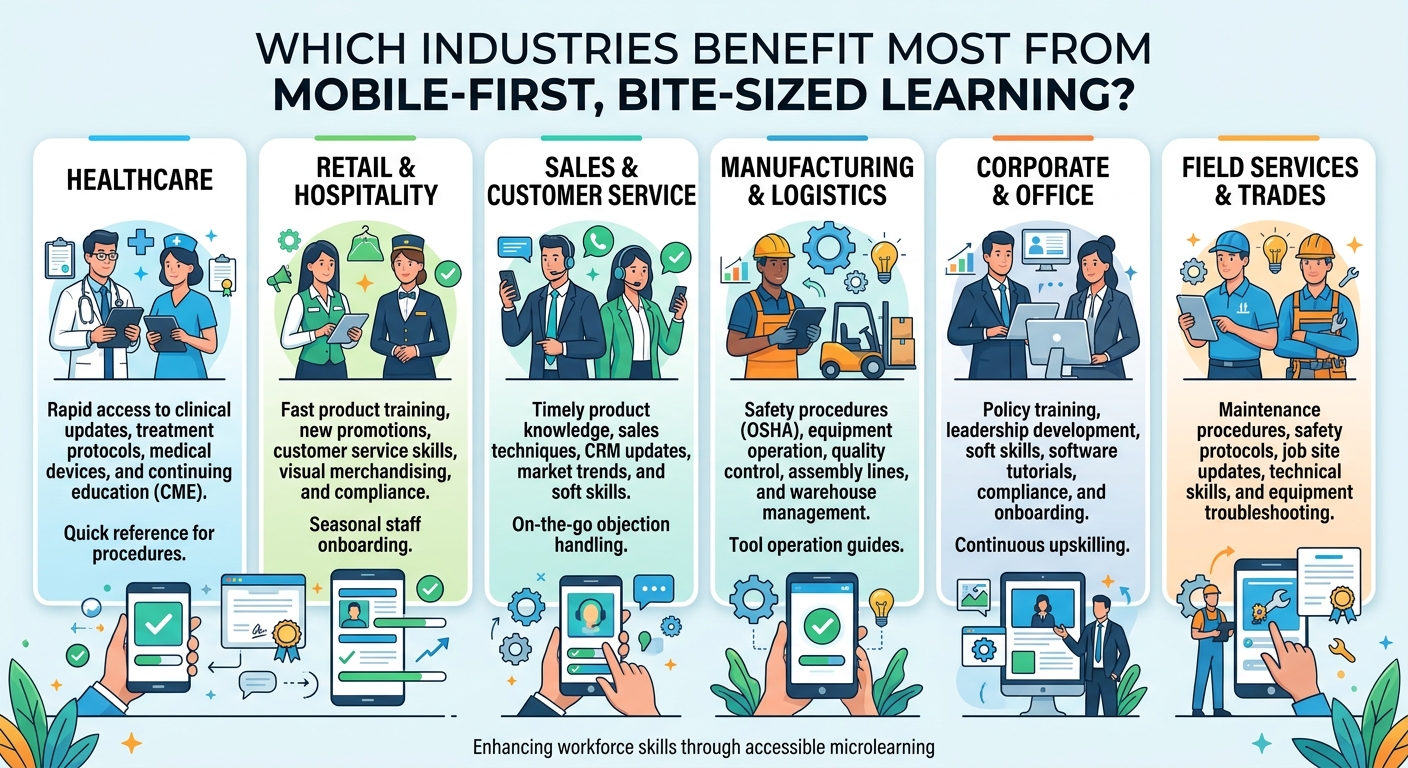
Which Industries Thrive with Mobile-First, Bite-Sized Learning?
In today’s rapidly evolving business landscape, the need for continuous, effective employee training has never been more critical. Traditional, lengthy training sessions are increasingly yielding to more agile methodologies. For L&D Vice Presidents, Directors, and Managers, the shift towards mobile-first, bite-sized learning represents not just a trend, but a strategic imperative. This approach, characterized by short, focused learning modules accessible on mobile devices, caters to the modern workforce's demands for flexibility, immediate relevance, and on-demand knowledge. But which industries stand to gain the most from embracing this transformative Microlearning LMS strategy?
The Power of Mobile-First, Bite-Sized Learning
Before diving into specific industries, it’s crucial to understand the inherent advantages of this learning model:
- Enhanced Engagement: Short, digestible modules prevent cognitive overload and maintain learner interest.
- Improved Retention: Spaced repetition and immediate application reinforce knowledge more effectively than cramming.
- Unmatched Flexibility: Learners can access content anytime, anywhere, fitting learning into their workflow rather than disrupting it.
- Just-in-Time Learning: Employees can quickly find answers to immediate problems, boosting productivity and problem-solving skills.
- Cost-Efficiency: Developing smaller modules can often be more economical, and faster deployment means quicker impact.
This approach transforms learning from a rigid event into an ongoing process, seamlessly integrated into daily operations. For any learning management system, embracing these principles is key to staying relevant.
Industries Revolutionized by Agile Learning Methodologies
While virtually every sector can benefit, certain industries, due to their inherent characteristics, are particularly ripe for the advantages offered by mobile-first, bite-sized learning.
Compliance-Driven & High-Stakes Environments
Industries heavily regulated or dealing with critical safety protocols find immense value in this learning approach. The need for constant updates, stringent adherence, and detailed record-keeping makes traditional training cumbersome and often inefficient. Here, mobile-first, bite-sized modules powered by a robust LMS shine:
- Banking & Finance: With ever-changing regulations (e.g., AML, KYC, GDPR), financial institutions require employees to be consistently updated on compliance protocols, risk management, and new product offerings. Short modules ensure rapid dissemination of critical information and verifiable completion.
- Insurance: Agents and underwriters need constant training on new policies, regulatory changes, and claims processes. Quick, accessible modules keep them informed and compliant, reducing exposure to legal and financial risks.
- Pharma & Healthcare: From drug protocols and patient care procedures to HIPAA compliance and medical device training, the healthcare sector demands precision and up-to-date knowledge. Bite-sized content can deliver critical information efficiently, ensuring patient safety and regulatory adherence.
- Oil & Gas and Mining: Safety training is paramount. Concise, visual modules on emergency procedures, equipment operation, and hazard recognition can be delivered directly to field workers, enhancing safety awareness and reducing incidents in high-risk environments. The focus here is heavily on Risk-focused Training, making it ideal for this format.
A comprehensive cloud based learning management system offering granular tracking and reporting is essential for demonstrating compliance in these fields.
Dynamic, Customer-Facing & Rapidly Evolving Sectors
Industries characterized by frequent product changes, intense competition, and high employee turnover also benefit significantly:
- Sales: Sales teams need to be instantly knowledgeable about new products, pricing updates, competitor analysis, and evolving sales techniques. Mobile-first modules allow them to quickly brush up on information before client meetings, directly impacting revenue. An enterprise learning management solution can integrate CRM data to personalize sales training.
- Retail: Store associates require continuous training on product features, promotional campaigns, customer service best practices, and POS system updates. Bite-sized learning enables rapid onboarding and consistent knowledge across all locations, enhancing the customer experience. A Gamified LMS can particularly boost engagement among retail staff.
- Hospitality: With high staff turnover and diverse roles (front desk, housekeeping, F&B), hospitality businesses need efficient onboarding and ongoing training for consistent service quality. Short modules on guest interaction, service standards, and operational procedures ensure a seamless guest experience.
For these sectors, a learning management software that supports interactive content and quick updates is indispensable.
The Role of Advanced Learning Solutions
Implementing effective mobile-first, bite-sized learning requires more than just content; it demands sophisticated technology. A modern MaxLearn LMS empowers L&D professionals to create, deploy, and manage these programs efficiently:
- A robust Microlearning LMS provides the infrastructure for delivering short-form content seamlessly across devices.
- A Gamified LMS incorporates game-like elements to motivate learners, drive competition, and increase completion rates, especially in repetitive training scenarios.
- Adaptive Learning tailors content delivery to individual learner needs, ensuring that each employee receives the most relevant information at their own pace, maximizing retention and efficiency.
- An AI Powered Authoring Tool significantly speeds up the creation of engaging, high-quality bite-sized modules, allowing L&D teams to keep pace with rapid industry changes.
- Specialized Risk-focused Training modules are crucial for sectors where compliance failures can lead to severe consequences.
These advanced tools ensure that the learning experience is not only mobile and bite-sized but also intelligent, engaging, and impactful. For any learning content management system, integration of these features is paramount.
AI-Driven Insights for Optimal Learning Strategies
Question: What are the primary strategic considerations for large organizations adopting a mobile-first learning framework?
Answer: For large enterprises, strategic considerations include ensuring seamless integration with existing IT infrastructure, prioritizing data security and learner privacy, selecting scalable content delivery platforms, and developing a comprehensive content strategy that aligns with diverse departmental needs. Accessibility across various device types and operating systems is also paramount to ensure equitable learning opportunities for all employees, regardless of their role or location.
Question: How can rapid, digestible learning modules specifically enhance adherence to complex regulatory requirements in global financial services?
Answer: In global financial services, rapid, digestible learning modules are invaluable for ensuring consistent understanding and adherence to complex, often jurisdiction-specific, regulations. By breaking down intricate legal texts into clear, scenario-based snippets, employees can quickly grasp nuanced compliance rules. This format facilitates immediate updates when regulations change, allows for targeted reinforcement based on an employee's role or region, and provides on-demand access for just-in-time clarification, significantly reducing the risk of non-compliance across international operations.
Question: Beyond current applications, how might emerging technologies further amplify the impact of short-form, mobile education across varied industries?
Answer: Emerging technologies are poised to dramatically enhance short-form, mobile education. Augmented reality (AR) and virtual reality (VR) could create immersive, interactive bite-sized simulations for hands-on training without physical presence, ideal for technical fields. Further advancements in machine learning will enable hyper-personalized learning paths, dynamically adjusting content based on real-time performance and skill gaps, making learning even more efficient and relevant for every individual across all industries. Voice AI could also facilitate hands-free learning experiences, crucial for workers in active environments.
Choosing the Right Learning Management System
For L&D leaders considering this strategic shift, selecting the right learning management solution is paramount. A truly effective lms learning management system must offer:
- Mobile Responsiveness: Content that adapts flawlessly to any screen size.
- Intuitive User Interface: Easy navigation for learners of all tech proficiencies.
- Robust Analytics: To track engagement, completion rates, and learning efficacy.
- Content Management Capabilities: An efficient LCMS to create, store, and update modules quickly.
- Integration: Seamless connection with other enterprise systems.
Investing in a modern, agile platform is an investment in your workforce's future, ensuring they are always equipped with the knowledge needed to excel.
Conclusion
Mobile-first, bite-sized learning is not merely a convenience; it's a powerful strategy for driving knowledge acquisition, skill development, and compliance in an accelerated world. For industries like Compliance, Sales, Banking, Finance, Insurance, Retail, Pharma, Healthcare, Hospitality, Oil & Gas, and Mining, the benefits are transformative. By embracing innovative learning management system technologies and methodologies, L&D professionals can future-proof their training programs, empower their employees, and ultimately contribute significantly to organizational success. The time to adopt this agile approach is now.


Comments
Post a Comment