What Is Gardner’s Multiple Intelligences Theory and How Does It Apply to Microlearning?
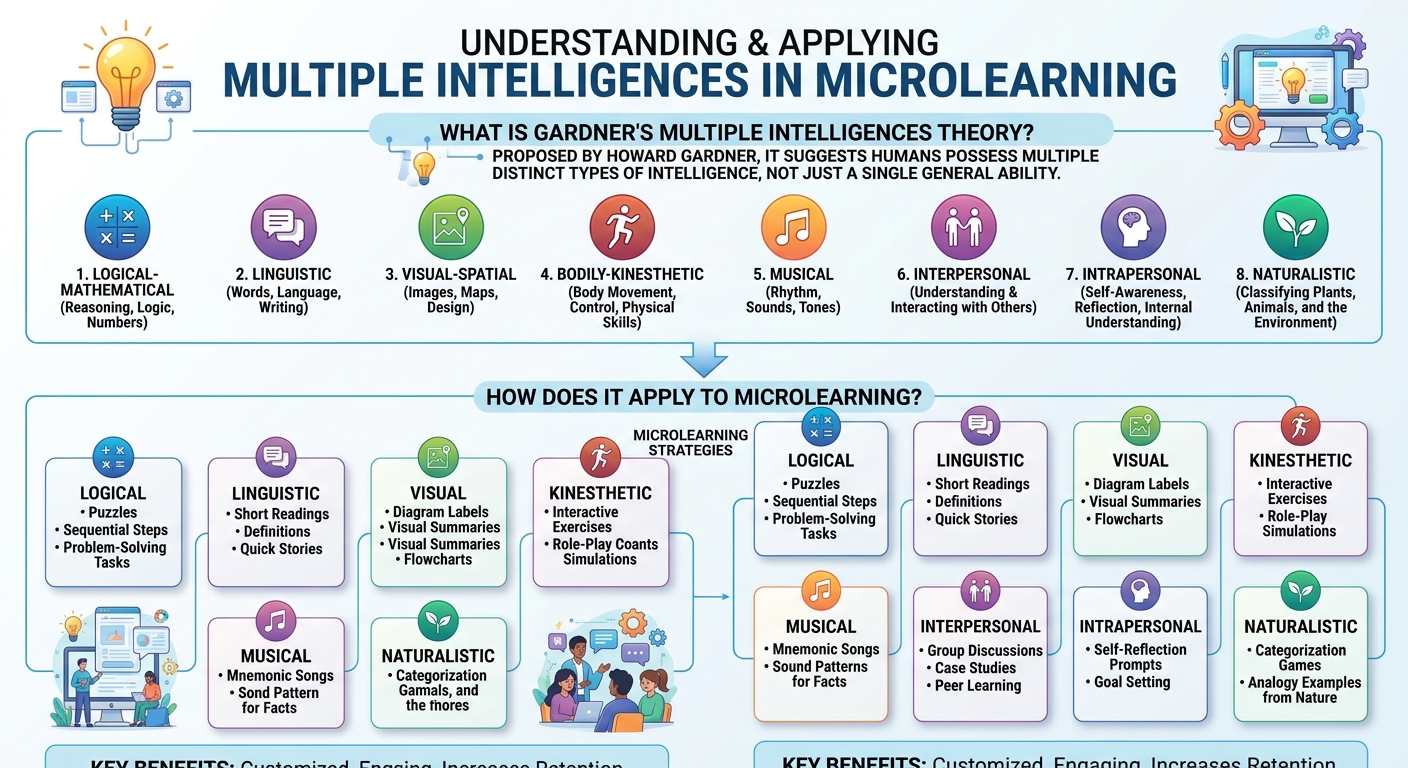
What Is Gardner’s Multiple Intelligences Theory and How Does It Apply to Microlearning?
In today's rapidly evolving corporate landscape, marked by constant innovation and fierce competition across sectors like Banking, Finance, Insurance, Retail, Pharma, Health care, Hospitality, Oil and Gas, Mining, and Compliance, effective employee development is paramount. Learning and Development (L&D) leaders – from Vice Presidents to Managers – face the challenge of engaging diverse workforces and ensuring knowledge retention amidst information overload. Traditional one-size-fits-all training models often fall short, leading to disengagement and ineffective skill transfer. This article delves into how Dr. Howard Gardner's groundbreaking Multiple Intelligences Theory, when strategically combined with the agility of microlearning, can revolutionize corporate training, amplified by intelligent technologies.
Understanding Gardner's Multiple Intelligences Theory
Developed by Harvard psychologist Dr. Howard Gardner in the 1980s, the Multiple Intelligences Theory posits that intelligence is not a single, monolithic entity but rather a collection of distinct capacities. Instead of measuring intellect solely by linguistic or logical-mathematical abilities, Gardner proposed that individuals possess varying strengths across multiple forms of intelligence. Recognizing these diverse aptitudes is crucial for designing learning experiences that resonate with every learner, maximizing comprehension and engagement. No two employees learn in precisely the same way, and this theory offers a powerful framework for understanding those differences.
Gardner initially identified seven intelligences, later adding an eighth:
- Linguistic Intelligence: The ability to use language effectively, both orally and in writing. Think writers, speakers, and communicators.
- Logical-Mathematical Intelligence: The capacity to analyze problems logically, carry out mathematical operations, and investigate issues scientifically. Think engineers, scientists, and analysts.
- Spatial Intelligence: The potential to recognize and use patterns of wide space and more confined areas. Think architects, artists, and navigators.
- Bodily-Kinesthetic Intelligence: The potential to use one's whole body or parts of the body to solve problems or fashion products. Think dancers, athletes, and surgeons.
- Musical Intelligence: The capacity to discern pitch, rhythm, timbre, and tone. Think musicians, composers, and sensitive listeners.
- Interpersonal Intelligence: The ability to understand the intentions, motivations, and desires of other people. Think leaders, educators, and counselors.
- Intrapersonal Intelligence: The capacity to understand oneself, to appreciate one's own feelings, fears, and motivations. Think psychologists, philosophers, and reflective individuals.
- Naturalist Intelligence: The ability to recognize, categorize, and draw upon features of the environment. Think botanists, environmentalists, and outdoor enthusiasts.
Understanding that individuals possess unique blends of these intelligences allows L&D professionals to move beyond generic training and craft more inclusive and effective programs.
The Power of Microlearning in Modern L&D
Microlearning, characterized by short, focused learning units designed to achieve a specific learning objective, has emerged as a cornerstone of modern corporate training. Unlike lengthy courses, microlearning modules typically last from 2 to 10 minutes, making them ideal for busy professionals who need just-in-time knowledge. This approach reduces cognitive overload, boosts retention, and provides unparalleled flexibility, allowing learners to access content whenever and wherever it's most convenient – during a commute, between meetings, or while performing a task. Its bite-sized nature ensures that learning doesn't disrupt workflow, but rather enhances it, providing critical information precisely when needed, whether for Sales training, Compliance updates, or technical skill enhancement.
Implementing a dedicated Microlearning LMS is essential for delivering these concise, impactful learning experiences consistently and at scale. Such a system streamlines content delivery, tracks progress, and offers analytics crucial for optimizing training effectiveness across large organizations.
Bridging the Gap: Multiple Intelligences and Microlearning
The true power of Gardner’s theory in L&D lies in its synergy with microlearning. By leveraging the principles of multiple intelligences, organizations can design microlearning modules that cater to diverse learning preferences, thereby maximizing engagement and knowledge transfer. Here’s how:
- For Linguistic Intelligence: Offer short articles, concise summaries, interactive text-based quizzes, and audio snippets covering key concepts. For example, a microlearning module on Risk-focused Training could include a quick summary of a new regulation.
- For Logical-Mathematical Intelligence: Provide infographics, data-driven mini-case studies, brief problem-solving scenarios, and interactive decision trees. A financial sector micro-module might present a quick calculation exercise.
- For Spatial Intelligence: Utilize engaging videos, animated explainers, diagrams, interactive simulations, and virtual reality (VR) snippets. Visual learners in healthcare or manufacturing would benefit from short demonstrations of equipment or procedures.
- For Bodily-Kinesthetic Intelligence: Incorporate click-and-drag activities, brief role-playing scenarios, interactive simulations of tasks, or quick "try-it-yourself" challenges. Sales teams could practice a quick pitch in an interactive simulation.
- For Musical Intelligence: While less common in corporate training, short jingles or rhythmic patterns can aid memory for key policies or procedures, especially in areas requiring recall like compliance.
- For Interpersonal Intelligence: Design short collaborative activities, discussion prompts, peer feedback micro-sessions, or brief group problem-solving exercises within the learning management software.
- For Intrapersonal Intelligence: Include reflection questions, self-assessment polls, and journal prompts that encourage learners to connect content with their personal experiences and goals.
- For Naturalist Intelligence: Frame learning within real-world, contextual examples or case studies relevant to the learner's environment or industry. For oil and gas, this might be a micro-lesson on environmental safety protocols.
AI's Role in Harmonizing Intelligences with Microlearning
The integration of artificial intelligence (AI) elevates the application of Gardner's theory within microlearning to new heights, enabling unprecedented personalization and efficiency.
How can advanced algorithms revolutionize personalized learning paths?
AI-driven Adaptive Learning platforms analyze individual learner preferences, performance data, and engagement patterns. This allows a sophisticated learning management system to dynamically adjust the type and format of micro-content delivered, ensuring that each learner receives material best suited to their dominant intelligences. For example, a learner strong in spatial intelligence might receive more video tutorials, while a linguistic learner gets concise textual summaries.
Where do intelligent systems offer the greatest benefit in diverse content delivery?
An AI Powered Authoring Tool can significantly accelerate the creation of varied micro-content formats required to cater to all intelligences. From generating concise text summaries from longer documents to suggesting visual aids or interactive elements, AI streamlines the content development process, making it easier for L&D teams to produce diverse, engaging material for a comprehensive learning content management system.
What measurable impact do smart analytics have on learner engagement and performance?
AI-powered analytics within a modern learning management software provides invaluable insights into how different types of micro-content perform with various learner groups. This data helps L&D leaders refine their strategies, identify content gaps, and continually optimize learning paths for maximum impact. Such insights also inform the design of a Gamified LMS, ensuring that challenges and rewards appeal to a broad spectrum of intelligences, driving higher motivation and completion rates.
Strategic Implementation for L&D Leaders
For Vice Presidents, Directors, Senior Managers, and Managers of L&D, the strategic imperative is clear: embrace a holistic approach that acknowledges individual differences while leveraging efficient learning methodologies. Invest in a robust Microlearning LMS that can host diverse content formats and support advanced analytics. A cutting-edge enterprise learning management solution, like a MaxLearn LMS, is key to orchestrating this complex yet rewarding approach.
When selecting a learning management system, consider its ability to integrate with an AI Powered Authoring Tool and support Adaptive Learning paths. This ensures that your organization can efficiently create and deliver personalized learning experiences at scale. Whether it's for critical Compliance training or enhancing Sales skills, tailoring content to individual intelligences through microlearning significantly enhances effectiveness. For sectors requiring precise knowledge and high stakes, like Risk-focused Training in Finance or Pharma, this personalized, agile approach can drastically improve comprehension and adherence.
A cloud based learning management system offering a comprehensive learning management software suite, or LCMS, provides the flexibility and scalability needed to manage and deploy rich, multi-intelligence content across global teams.
Conclusion
The fusion of Gardner's Multiple Intelligences Theory with microlearning, powered by intelligent technologies, represents a paradigm shift in corporate training. L&D leaders who champion this approach will not only boost engagement and retention but also cultivate a more skilled, adaptable, and motivated workforce. By understanding how employees learn best and delivering knowledge in digestible, tailored formats, organizations can unlock their full potential and thrive in any industry. This strategic investment in personalized, efficient learning ensures that every employee, regardless of their dominant intelligence, is empowered to succeed.


Comments
Post a Comment