What Is the Blueprint Stage in the DDE Microlearning Framework?
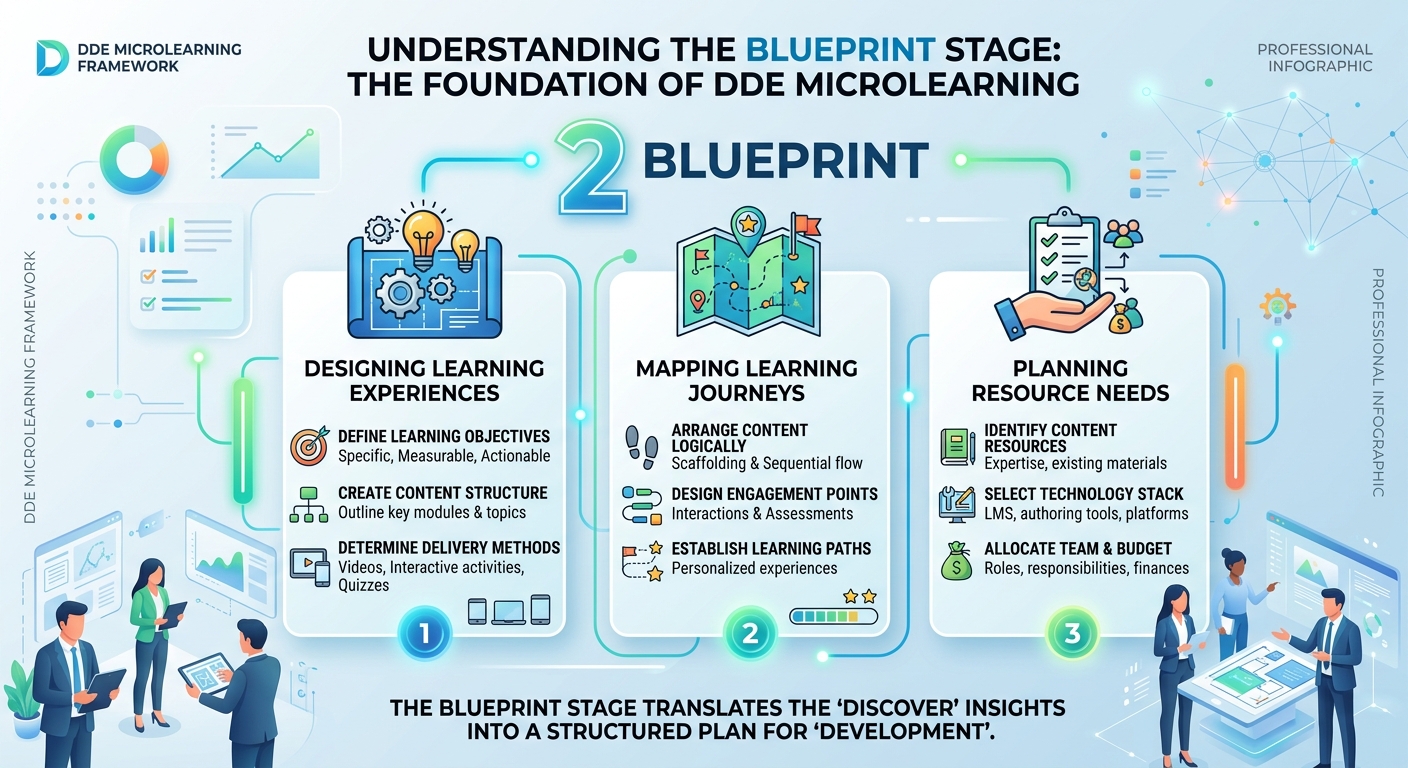
Navigating the Blueprint Stage in the DDE Microlearning Framework: A Strategic Imperative for L&D Leaders
In today's fast-paced corporate landscape, where information overload is a constant challenge, the demand for efficient and effective employee training has never been higher. For Vice Presidents, Directors, and Managers of Learning & Development across diverse sectors like Compliance, Sales, Banking, Finance, Insurance, Retail, Pharma, Health care, Hospitality, Oil and Gas, and Mining, microlearning has emerged as a powerful solution. But how do you ensure your microlearning initiatives truly deliver impact? The answer lies in a robust design methodology, and specifically, in the critical Blueprint stage of the Discover, Design, Engage (DDE) Microlearning Framework.
The DDE framework provides a structured approach to creating compelling microlearning experiences. While 'Discover' focuses on identifying needs and opportunities, and 'Engage' on delivery and continuous improvement, it is the 'Design' phase – and its foundational Blueprint stage – where strategic intent translates into actionable plans. This is where L&D leaders lay the groundwork for a successful, scalable, and impactful learning solution.
What is the DDE Microlearning Framework?
The DDE Microlearning Framework is a cyclical, agile methodology designed to optimize the creation and deployment of targeted learning experiences. It comprises three interconnected phases:
- Discover: This initial phase involves in-depth analysis of learning needs, audience profiles, business objectives, and existing content. It's about asking the right questions to uncover performance gaps and strategic goals.
- Design: The core of our discussion, this phase is where the strategic insights from 'Discover' are translated into a concrete learning plan. It includes the crucial Blueprint stage, followed by content creation and development.
- Engage: This final phase focuses on the delivery of microlearning modules, learner interaction, performance tracking, feedback collection, and iterative refinement to ensure continuous improvement and lasting impact.
Each phase is vital, but without a meticulously crafted Blueprint, even the most innovative content or advanced delivery systems risk falling short of their potential.
The Heart of Design: Unpacking the Blueprint Stage
The Blueprint stage is essentially the architectural drawing for your microlearning program. It’s where every strategic decision, every learning objective, and every technical requirement is meticulously mapped out. For L&D leaders managing complex enterprise learning management systems, this stage is non-negotiable.
Strategic Alignment and Goal Setting
Before any content is developed, the Blueprint must clearly define the overarching learning goals and how they align with organizational objectives. What specific behavioral changes or skill enhancements are required? For a sales team, it might be improving conversion rates; for compliance, ensuring 100% adherence to new regulations; for healthcare, mastering a new medical procedure. This stage also identifies key performance indicators (KPIs) that will measure success, transforming a general learning management system into a strategic business tool. It's about moving beyond mere training to demonstrable business impact.
Audience Analysis and Segmentation
Effective microlearning is highly personalized. The Blueprint details who the learners are – their roles, prior knowledge, learning preferences, and daily workflows. Are they frontline retail staff, senior bankers, or field service engineers? Understanding their context allows for content that is not only relevant but also delivered in the most opportune moments. This segmentation is crucial for tailoring content to specific groups within a large organization, ensuring the lms learning management system serves diverse needs.
Content Curation and Chunking
Microlearning thrives on conciseness. The Blueprint dictates how vast subjects are broken down into bite-sized, digestible modules, typically 2-7 minutes in length. It identifies existing content that can be repurposed, areas where new content is needed, and the format (video, quiz, infographic, simulation). This step transforms a mountain of information into manageable 'chunks' suitable for a modern learning content management system.
Instructional Design Principles for Microlearning
This is where pedagogical expertise comes to the forefront. The Blueprint outlines the specific instructional strategies to be employed for each micro-module. This includes decisions on learning activities, interactive elements, scenarios, and how principles of Adaptive Learning will be incorporated to personalize paths based on learner performance and needs. It ensures that content is not just small, but also effective and engaging.
Technology & Platform Integration
The Blueprint specifies the technological infrastructure for delivery. Will it be a dedicated Microlearning LMS? What features are essential, such as mobile accessibility, analytics, and integration with existing HR systems? For engaging learners, the Blueprint might also consider a Gamified LMS to boost motivation and retention. This stage confirms that the chosen learning management software can support all design specifications.
Assessment and Feedback Mechanisms
How will learning be measured? The Blueprint outlines assessment strategies, which for microlearning often include quick quizzes, simulations, or scenario-based questions embedded directly into modules. It also defines how feedback will be provided, both to learners and to the L&D team for program refinement. This data is invaluable for validating the effectiveness of your learning management solutions.
Leveraging Intelligence in Blueprinting
In an era driven by data and artificial intelligence, the Blueprint stage gains even greater strategic importance. L&D leaders are increasingly looking for intelligent ways to optimize their learning programs.
How can data insights refine microlearning design in this initial phase?
Data plays a pivotal role in creating a truly optimized Blueprint. By analyzing existing performance metrics, previous training outcomes, and even employee sentiment, L&D teams can pinpoint precise knowledge gaps and skill deficiencies. This allows for the creation of highly targeted microlearning modules that address actual needs, rather than perceived ones. For instance, in a large financial institution, transaction data might reveal common errors, prompting a specific microlearning series on particular transaction protocols. This data-driven approach ensures that every piece of learning content contributes directly to improving performance and mitigating risks. Identifying patterns in learning consumption and success rates from a cloud based learning management system can also inform future design choices, making learning paths more effective and efficient.
Where does a robust Blueprint yield the most significant returns across diverse sectors?
A well-executed Blueprint delivers substantial benefits across all industries. In Compliance, it ensures employees quickly grasp evolving regulations, minimizing legal exposure. In Sales, it equips teams with immediate product knowledge or objection-handling techniques, boosting quotas. For sectors like Pharma and Healthcare, it facilitates rapid dissemination of critical procedural updates, enhancing patient safety. In Oil and Gas or Mining, it can provide crucial safety protocol refreshers on demand, significantly reducing workplace incidents. Effectively, a strong Blueprint is the foundation for Risk-focused Training, transforming potential liabilities into operational strengths. For any organization utilizing an enterprise learning management system, the Blueprint directs resources towards areas of highest impact, ensuring maximum ROI.
What role can smart technologies play in streamlining the blueprint process for L&D leaders?
Smart technologies, particularly artificial intelligence, are revolutionizing the Blueprint stage. AI can analyze vast amounts of existing content, identifying redundancies, gaps, and optimal ways to 'chunk' information for microlearning. AI-powered tools can also help profile learners based on their roles, performance data, and even preferred learning styles, recommending personalized learning paths right from the design phase. For L&D leaders, an AI Powered Authoring Tool can significantly reduce the time and effort required to develop initial content frameworks and storyboards, ensuring consistency and adherence to best practices. This dramatically speeds up the transition from strategy to development within a comprehensive MaxLearn LMS or similar LCMS.
Why the Blueprint Stage is Indispensable for L&D Leaders
For L&D VPs, Directors, and Managers, the Blueprint stage isn't just another step; it's a strategic imperative. It provides:
- Clarity and Direction: It ensures everyone involved—from subject matter experts to instructional designers—is aligned on objectives and scope.
- Resource Optimization: By meticulously planning content and technology, it prevents wasted effort, time, and budget. It helps make informed decisions about your learning management system investment.
- Risk Mitigation: A thorough Blueprint identifies potential challenges early, allowing for proactive solutions before development begins, especially crucial in high-stakes industries.
- Scalability: A well-defined Blueprint creates a repeatable framework, enabling efficient expansion of microlearning initiatives across departments or new business units.
- Measurement of Success: By setting clear KPIs, the Blueprint lays the foundation for accurate evaluation of program effectiveness, demonstrating the tangible value of L&D to the organization.
Conclusion
The Blueprint stage within the DDE Microlearning Framework is the strategic bedrock upon which all successful microlearning initiatives are built. It’s where vision meets execution, where data informs design, and where L&D leaders transform abstract goals into tangible learning experiences. By investing time and expertise in this critical phase, organizations can unlock the true potential of microlearning, driving significant improvements in performance, compliance, and overall business growth. Ensure your organization’s learning strategy is robust from the ground up – start with a powerful Blueprint.


Comments
Post a Comment