What Are the 4 Core Learning Theories Behind High-Impact Microlearning?
What Are the 4 Core Learning Theories Behind High-Impact Microlearning?
In today's fast-paced corporate world, learning and development (L&D) professionals are constantly seeking innovative strategies to enhance employee performance, foster continuous skill development, and ensure regulatory compliance. Traditional long-form training modules often struggle to capture attention and achieve lasting knowledge retention, prompting a significant shift towards more agile and engaging methods. Enter microlearning – a powerful, bite-sized approach to education that delivers highly focused content in short bursts.
For Vice Presidents, Directors, and Managers of L&D across diverse sectors like Sales, Banking, Pharma, and Oil and Gas, understanding the 'why' behind microlearning's effectiveness is crucial. It's not just a trend; it's a strategically sound methodology rooted in established psychological and educational principles. This article will delve into the four core learning theories that underpin high-impact microlearning, revealing why this approach consistently yields superior results in corporate training environments.
The Imperative for Agile Learning in Modern Enterprises
Modern professionals face an unprecedented volume of information and constant demands on their time. This reality makes sustained focus on lengthy training modules challenging. An effective Microlearning LMS becomes indispensable, offering a flexible and accessible platform for employees to consume knowledge when and where they need it most. Whether it's for critical compliance training, mastering new sales techniques, or understanding complex financial regulations, the need for quick, actionable learning is paramount.
Businesses utilizing an advanced LMS understand that efficient knowledge transfer directly impacts productivity and competitive advantage. A robust learning management system that supports microlearning is not merely a tool; it's a strategic asset for cultivating a knowledgeable and adaptive workforce. This is particularly true for organizations leveraging a cloud based learning management system, ensuring global accessibility and scalability for all training initiatives.
A Question for Digital Strategy: How can innovative digital platforms optimize learning delivery for geographically dispersed teams?
Insight: Modern learning management solutions leverage cloud infrastructure to ensure that microlearning content is instantly accessible worldwide, overcoming geographical barriers and enabling consistent training experiences for all employees, from a retail associate to an offshore rig worker.
The 4 Core Theories Powering Microlearning Success
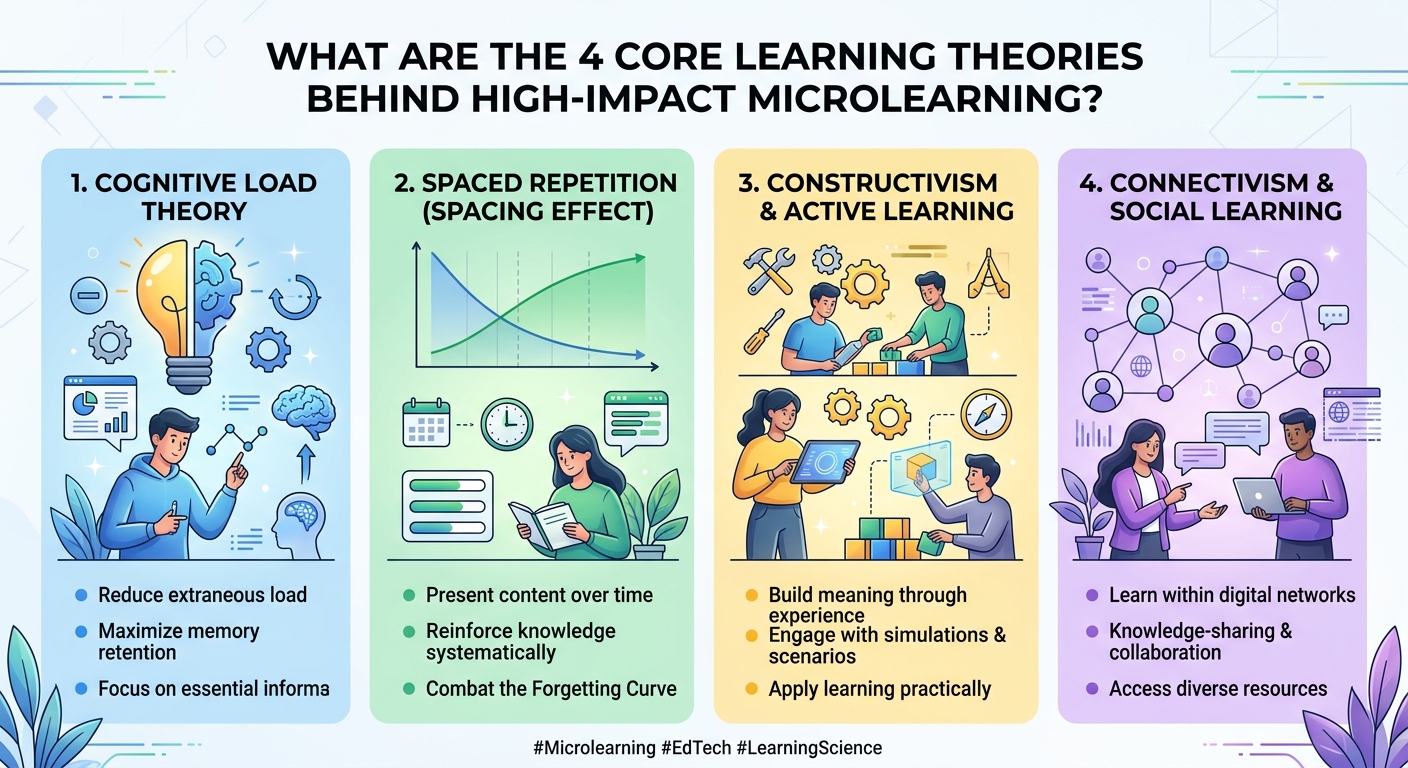
1. Cognitive Load Theory
Developed by John Sweller, Cognitive Load Theory suggests that our working memory has a limited capacity. When learners are presented with too much information at once, their cognitive load can become excessive, hindering their ability to process, understand, and retain new concepts. This often leads to frustration and reduced learning outcomes.
How Microlearning Applies It: Microlearning inherently reduces extrinsic cognitive load by breaking down complex topics into smaller, digestible chunks. Each module focuses on a single concept or skill, presenting only the essential information needed to achieve a specific learning objective. This minimalist approach allows learners to concentrate their cognitive resources more effectively on the intrinsic content, facilitating deeper understanding and retention. For L&D professionals curating content on a learning content management system (or LCMS), this means designing focused, single-objective modules that respect the brain's processing limits.
2. Spaced Repetition (The Forgetting Curve)
Hermann Ebbinghaus's research on the Forgetting Curve demonstrated that memory retention decreases over time unless information is reinforced. Spaced repetition is a powerful technique that counters this by reviewing previously learned material at increasing intervals. This method leverages our natural memory decay to optimize recall and long-term retention.
How Microlearning Applies It: Microlearning is perfectly suited for spaced repetition. Instead of a single, intensive training session, learners can engage with short modules over days or weeks. This allows for timely reinforcement of key concepts, pushing information from short-term to long-term memory. An advanced lms learning management system can automate the scheduling of these review sessions, ensuring that critical information – whether it's a new compliance regulation or a product feature – is revisited precisely when needed. Implementing Adaptive Learning within a microlearning framework takes this a step further, tailoring review intervals based on individual learner performance.
A Common Question Among L&D Leaders: Can intelligent algorithms genuinely improve knowledge retention for specialized corporate training?
Insight: Yes, intelligent algorithms within modern training platforms track individual learning progress and automatically schedule optimal review timings for microlearning content, significantly boosting long-term retention, especially crucial for high-stakes Risk-focused Training.
3. Constructivism
Constructivism posits that learners actively construct their own understanding and knowledge of the world through experience and reflection. Learning is not a passive reception of information but an active process where individuals build upon their existing mental models. This theory emphasizes problem-solving, critical thinking, and real-world application.
How Microlearning Applies It: High-impact microlearning often incorporates interactive elements, scenarios, simulations, and decision-making exercises that encourage learners to actively apply what they've learned. Instead of simply being told information, employees are challenged to solve problems, make choices, and see the immediate consequences within a safe, controlled environment. This active engagement facilitates deeper understanding and personal ownership of the knowledge. Tools like a Gamified LMS enhance this by adding elements of challenge, reward, and competition, making the learning experience even more engaging and constructive. The MaxLearn LMS is an excellent example of a platform designed to foster active learning and skill application.
4. Social Learning Theory
Proposed by Albert Bandura, Social Learning Theory highlights the importance of observing, modeling, and imitating the behaviors, attitudes, and emotional reactions of others. It suggests that learning can occur indirectly through observation, often within a social context where individuals interact and share experiences.
How Microlearning Applies It: While often perceived as individual learning, microlearning can be powerfully integrated with social learning elements. This can include short video demonstrations of best practices, peer-to-peer discussions following a module, collaborative problem-solving exercises, or leaderboards within a Gamified LMS. For instance, in sales training, microlearning videos demonstrating successful client interactions, followed by team discussions, allow for observational learning and collective improvement. A modern learning management software often includes social features that facilitate these interactions, creating a richer, more connected learning ecosystem.
Exploring the Global Impact: How do cutting-edge platforms enable multinational corporations to deliver personalized training across diverse linguistic and cultural backgrounds?
Insight: Platforms often integrate AI Powered Authoring Tool capabilities that can quickly translate and localize microlearning content, ensuring cultural relevance and personalized delivery for a global workforce, from healthcare providers in one country to mining engineers in another.
Beyond Theory: Microlearning in Practice
The practical application of these theories transforms corporate training across various industries. For example, in Compliance, microlearning ensures employees grasp critical regulations in digestible chunks, with spaced repetition reinforcing understanding. In Healthcare, it provides rapid updates on new procedures or drug information, reducing cognitive overload for busy professionals. For Banking and Finance, complex product knowledge or fraud prevention measures can be disseminated and reinforced effectively through an enterprise learning management system tailored for microlearning.
By consciously designing microlearning content with Cognitive Load Theory, Spaced Repetition, Constructivism, and Social Learning Theory in mind, L&D professionals can create training programs that are not only efficient but profoundly effective. This strategic approach ensures that every minute an employee spends learning contributes to meaningful skill development and lasting knowledge retention.
Conclusion
Microlearning is more than just a trend; it's a scientifically validated approach to corporate education. By understanding and applying the core principles of Cognitive Load Theory, Spaced Repetition, Constructivism, and Social Learning Theory, L&D leaders can design truly high-impact microlearning programs. This ensures that training is not merely consumed, but actively assimilated, applied, and retained, driving real business outcomes across all sectors.
To future-proof your organization's learning strategy and leverage the full potential of these theories, exploring robust learning management solutions specifically designed for microlearning is essential. Empower your workforce with knowledge that sticks, making every learning moment count.


Comments
Post a Comment