Transforming Compliance and Sales Training Through the DDE Game Framework
Transforming Compliance and Sales Training Through the DDE Game Framework
In today's rapidly evolving corporate landscape, the twin pillars of compliance and sales training are more critical than ever. Yet, traditional approaches often fall short, struggling to capture attention, foster retention, and ultimately, drive desired behavioral changes and performance improvements. L&D leaders, from Vice Presidents to Managers, are consistently seeking innovative solutions to these pervasive challenges. Enter the Discover, Design, Engage (DDE) Game Framework – a strategic methodology poised to revolutionize how organizations approach critical learning initiatives.
The DDE Game Framework is not just about adding badges and leaderboards; it's a profound shift in pedagogical philosophy. It emphasizes a learner-centric, data-driven approach to creating immersive and highly effective training experiences. By systematically understanding learner needs, crafting compelling content, and employing advanced engagement strategies, the DDE framework transforms mundane requirements into exciting opportunities for growth and skill development.
Understanding the DDE Game Framework
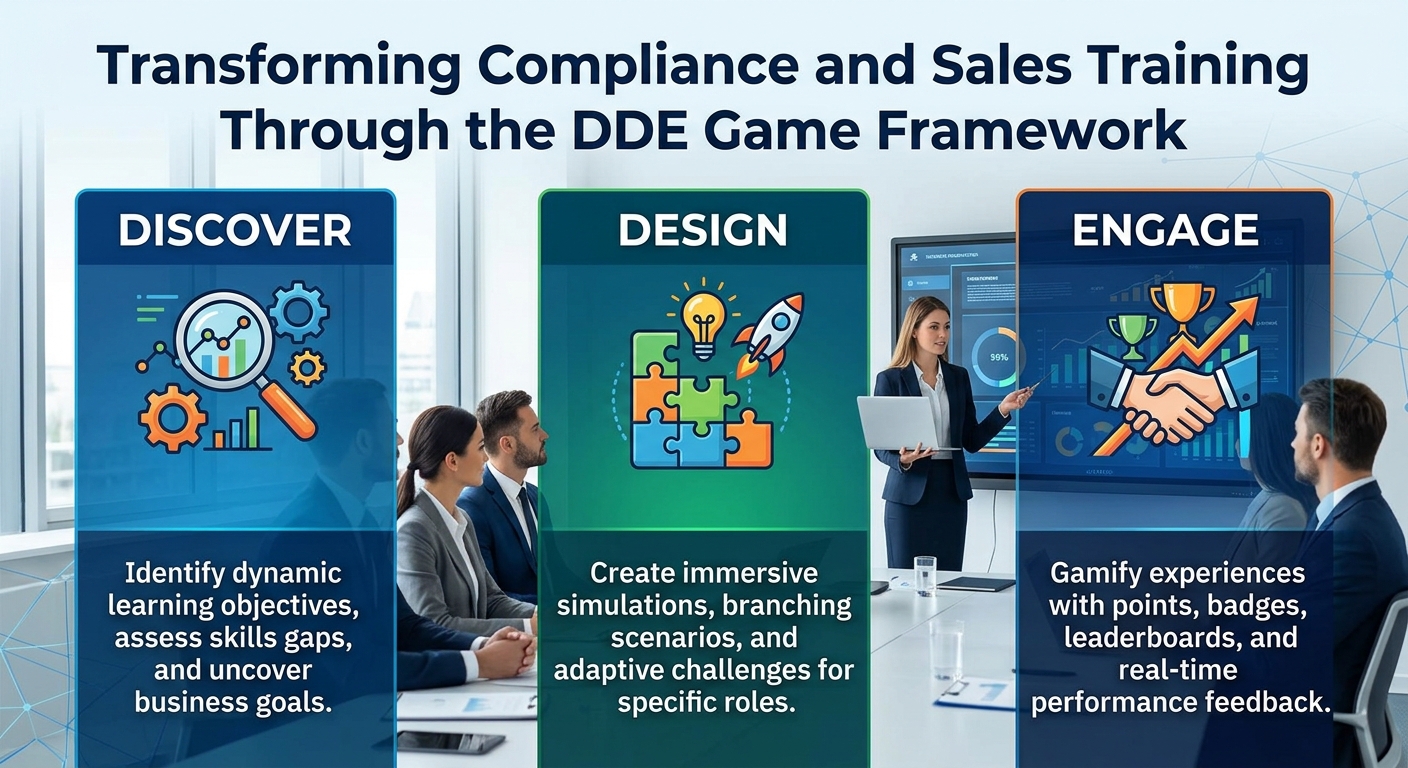
The DDE Game Framework operates on three core principles:
- Discover: This initial phase involves a deep dive into understanding the target audience, their existing knowledge, learning preferences, and the specific performance gaps or compliance risks that need addressing. It's about data collection, needs assessment, and defining clear learning objectives. What motivates your sales team? Where are the common pitfalls in compliance understanding? This phase answers these fundamental questions.
- Design: Armed with insights from the discovery phase, the design phase focuses on crafting the learning experience. This is where instructional design principles meet gamification mechanics. Content is structured into digestible modules, often leveraging a Microlearning LMS, and infused with game elements like challenges, scenarios, points, and progression paths. The goal is to make learning inherently rewarding and directly relevant to the learner's role.
- Engage: The engagement phase is about sustaining learner interest and ensuring practical application of knowledge. This involves interactive elements, simulations, collaborative activities, and continuous feedback loops. It's about creating a dynamic environment where learners are active participants, not passive recipients, leading to higher knowledge retention and skill mastery. This is where a robust Gamified LMS truly shines, driving consistent interaction and measurable progress.
The Challenge: Why Traditional Training Fails
Before diving deeper into DDE's transformative power, it's crucial to acknowledge the shortcomings of conventional training methods. Lengthy, text-heavy modules, generic presentations, and infrequent assessments often result in:
- Low engagement and high dropout rates.
- Poor knowledge retention, especially for complex compliance regulations or nuanced sales techniques.
- Inability to track true understanding or application of skills.
- A perceived burden rather than an opportunity for growth, particularly in mandatory compliance scenarios.
These issues are not just inconvenient; they pose significant financial and reputational risks to organizations across sectors like Banking, Finance, Insurance, Retail, Pharma, and Healthcare, where compliance failures can lead to hefty fines, and inadequate sales training directly impacts revenue.
DDE in Action: Revolutionizing Compliance Training
Compliance training, often viewed as a necessary evil, can be revitalized through the DDE framework. By transforming abstract rules into interactive scenarios and relatable challenges, organizations can foster a culture of understanding and adherence.
Imagine a compliance module where employees navigate a virtual office, identifying Risk-focused Training areas, making decisions that impact their score, and facing immediate consequences for errors. This approach, facilitated by a modern learning management system, moves beyond rote memorization to contextual understanding. The 'Discover' phase identifies the specific high-risk areas pertinent to an industry like Oil and Gas or Mining. The 'Design' phase then builds interactive simulations that mirror real-world dilemmas, followed by 'Engage' elements that offer dynamic feedback and reinforce correct behaviors, ensuring that legal and ethical guidelines are not just known, but deeply understood and applied.
DDE in Action: Elevating Sales Training
For sales teams, the DDE framework offers a powerful way to refine skills, introduce new products, and boost confidence. Sales professionals need dynamic, relevant, and immediately applicable training. The DDE framework delivers this by creating simulations of customer interactions, negotiation challenges, and product knowledge quests.
In the 'Discover' phase, an organization identifies the common objections sales reps face or the critical features of a new product launch. The 'Design' phase then leverages an AI Powered Authoring Tool to rapidly create adaptive scenarios where salespeople practice pitching, handling objections, and closing deals in a safe, simulated environment. The 'Engage' phase provides real-time feedback, peer comparisons, and progression through different difficulty levels, ensuring that training is not a one-off event but a continuous journey of improvement. This also allows for Adaptive Learning paths, tailoring content to individual sales reps' strengths and weaknesses.
The Role of Advanced Technology in DDE-Powered Training
The effectiveness of the DDE Game Framework is significantly amplified by sophisticated learning technologies. L&D leaders often ponder how to best leverage innovation for maximum impact:
How can intelligent algorithms assist in identifying critical learning gaps or designing highly relevant training scenarios for our diverse workforce?
Modern learning management software often incorporates advanced analytics to pinpoint where learners struggle most or what topics are most frequently accessed. These insights, powered by sophisticated processing, inform the 'Discover' phase, allowing L&D teams to identify specific pain points and tailor content precisely. Furthermore, content creation tools can use this data to suggest or even generate personalized learning modules, ensuring relevance for every learner, whether they're in Hospitality or Pharma.
What role does advanced analytical processing play in tailoring learning paths or providing real-time feedback to individual learners, regardless of their geographical location or specific role?
Through the 'Design' and 'Engage' phases, advanced analytics enable highly personalized learning experiences. An enterprise learning management system can dynamically adjust the difficulty of questions, recommend next steps based on performance, and provide instant, constructive feedback. This ensures that a learner in New York receives the same quality and tailored experience as one in Singapore, optimizing the learning journey for maximum engagement and skill acquisition across all organizational segments.
Beyond current performance, how can predictive models help us anticipate future training needs or potential compliance risks within the organization?
Leveraging large datasets, predictive models can analyze patterns in compliance breaches or sales performance trends to foresee future challenges. For example, if a certain type of compliance error is increasing in a specific department, the system can proactively recommend targeted training. Similarly, if market shifts are expected, predictive insights can help L&D teams develop new sales strategies and product training before the need becomes urgent, thereby minimizing reactive training and maximizing proactive skill development.
Benefits of Adopting the DDE Framework with a Powerful LMS
Implementing the DDE Game Framework, supported by a robust LMS or a comprehensive learning content management system, offers a multitude of benefits for organizations seeking superior training outcomes:
- Increased Engagement and Retention: Gamified elements make learning fun and memorable, leading to higher completion rates and better retention of critical information.
- Improved Performance: Practical, scenario-based training directly translates to improved on-the-job performance in both compliance adherence and sales effectiveness.
- Measurable ROI: Advanced analytics within a lms learning management system provide clear data on learner progress, skill mastery, and ultimately, the impact on business outcomes, justifying the investment in training.
- Scalability and Consistency: A cloud based learning management system ensures consistent training delivery across diverse geographical locations and teams, maintaining quality standards.
- Reduced Risk: Proactive, engaging compliance training significantly lowers the likelihood of costly penalties and reputational damage.
Choosing the Right Technology Partner
To successfully implement the DDE Game Framework, selecting the right learning management solutions is paramount. Organizations need a system that offers flexibility, powerful analytics, and strong content authoring capabilities. A modern LCMS (Learning Content Management System) or learning management software like MaxLearn LMS provides the infrastructure needed to discover insights, design engaging content, and effectively engage learners with rich multimedia and interactive experiences. It's about finding a platform that supports microlearning, gamification, and adaptive paths, ensuring that your training initiatives are not just effective, but truly transformative.
Conclusion
The DDE Game Framework represents a paradigm shift in how organizations approach compliance and sales training. By focusing on discovery, intelligent design, and sustained engagement, businesses can move beyond mere checkboxes and towards a culture of continuous learning and high performance. Coupled with an advanced learning management system, this framework empowers L&D professionals to create impactful, measurable, and genuinely enjoyable learning experiences that drive tangible results across every segment and industry.


Comments
Post a Comment