Traditional LMS vs. AI Microlearning LMS: A 2026 Enterprise Architecture Comparison
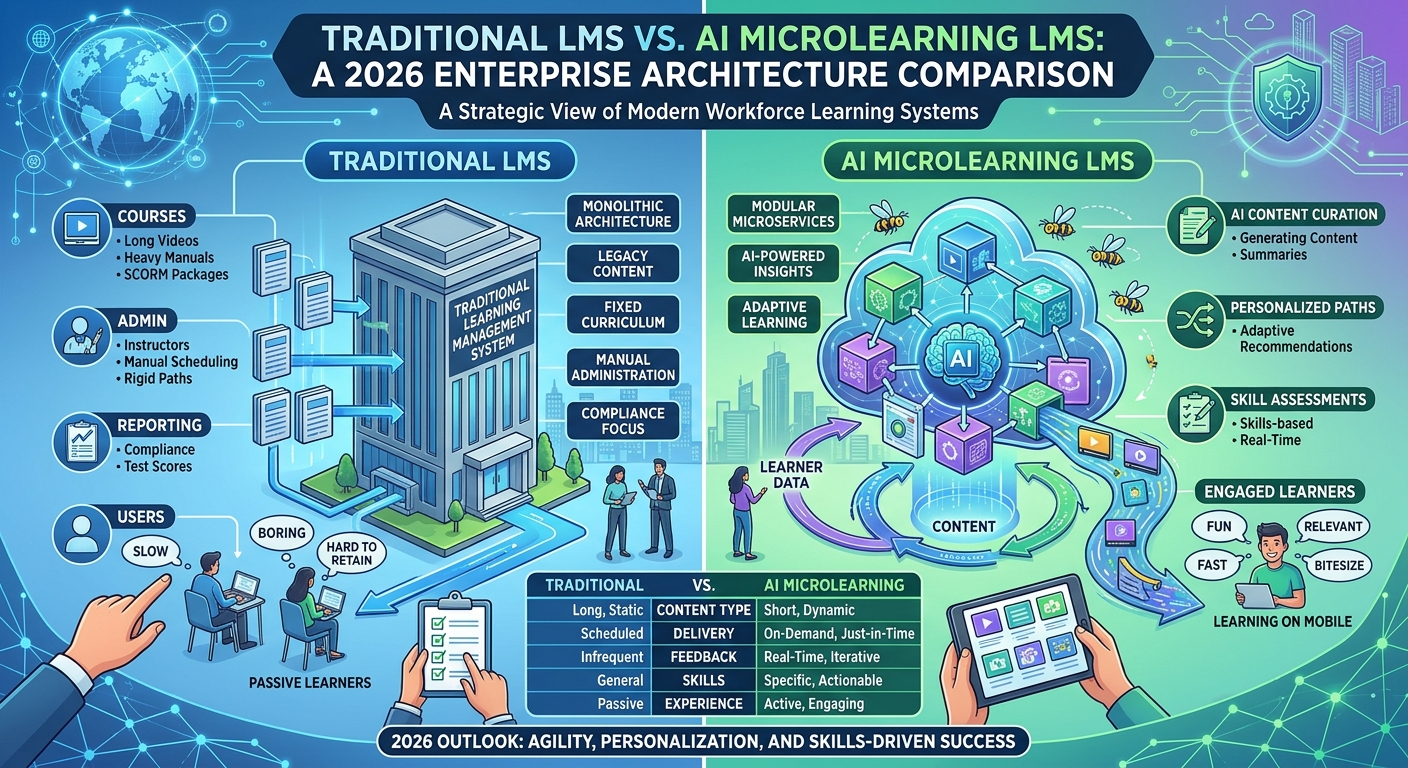
Traditional LMS vs. AI Microlearning LMS: A 2026 Enterprise Architecture Comparison
The landscape of corporate learning and development is undergoing a seismic shift. As L&D leaders, VPs, Directors, and Managers, you're tasked with building a resilient, agile, and effective learning infrastructure. The traditional Microlearning LMS, while foundational, is increasingly challenged by the rapid pace of technological change and the evolving demands of the modern workforce. By 2026, the architectural differences between a legacy learning management system and an AI-powered microlearning platform will dictate an organization's competitive edge.
This article delves into a detailed comparison, dissecting the enterprise architecture of both systems and offering insights into strategic considerations for future-proofing your learning initiatives across diverse industries like Compliance, Sales, Banking, Finance, Insurance, Retail, Pharma, Healthcare, Hospitality, Oil and Gas, and Mining.
The Traditional Learning Management System (LMS) in 2026
Even in 2026, many organizations still rely on a traditional learning management system. These systems, designed primarily for content delivery and learner tracking, often feature a monolithic or tightly coupled architecture. Their strengths lie in their robustness for large-scale content libraries, compliance reporting, and structured course progression.
- Architecture: Typically on-premise or cloud-hosted, with a centralized database and application layer. Content management is often integrated but can be cumbersome for rapid updates.
- Content Delivery: Predominantly course-centric, with long-form modules, SCORM/AICC packages, and standard assessments. While some may integrate elements of a Gamified LMS, the core content structure remains traditional.
- Data & Analytics: Focuses on completion rates, scores, and learner progress. Reporting is often retrospective and descriptive, offering limited predictive capabilities or real-time insights into skill gaps or learning effectiveness.
- Integration: Can be challenging, often requiring custom APIs or middleware for integration with HRIS, CRM, or other enterprise systems.
- Scalability: Can scale, but often requires significant infrastructure upgrades or licensing adjustments, lacking the elasticity of cloud-native solutions.
For organizations requiring stringent audit trails or static, compliance-heavy training that changes infrequently, a traditional LMS still holds some value. However, its limitations in personalization, adaptability, and dynamic content management are becoming increasingly apparent, hindering true enterprise learning management.
The Rise of the AI Microlearning LMS in 2026
An AI microlearning learning management system represents a paradigm shift. It’s not just an upgrade; it’s a fundamentally different approach to learning content management system delivery and consumption. By 2026, these platforms are characterized by their intelligent, adaptive, and highly personalized experiences, leveraging artificial intelligence to drive unprecedented engagement and effectiveness.
- Architecture: Cloud-native, microservices-based, and API-first. This distributed architecture allows for greater flexibility, resilience, and seamless integration with other enterprise tools. It’s a true cloud based learning management system, designed for agility.
- Content Delivery: Hyper-focused on short, digestible learning nuggets (microlearning) delivered precisely when and where needed. Leveraging Adaptive Learning paths, content is personalized based on learner performance, preferences, roles, and real-time business needs.
- Core AI Capabilities: Includes natural language processing for content analysis, machine learning for predictive analytics, recommendation engines for personalized learning paths, and intelligent agents for adaptive feedback.
- Data & Analytics: Provides real-time, prescriptive, and predictive analytics. AI can identify at-risk learners, forecast skill gaps, measure the direct impact of training on business outcomes, and optimize content effectiveness.
- Integration: Built with open APIs, enabling effortless integration with HR, CRM, ERP, and other critical business systems, making it a cohesive part of the enterprise ecosystem.
The MaxLearn LMS exemplifies this next generation of learning management software, offering a robust, AI-driven platform tailored for the demands of 2026 enterprise learning.
Key Architectural Differences: Traditional vs. AI Microlearning
Content Management and Creation (LCMS)
In a traditional learning content management system, content is often static and requires manual updates. An AI microlearning lms learning management system, however, integrates advanced capabilities like an AI Powered Authoring Tool. This allows for dynamic content generation, automatic updates, and personalized content delivery based on learner profiles and performance, dramatically reducing the burden on L&D teams and ensuring content remains relevant and fresh.
Data Analytics and Insights
Traditional learning management solutions provide basic reporting. An AI microlearning system excels in advanced analytics. It can detect patterns in learning behavior, predict future skill requirements, and provide prescriptive recommendations. For industries like Banking or Pharma, this means better identification of Risk-focused Training needs and precise measurement of compliance effectiveness.
Scalability and Flexibility
AI microlearning platforms, being cloud-native and modular, offer unparalleled scalability. They can effortlessly accommodate fluctuating learner numbers and rapidly deploy new learning initiatives without extensive infrastructure changes. This elasticity is crucial for large enterprises in Retail or Hospitality experiencing seasonal demands or rapid growth.
User Experience and Personalization
The personalized user experience is where AI microlearning truly shines. It moves beyond a one-size-fits-all approach to deliver highly relevant, timely content. This significantly boosts engagement and knowledge retention, leading to measurable improvements in performance across all segments, from Sales to Healthcare.
Optimizing Learning Experience with AI
How does intelligent automation personalize learning paths for enterprise employees?
Intelligent automation, at the heart of an AI microlearning platform, continuously analyzes a learner's interactions, progress, preferences, and performance data. It dynamically adjusts learning paths, recommending specific modules, resources, or challenges that align with individual needs and organizational objectives. This means a sales professional receives training relevant to their specific product line or sales challenges, rather than generic content. This level of customization ensures every minute spent on the learning management software is highly impactful.
What role does generative intelligence play in creating engaging and evolving training content?
Generative intelligence empowers the learning content management system to go beyond static content. It can create adaptive scenarios, dynamic quizzes, interactive simulations, and even personalized practice exercises on the fly. For example, in a banking compliance module, AI can generate new fraud scenarios based on emerging threats, ensuring employees are always trained on the latest risks. This keeps the content fresh, relevant, and highly engaging, boosting knowledge application and critical thinking.
How do advanced analytics from an AI-driven platform empower L&D leaders with strategic insights?
An AI microlearning LMS transforms raw data into actionable intelligence. L&D leaders gain insights into the effectiveness of specific learning interventions, identify organization-wide skill gaps before they become critical, and predict future training needs based on business strategy and market trends. For a director in the Oil and Gas sector, this means understanding which safety training modules are most effective in reducing incidents, or for a VP in Insurance, pinpointing areas where employees need development to improve customer retention. This predictive power allows L&D to proactively align learning strategies with business outcomes, making the learning management system a strategic asset.
Strategic Implications for L&D Leaders
For L&D VPs, Directors, and Managers across industries, the architectural shift to an AI microlearning learning management system is not just about adopting new technology; it's about fundamentally rethinking how talent is developed and managed. It offers:
- Enhanced Compliance & Risk Mitigation: In regulated industries like Pharma, Healthcare, and Banking, AI ensures up-to-date compliance training and precisely targets Risk-focused Training, providing robust audit trails and proactive identification of knowledge gaps.
- Improved Performance & Productivity: For Sales and Retail, personalized, just-in-time microlearning directly impacts performance metrics, from closing sales to improving customer service.
- Agile Skill Development: In fast-evolving sectors like Technology or Manufacturing, an AI-powered cloud based learning management system allows organizations to rapidly develop new skills and reskill workforces to stay competitive.
- Strategic Talent Management: An AI microlearning platform becomes a powerful tool for talent retention and development, offering clear growth paths and personalized learning experiences that boost employee satisfaction and loyalty.
Organizations that embrace an AI microlearning learning management system like MaxLearn LMS by 2026 will not just deliver training; they will foster a culture of continuous, intelligent learning that is intrinsically linked to business success.
The choice between a traditional learning management system and an AI microlearning LMS is a strategic one, defining your organization’s capacity for adaptability and innovation. By 2026, a truly future-ready enterprise learning management strategy will undoubtedly be powered by the intelligence and agility of AI microlearning.


Comments
Post a Comment