The Psychology of Workplace Competency: Building Sustainable KSAs Through Multiple Intelligences
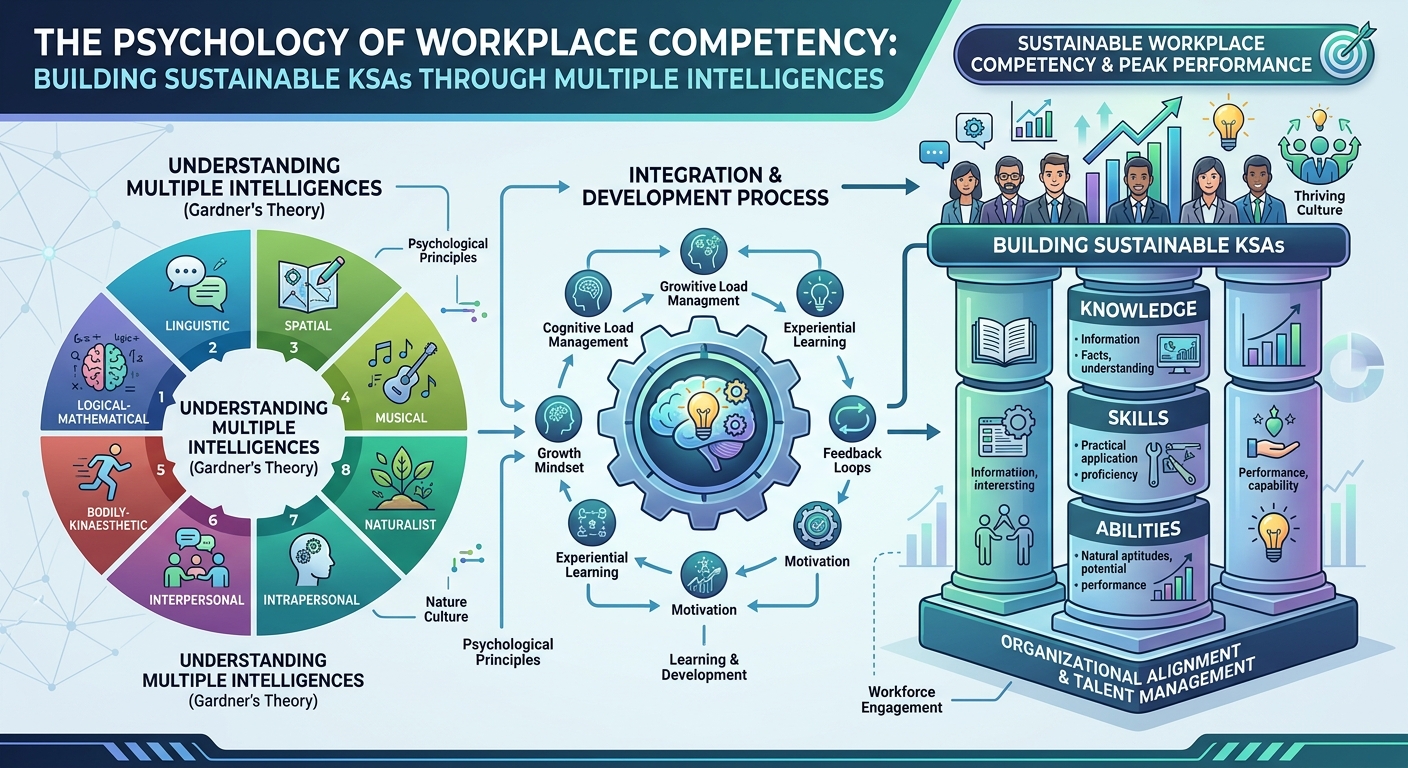
The Psychology of Workplace Competency: Building Sustainable KSAs Through Multiple Intelligences
For Vice Presidents, Directors, and Senior Managers in Learning & Development, the pursuit of a highly competent workforce is ceaseless. In today's dynamic global marketplace, merely having employees is insufficient; they must possess the right Knowledge, Skills, and Abilities (KSAs) to drive innovation, ensure compliance, and secure competitive advantage. From the fast-paced world of Finance and Sales to the rigorous demands of Health care and Oil and Gas, robust competency frameworks are the bedrock of organizational success. But how do we move beyond transient training programs to cultivate truly sustainable KSAs that resonate deeply with individual learners?
The answer lies in understanding the profound psychology of how people learn and assimilate information – specifically, by embracing the theory of Multiple Intelligences. This article delves into how L&D leaders can leverage psychological insights and modern eLearning tools to build a workforce not just trained, but intrinsically intelligent and adaptable.
Understanding Workplace Competency and KSAs
Workplace competency refers to the defined set of observable behaviors, KSAs, and attributes that are critical for successful job performance. KSAs are the building blocks:
- Knowledge: The theoretical and practical understanding of a subject.
- Skills: The proficiency gained through training and experience.
- Abilities: The inherent capabilities and talents that allow an individual to perform a specific task.
For industries like Compliance, precise knowledge of regulations and the skill to apply them ethically are paramount. In Banking and Finance, logical-mathematical abilities combined with interpersonal skills for client relations are essential. Pharma and Health care demand meticulous knowledge, critical thinking skills, and empathetic abilities. Retail, Hospitality, and Sales thrive on interpersonal and communication skills. Even in heavy industries like Oil and Gas and Mining, technical knowledge, spatial reasoning, and problem-solving abilities are critical for safety and efficiency.
Traditionally, KSA development often involved one-size-fits-all classroom sessions or generic online modules. While foundational, this approach frequently overlooks the diverse ways individuals process and retain information, leading to knowledge gaps and unsustainable skill development. This is where the psychology of Multiple Intelligences offers a revolutionary perspective.
The Power of Multiple Intelligences in Learning
Introduced by Howard Gardner, the theory of Multiple Intelligences (MI) posits that intelligence is not a single, monolithic entity but rather a collection of distinct capacities. While individuals may excel in some areas more than others, everyone possesses a unique blend of these intelligences:
- Linguistic Intelligence: Word smart – reading, writing, storytelling.
- Logical-Mathematical Intelligence: Number/reasoning smart – problem-solving, calculations, critical thinking.
- Spatial Intelligence: Picture smart – visualizing, designing, navigating.
- Bodily-Kinesthetic Intelligence: Body smart – physical activity, hands-on tasks, performing.
- Musical Intelligence: Music smart – rhythm, pitch, melody, appreciating music.
- Interpersonal Intelligence: People smart – understanding others, collaboration, communication.
- Intrapersonal Intelligence: Self smart – self-awareness, introspection, understanding motivations.
- Naturalistic Intelligence: Nature smart – understanding the natural world, patterns.
- Existential Intelligence: Life smart – contemplating deeper questions about existence.
Recognizing these intelligences empowers L&D to move beyond uniform training. It allows for the creation of learning experiences that cater to an individual's natural strengths, making learning more engaging, effective, and ultimately, leading to more sustainable KSA acquisition.
Integrating Multiple Intelligences for Sustainable KSA Development
Implementing MI theory means diversifying learning methodologies to appeal to different cognitive strengths. For instance:
- For Compliance training, leverage logical-mathematical intelligence with case studies and flowcharts, and linguistic intelligence with clear, concise policy documents and interactive quizzes.
- In Sales, enhance interpersonal intelligence through role-playing simulations and group discussions, and bodily-kinesthetic intelligence through practice scenarios and virtual reality sales pitches.
- Healthcare professionals benefit from spatial intelligence via anatomical models and simulations, and interpersonal intelligence through patient communication workshops.
- For industries like Oil and Gas or Mining, spatial intelligence can be tapped through 3D simulations of equipment and sites, while logical-mathematical intelligence is engaged through complex problem-solving exercises.
The key is not to identify one intelligence and stick to it, but to offer a rich tapestry of learning opportunities that engage multiple intelligences, thereby reinforcing learning from various angles. This holistic approach ensures deeper understanding and retention, turning momentary knowledge into lasting competency.
Leveraging Modern eLearning for MI-Based KSA Building
Modern eLearning platforms are uniquely positioned to deliver this multi-faceted approach to KSA development. An advanced Microlearning LMS can provide short, focused modules that appeal to different intelligences – a visual infographic for spatial learners, an audio clip for musical/linguistic learners, or an interactive quiz for logical-mathematical learners. This granular approach makes learning digestible and accessible.
A Gamified LMS transforms learning into an engaging experience. Leaderboards, badges, and challenge-based learning appeal to competitive logical-mathematical and interpersonal intelligences, while immersive scenarios can engage bodily-kinesthetic and spatial learners, particularly effective for onboarding in Retail or scenario-based training in Insurance.
Adaptive Learning technologies are game-changers. By analyzing a learner's interactions, progress, and even preferred content formats, an adaptive system can dynamically adjust the learning path. This personalization ensures that content is delivered in a way that aligns with an individual's dominant intelligences, making the learning journey highly efficient and effective. For an enterprise learning management system, this level of personalization is invaluable.
Creating diverse content for multiple intelligences is streamlined with an AI Powered Authoring Tool. These tools can assist in generating varied content formats quickly – from text-based explanations for linguistic learners to scenario-based simulations for interpersonal and bodily-kinesthetic learners, or even interactive diagrams for spatial thinkers. This empowers L&D teams to design a truly comprehensive and inclusive curriculum.
Furthermore, Risk-focused Training, often critical in Banking, Finance, and Pharma, benefits immensely from MI integration. Scenario-based training allows learners to experience potential risks (bodily-kinesthetic, spatial), analyze outcomes (logical-mathematical), and collaborate on solutions (interpersonal), ensuring a deeper understanding of risk mitigation strategies.
The right learning management system (LMS) acts as the central nervous system for these diverse initiatives. Whether it's a dedicated learning management software or a comprehensive learning content management system (LCMS), it provides the infrastructure to deploy varied content, track progress, and analyze the effectiveness of MI-based approaches. A modern MaxLearn LMS, for example, combines these features in a seamless, user-friendly experience, making it a robust learning management solution for any organization. Such a cloud based learning management system ensures scalability and accessibility for global teams.
Addressing Key L&D Challenges with Intelligent Systems
As L&D leaders navigate the complexities of modern competency development, certain questions frequently arise:
Question: How can our learning programs be designed to anticipate and fulfill the specific informational needs of employees as they search for solutions?
Answer: By implementing an advanced learning management system that incorporates intelligent search and recommendation engines, L&D can ensure content is easily discoverable. Structuring learning resources into bite-sized, keyword-rich modules within a learning content management system helps employees find answers swiftly. Using an Adaptive Learning approach, content can even proactively suggest relevant materials based on an employee's role and past learning history, effectively serving their informational needs before they even search.
Question: What strategies are most effective for ensuring consistent and culturally relevant competency development across our globally dispersed workforce?
Answer: A cloud based learning management system is fundamental for global reach, providing universal access. Beyond infrastructure, effective strategies include content localization, offering diverse content formats (videos, interactive simulations, text) to accommodate different cultural learning preferences, and facilitating virtual collaboration. Employing an AI Powered Authoring Tool can expedite the creation of culturally adapted content variations, ensuring relevance and consistency without excessive manual effort.
Question: How can advanced algorithms and smart technologies transform how we identify, develop, and measure individual competencies?
Answer: Smart technologies within a modern lms learning management system can revolutionize competency development. Algorithms can analyze performance data and learning patterns to identify skill gaps and recommend personalized learning paths, often through Adaptive Learning. Predictive analytics can forecast future competency needs, allowing L&D to proactively develop talent. Integrated assessment tools, enhanced by AI, can measure competency acquisition more accurately and provide actionable insights, ensuring development is targeted and effective.
The MaxLearn Advantage
To truly embrace the psychology of competence and the power of Multiple Intelligences, L&D leaders need a robust and intelligent platform. A comprehensive MaxLearn LMS offers the ideal solution, integrating a Microlearning LMS for digestible content, a Gamified LMS for engagement, and Adaptive Learning capabilities for personalized journeys. This enterprise learning management platform, coupled with an AI Powered Authoring Tool, empowers L&D to create and deliver highly effective, psychologically informed training programs that build sustainable KSAs across all industries, from Pharma to Finance, and from Compliance to Hospitality.
Conclusion
Building sustainable KSAs is no longer about simply delivering content; it's about understanding the human mind and harnessing its diverse ways of learning. By integrating the psychology of Multiple Intelligences with advanced eLearning solutions like a sophisticated learning management software, L&D leaders can transform their organizations. This strategic approach ensures that employees are not just trained, but truly developed, fostering a highly competent, adaptable, and engaged workforce ready to face the challenges and opportunities of the future. Invest in an LMS that understands learning at a deeper, psychological level, and watch your organizational competencies flourish.


Comments
Post a Comment