The Neuroscience of Game-Based Learning: Applying DDE to Corporate Upskilling
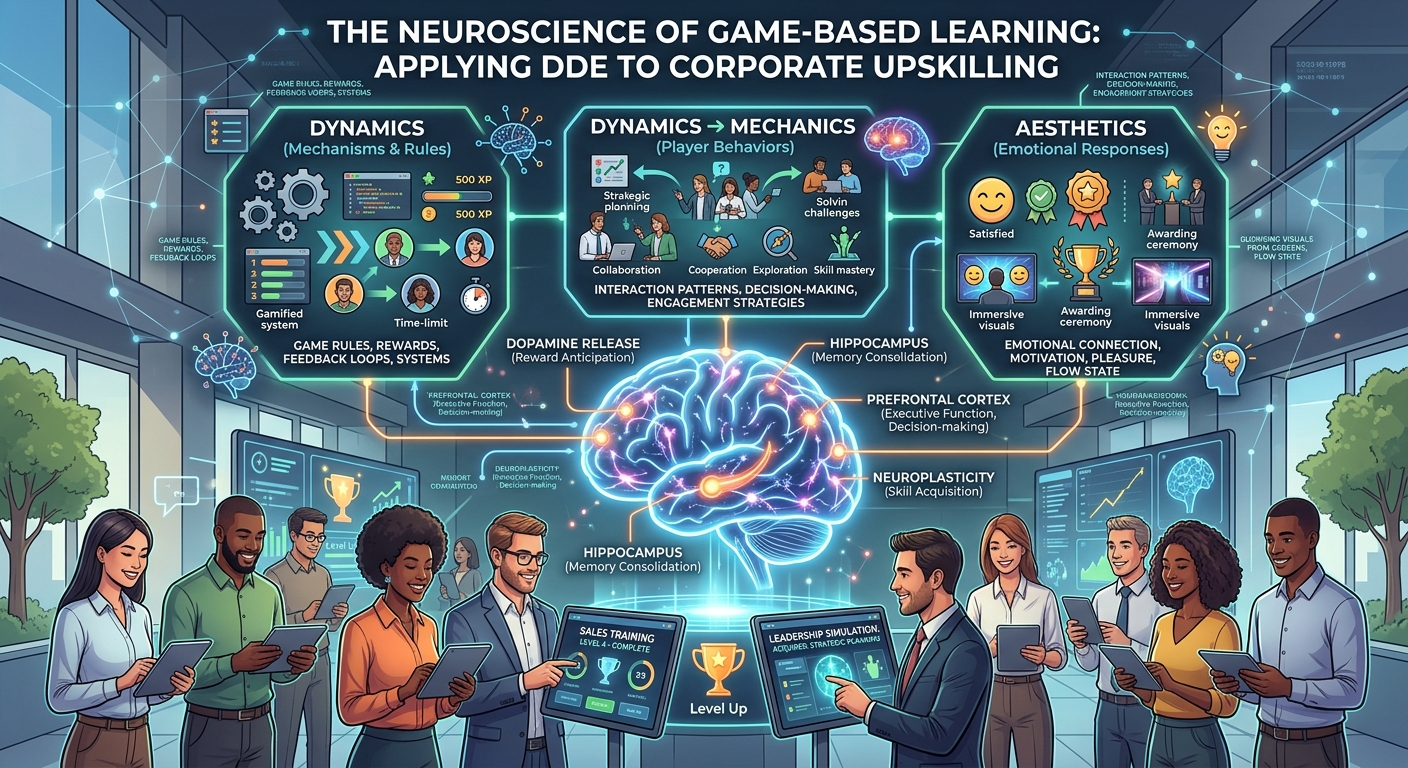
The Neuroscience of Game-Based Learning: Applying DDE to Corporate Upskilling
In today's rapidly evolving corporate landscape, the imperative for continuous upskilling and reskilling is undeniable. Yet, traditional training methods often fall short, struggling to capture attention, foster retention, and drive real behavioral change. Learning and Development (L&D) leaders – from VPs and Directors to senior managers – are constantly seeking innovative solutions. What if the secret to truly effective corporate upskilling lay not just in new technologies, but in a profound understanding of how the human brain learns best?
Enter game-based learning, a methodology that, when coupled with the neuroscience-backed DDE (Discovery, Design, Experience) model, offers a powerful paradigm shift. This approach leverages the brain's natural inclination towards play, challenge, and reward, transforming compliance, sales, finance, healthcare, retail, and even high-stakes industrial training into engaging and impactful experiences.
Decoding the DDE Model: A Brain-Centric Approach to Learning
The DDE model provides a structured framework for creating learning experiences that are inherently aligned with cognitive processes. It moves beyond rote memorization, fostering deeper understanding and practical application.
Discovery: Igniting Curiosity and Engagement
The "Discovery" phase taps into the brain's natural quest for novelty and pattern recognition. It’s about creating an initial spark, an intrigue that compels learners to explore. In game-based learning, this often involves presenting a scenario, a problem, or a mystery that requires active investigation. From a neuroscientific perspective, novel stimuli trigger the release of dopamine, a neurotransmitter associated with motivation and reward, priming the brain for learning.
Consider the challenge: How can artificial intelligence personalize learning journeys to cater to individual curiosity drivers? By analyzing learner interactions, AI can adapt game narratives and challenges, ensuring each individual's discovery phase is uniquely engaging and relevant to their current skill level and learning preferences. This fosters an intrinsic motivation that traditional passive learning struggles to achieve.
Design: Structuring for Optimal Cognitive Load and Retention
Once curiosity is piqued, the "Design" phase focuses on structuring the learning content in a way that is digestible, logical, and supports memory consolidation. This involves presenting information in manageable chunks (microlearning principles are key here), providing clear feedback, and guiding the learner through increasing levels of complexity.
From a neuroscientific standpoint, effective design minimizes cognitive overload, allowing the prefrontal cortex to process information efficiently. Well-designed games break down complex tasks into smaller, achievable goals, mirroring the brain's preferred method of processing new information and building schema. An effective Microlearning LMS can be instrumental in delivering content designed for optimal cognitive assimilation.
Experience: Activating Neural Pathways for Lasting Impact
The "Experience" phase is where active engagement and practical application cement learning. This is the heart of game-based learning – hands-on practice, decision-making under simulated pressure, and real-time consequences. This phase actively engages multiple brain regions, strengthening neural connections and facilitating long-term potentiation, the process by which synapses become stronger over time.
Interactive simulations, role-playing, and problem-solving scenarios within a game provide rich sensory input and emotional connection, both powerful enhancers of memory. This experiential learning isn't just about 'doing'; it's about doing, reflecting, and adapting, mirroring real-world challenges and fostering adaptive expertise. A Gamified LMS is designed to excel in delivering these immersive experiences.
The Neuroscience Behind Game-Based Learning: Why it Works
Game-based learning isn't just "fun"; it's fundamentally aligned with how our brains are wired to acquire and retain information.
- Dopamine and Reward Pathways: Games are masters of delivering immediate feedback and rewards (points, badges, level-ups). This triggers dopamine release, reinforcing positive behaviors and making the learning process inherently motivating and enjoyable. This neurological reward system is crucial for sustained engagement.
- Prefrontal Cortex and Problem Solving: Strategic games demand critical thinking, planning, and decision-making, actively engaging the prefrontal cortex – the brain's executive control center. This strengthens problem-solving skills and executive functions vital for corporate roles.
- Hippocampus and Memory Consolidation: By embedding learning within a narrative or contextual environment, games activate the hippocampus, crucial for forming and consolidating long-term memories. Learning by doing in a simulated environment provides stronger memory traces than passive information consumption.
- Neuroplasticity: The brain's ability to reorganize itself by forming new neural connections is called neuroplasticity. Game-based learning, with its emphasis on practice, adaptation, and skill development, actively promotes neuroplasticity, allowing employees to genuinely rewire their brains for new competencies.
Applying DDE to Corporate Upskilling Across Industries
The DDE framework, powered by game-based learning principles, offers unprecedented potential for corporate upskilling across diverse sectors.
Compliance & Risk-focused Training
Often perceived as dull and mandatory, compliance training benefits immensely from DDE. Imagine a game where employees navigate ethical dilemmas, identify Risk-focused Training scenarios, and experience the consequences of their choices in a safe simulation. This fosters active understanding rather than passive acknowledgment, crucial for industries like banking, finance, insurance, and healthcare where adherence to regulations is paramount.
A pertinent question for L&D leaders might be: What is the most effective way to measure ROI for game-based upskilling programs in high-stakes compliance environments? By tracking decision-making accuracy within simulations, completion rates, and post-training behavioral changes, organizations can quantify the impact.
Sales Training & Product Knowledge
For sales teams, role-playing simulations, virtual product demos, and strategic negotiation games can revolutionize training. DDE enables salespeople to discover customer needs, design tailored pitches, and experience the impact of their communication styles. An AI Powered Authoring Tool can help rapidly develop these interactive scenarios, personalizing them for different product lines or market segments in industries like retail, pharma, and even oil & gas.
Banking, Finance & Insurance
Complex financial concepts, risk assessment, and customer service scenarios can be distilled into engaging games. Employees can discover new financial products, design personalized solutions for virtual clients, and experience the outcomes of their investment recommendations. This approach improves financial literacy and decision-making skills.
L&D professionals in these sectors might ask: What specific benefits can game-based learning offer for improving financial literacy in employees across geographically dispersed teams? Games provide a consistent, interactive learning experience that transcends location, ensuring equitable access to high-quality training.
Pharma & Health Care
From mastering new surgical procedures to understanding complex drug interactions, game-based learning offers safe environments for practice. Medical simulations allow healthcare professionals to discover protocols, design treatment plans, and experience patient outcomes, enhancing critical thinking and procedural accuracy.
Retail & Hospitality
Customer service excellence, inventory management, and operational efficiency can be honed through simulated environments. Employees discover best practices, design service interactions, and experience customer satisfaction or challenges, leading to improved performance on the front lines.
Oil & Gas and Mining
Safety training, emergency response, and equipment operation can be profoundly enhanced through immersive simulations. The DDE model allows professionals to discover hazardous conditions, design safe operational procedures, and experience the consequences of errors without real-world risk, fostering a culture of safety.
A critical consideration here: Can AI analyze employee performance within game-based modules to identify skill gaps specific to operational roles in resource extraction? Absolutely. Advanced learning management software can track in-game decisions and outcomes, providing granular insights into individual and team competencies.
Integrating Advanced Learning Technologies for DDE Success
Implementing a neuroscience-backed DDE model for corporate upskilling requires robust technological infrastructure. A modern LMS (learning management system) is no longer just a content repository; it's a dynamic ecosystem.
Leading solutions function as a comprehensive learning content management system, offering features like a Gamified LMS to host interactive content, and an Adaptive Learning engine to personalize pathways based on learner performance. The best learning management software provides the flexibility of a cloud based learning management system, ensuring accessibility for global workforces.
For enterprise learning management, an advanced MaxLearn LMS offers not only a powerful LCMS but also analytics to track engagement and mastery, ensuring that the investment in innovative learning solutions translates into measurable business impact.
L&D leaders might ponder: Where can organizations find innovative learning management solutions that seamlessly integrate game-based learning with adaptive pathways? The answer lies in platforms designed from the ground up to support modern learning theories and deliver an engaging, effective learning management system experience.
Conclusion
The convergence of neuroscience, the DDE model, and game-based learning offers L&D leaders a powerful toolkit for addressing the complex demands of corporate upskilling. By understanding how the brain learns and leveraging technology to create engaging, experiential, and personalized pathways, organizations can move beyond merely training employees to genuinely transforming their capabilities. This isn't just about making learning fun; it's about making learning profoundly effective, driving retention, enhancing performance, and ultimately, building a more skilled, adaptable, and resilient workforce for the future.


Comments
Post a Comment