The Future of Adaptive Upskilling: Integrating Cognitive Science with Enterprise AI
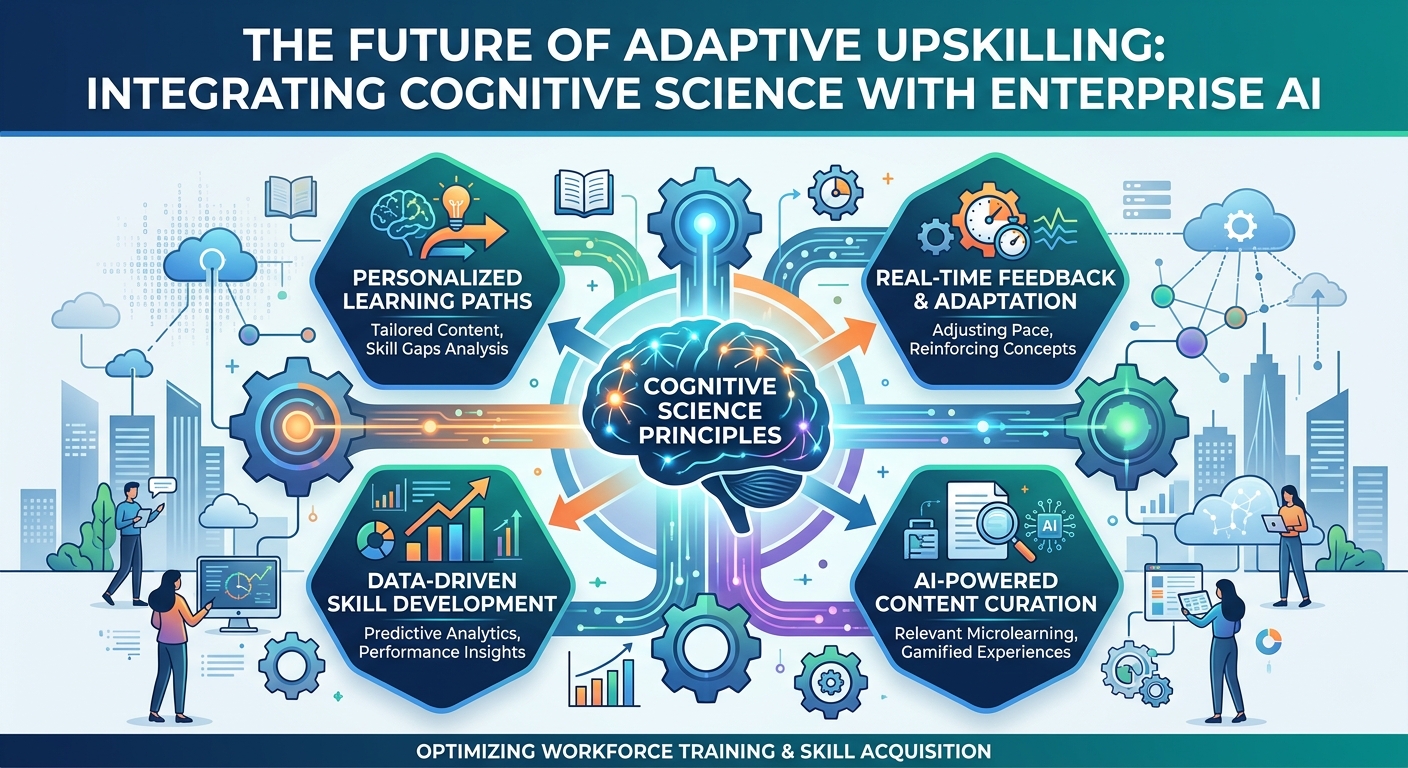
The Future of Adaptive Upskilling: Integrating Cognitive Science with Enterprise AI
The pace of technological change is relentless, constantly reshaping industries and demanding new skill sets from employees. For Vice Presidents, Directors, Senior Managers, and Managers of L&D, the challenge isn't just about training; it's about building a workforce that can adapt, innovate, and thrive in an ever-evolving landscape. Traditional learning methods often fall short, struggling with scalability, personalization, and measurable impact. Enter the powerful synergy of cognitive science and Enterprise AI – a combination poised to revolutionize adaptive upskilling, making learning more efficient, engaging, and effective across all sectors, from Compliance and Sales to Healthcare and Oil & Gas.
The Upskilling Imperative in a Dynamic World
The imperative to upskill is no longer a strategic option but a fundamental business necessity. Organizations across Banking, Finance, Insurance, Retail, Pharma, and Hospitality are grappling with skill gaps exacerbated by automation, digital transformation, and shifting market demands. Employees need to learn faster, retain more, and apply knowledge in increasingly complex scenarios. Without an agile and personalized approach, companies risk falling behind, losing talent, and failing to meet their strategic objectives. The question for many L&D leaders isn't just 'how do we train?' but 'how do we foster continuous, adaptive growth at scale?'
Cognitive Science: The Human Blueprint for Learning
At its core, effective learning must align with how the human brain actually works. Cognitive science provides the bedrock principles for understanding memory, attention, motivation, and problem-solving. It teaches us the importance of:
- Spaced Repetition: Distributing learning over time to enhance long-term retention.
- Active Recall: Retrieving information from memory rather than passively re-reading it, strengthening neural pathways.
- Interleaving: Mixing different topics or skills during practice to improve discrimination and transfer of learning.
- Personalized Feedback: Tailored, timely, and constructive information that guides learners towards improvement.
- Emotional Engagement: Leveraging intrinsic motivation and positive emotions to make learning more meaningful and memorable.
Applying these principles is vital, but scaling them across a large enterprise using manual methods is incredibly difficult. This is where Enterprise AI becomes indispensable.
Enterprise AI: The Scalable Engine for Personalization
Enterprise AI offers the computational power to apply cognitive science principles at an unprecedented scale and level of personalization. When integrated into a robust LMS or learning content management system, AI can:
- Personalize Learning Paths: By analyzing performance data, learning styles, career goals, and role requirements, AI can dynamically recommend relevant content and learning activities. How does AI personalize learning paths? It continuously assesses a learner's progress, identifies knowledge gaps, and adapts the curriculum in real-time.
- Curate and Create Content: AI algorithms can sift through vast amounts of information to identify relevant resources, or even assist in generating new, high-quality learning content tailored to specific needs. An AI Powered Authoring Tool can significantly reduce the time and effort involved in creating engaging material for an LCMS.
- Predict Performance and Identify Skill Gaps: Using predictive analytics, AI can forecast future skill needs and proactively identify individuals or teams at risk of developing skill deficiencies, allowing for timely intervention. Can AI identify skill gaps across a global workforce? Yes, by aggregating data from various regions, performance reviews, and job roles, an enterprise learning management system can highlight universal and localized skill deficiencies, regardless of geographic location.
- Adaptive Assessment: AI can create assessments that adjust difficulty based on a learner's responses, providing a more accurate measure of mastery and focusing practice where it’s most needed.
What specific AI technologies are most impactful for upskilling? Machine learning for recommendations, natural language processing for content analysis, predictive analytics for future skill needs, and intelligent tutoring systems are all transforming how organizations approach talent development.
The Synergy: Bridging the Gap
The true power lies in integrating these two fields. AI, informed by cognitive science, moves beyond simple automation to truly intelligent learning solutions. Imagine a learning management system that doesn't just deliver content, but understands *how* each individual learns best.
This integration manifests in several key areas:
- Intelligent Tutoring Systems: AI provides personalized guidance, much like a human tutor, but at scale. It can detect misconceptions, offer targeted explanations, and provide practice problems tailored to individual weaknesses, ensuring principles like personalized feedback are consistently applied.
- Adaptive Learning Pathways: Leveraging cognitive principles like spaced repetition and active recall, AI dynamically adjusts content delivery based on a learner's progress and forgetting curve. This ensures optimal retention and application. Adaptive Learning isn't just about changing difficulty; it's about optimizing the learning experience for the individual brain.
- Engagement through Gamified LMS: AI can personalize gamified elements, rewards, and challenges to maintain learner motivation, drawing from cognitive science insights into reinforcement and intrinsic drive.
- Sentiment Analysis and Emotional Feedback: AI can analyze learner interactions to gauge engagement and frustration, allowing the learning management software to adjust content or intervention strategies to maintain optimal emotional states for learning.
Practical Applications Across Industries
The combined force of cognitive science and Enterprise AI holds immense promise for diverse industries:
- Compliance & Finance: For regulatory training, an LMS learning management system powered by AI can ensure personalized modules for specific roles, test for comprehension using adaptive assessments, and provide Risk-focused Training that adapts to evolving threats. This ensures that critical knowledge for Banking, Finance, and Insurance sectors is not just consumed, but deeply understood and retained.
- Sales & Retail: Sales teams need dynamic product knowledge and objection handling skills. An AI Powered Authoring Tool can rapidly update sales training content, delivered via a Microlearning LMS that provides bite-sized, adaptive modules for product features, competitor analysis, and customer service scenarios.
- Healthcare & Pharma: Medical professionals require continuous updates on treatments, equipment, and protocols. AI can tailor CPD paths, simulate complex scenarios, and ensure high-stakes knowledge transfer with adaptive feedback loops. In Pharma, it supports understanding complex drug mechanisms and regulatory adherence.
- Hospitality: AI can personalize training for customer service excellence, cultural sensitivity, and operational procedures, ensuring staff are always ready to deliver exceptional guest experiences.
- Oil & Gas & Mining: Safety is paramount. AI-driven adaptive training can simulate hazardous environments, reinforce critical safety protocols through spaced repetition, and analyze incident data to proactively address weak spots in training, enhancing overall enterprise learning management for high-risk operations.
Key Components of an Adaptive Upskilling Ecosystem
To fully realize this future, organizations need a robust ecosystem that includes:
- A cloud based learning management system capable of integrating advanced AI functionalities.
- Intelligent learning content management system for dynamic content creation and curation.
- An Adaptive Learning engine that leverages cognitive science principles.
- Rich data analytics to track individual and organizational learning progress.
- A commitment to continuous improvement and ethical AI deployment.
What are the benefits of a cloud based learning management system that incorporates AI? Scalability, accessibility, real-time data insights, enhanced personalization, and continuous updates without on-premise infrastructure are just a few, all contributing to a superior MaxLearn LMS experience.
Challenges and Considerations
While the promise is immense, L&D leaders must also navigate challenges. Data privacy and security are paramount, requiring robust protocols within any learning management solutions. Ethical AI deployment ensures fairness and avoids bias. Human oversight remains crucial; AI enhances, but does not replace, the strategic vision and empathy of L&D professionals. Finally, ensuring the quality and pedagogical soundness of AI-generated or curated content is vital.
The Future is Now
The integration of cognitive science and Enterprise AI is not a distant dream; it's the present and future of adaptive upskilling. For L&D leaders looking to build a future-ready workforce, investing in a sophisticated LMS learning management system that intelligently applies these principles will be the decisive factor in driving business success and cultivating a culture of continuous learning and growth.


Comments
Post a Comment