The Executive Blueprint to Microlearning Gamification Using the DDE Framework
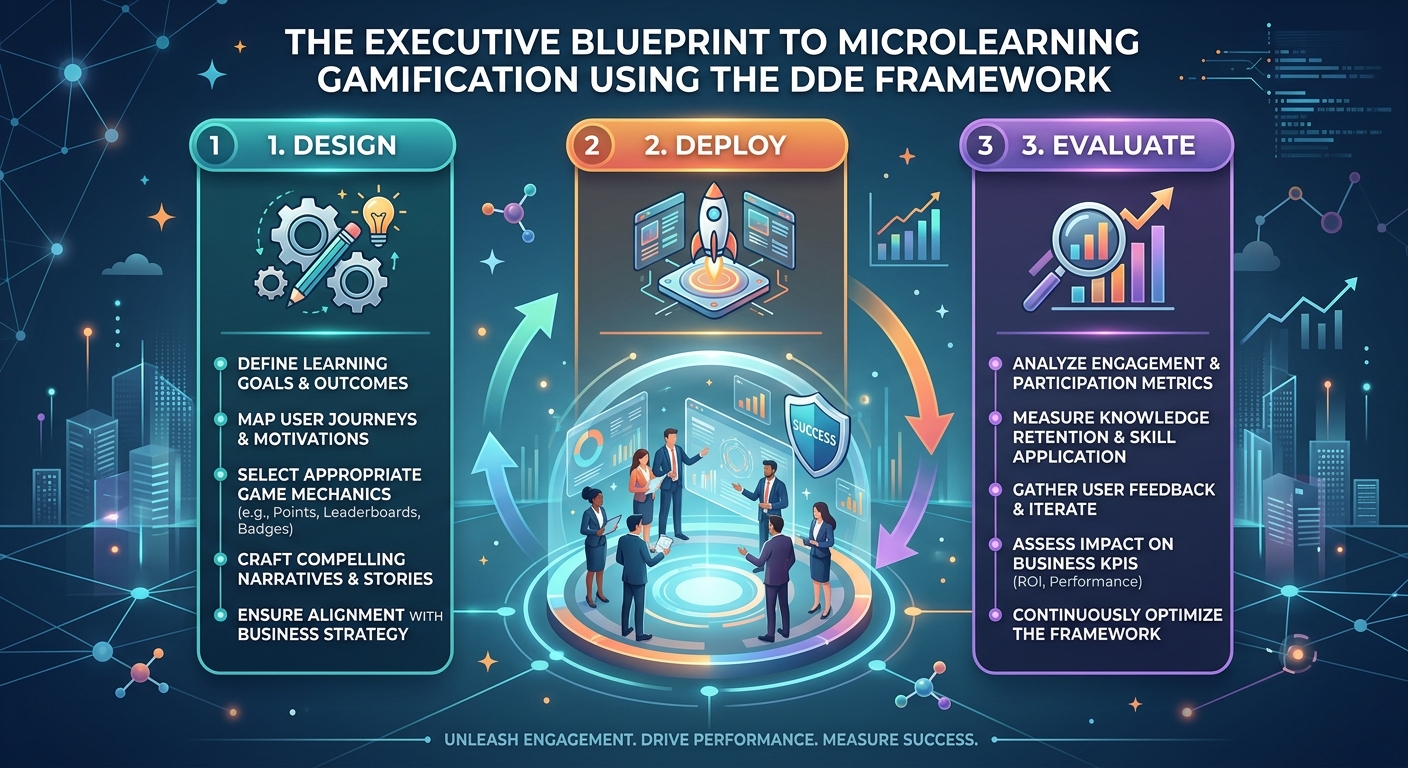
The Executive Blueprint to Microlearning Gamification Using the DDE Framework
In today's fast-paced corporate environment, traditional lengthy training sessions are often met with dwindling engagement and limited knowledge retention. Vice Presidents, Directors, and Senior Managers of Learning & Development are constantly seeking innovative strategies to empower their workforce, drive performance, and ensure compliance across diverse industries like Banking, Pharma, Retail, and Oil and Gas. The answer lies in a strategic fusion of microlearning and gamification, meticulously orchestrated through the DDE Framework: Discover, Design, and Evaluate.
This article provides an executive blueprint for L&D leaders to harness the power of this trifecta, ensuring a dynamic, effective, and measurable learning ecosystem that directly impacts business outcomes.
Understanding the DDE Framework
The DDE Framework – Discover, Design, Evaluate – is a structured, cyclical approach to instructional design and strategic planning. It moves beyond linear development models, advocating for continuous improvement and alignment with organizational goals. For L&D leaders, applying DDE to microlearning gamification provides a robust methodology for developing impactful, engaging, and measurable learning experiences.
Discover: Uncovering Learning Needs
The initial Discover phase is critical for laying a solid foundation. It involves a deep dive into organizational objectives, performance gaps, and learner profiles to identify precisely what training is needed and why.
- Strategic Alignment: Begin by aligning learning initiatives with overarching business goals. What are the key performance indicators (KPIs) that L&D can influence? For instance, in sales, it might be reducing sales cycle time; in compliance, it’s ensuring 100% adherence to new regulations.
- Audience Analysis: Understand your learners – their roles, prior knowledge, preferred learning styles, and technological access. Are they frontline retail staff, high-level financial analysts, or field engineers in mining? Their context dictates the microlearning approach.
- Data-Driven Insights: Utilize existing performance data, surveys, and stakeholder interviews to pinpoint specific skill gaps and knowledge deficits.
Executive Insight: How can L&D leaders pinpoint the most critical knowledge gaps across diverse global teams efficiently?
By leveraging advanced analytics tools, L&D can analyze performance data, skill inventories, and even insights from communication platforms to identify common pain points and learning needs that transcend geographical boundaries. This data-driven approach helps prioritize training initiatives where they will have the greatest impact, ensuring resources are allocated effectively, whether for a global sales team or a distributed healthcare network.
Design: Crafting Engaging Experiences
With a clear understanding of needs, the Design phase focuses on creating compelling learning content and experiences using microlearning and gamification principles. This is where innovation meets instructional effectiveness.
Microlearning Integration
Microlearning breaks down complex topics into bite-sized, digestible modules, typically 3-7 minutes long. This format is perfect for busy professionals in industries like hospitality or finance who need to learn on the go or quickly refresh specific skills.
- Focus and Brevity: Each module addresses a single learning objective.
- Accessibility: Content should be easily accessible on any device, anywhere. A robust Microlearning LMS is essential for this.
- Variety: Utilize diverse formats like short videos, infographics, quizzes, and interactive simulations.
Gamification Mechanics
Gamification applies game-like elements to non-game contexts to boost engagement, motivation, and retention. When integrated with microlearning, it transforms mundane training into an exciting journey.
- Points and Rewards: Acknowledge progress and achievement.
- Badges and Certificates: Offer digital recognition for mastering skills or completing modules.
- Leaderboards: Foster healthy competition among individuals or teams.
- Challenges and Quests: Structure learning paths as engaging narratives or missions.
- Levels and Progress Bars: Visually indicate advancement, encouraging learners to continue.
A sophisticated Gamified LMS can seamlessly integrate these elements, providing a rich, interactive experience. For example, a sales team could earn points for completing product knowledge micro-modules, unlock "expert" badges, and climb a leaderboard based on their learning achievements, directly correlating to improved sales performance.
Executive Insight: What's the most effective way to personalize learning paths for thousands of employees with varied roles and skill levels?
Implementing Adaptive Learning capabilities, often powered by AI, is key. This technology tailors content delivery and gamified challenges based on an individual's progress, performance, and preferences. For instance, an employee struggling with a specific compliance topic might receive additional micro-modules and challenges, while another who excels moves on to advanced material. Utilizing an AI Powered Authoring Tool can also expedite the creation of diverse, personalized content, ensuring relevance for every learner within your enterprise learning management system.
Evaluate: Measuring Impact and ROI
The Evaluate phase closes the DDE loop, focusing on assessing the effectiveness of the designed learning experiences and demonstrating tangible return on investment (ROI). This is crucial for securing continued executive buy-in and optimizing future initiatives.
Metrics That Matter
Beyond simple completion rates, L&D leaders must focus on metrics that reflect true impact:
- Knowledge Retention: How well do learners remember and apply what they've learned over time?
- Behavioral Change: Are employees demonstrating new skills or modified behaviors in their roles?
- Business Outcomes: What is the direct impact on KPIs such as productivity, customer satisfaction, sales figures, or compliance adherence?
A robust LMS provides comprehensive analytics dashboards that track learner progress, engagement with gamified elements, and performance improvements. These insights are vital for continuous improvement.
Executive Insight: How can L&D accurately quantify the return on investment for new training initiatives, especially across distributed teams and different compliance requirements?
By leveraging AI-driven analytics within your learning management software, L&D can correlate learning engagement and performance data with tangible business metrics. For a global corporation, this means analyzing how microlearning gamification impacts sales quotas in different regions, or how quickly new compliance protocols are adopted across various departments. AI can provide nuanced insights into impact, even for specific regional or departmental cohorts. This data not only proves the value of the investment but also identifies areas where Risk-focused Training can be further refined to mitigate specific organizational vulnerabilities.
Strategic Implementation for L&D Leaders
Adopting microlearning gamification via the DDE Framework requires strategic leadership. L&D VPs, Directors, and Managers must:
- Champion the Vision: Secure buy-in from senior leadership by clearly articulating the benefits and demonstrating potential ROI.
- Invest in Technology: Choose a sophisticated learning content management system (LCMS) that supports both microlearning and advanced gamification features. A cloud based learning management system offers scalability and flexibility for global operations. MaxLearn LMS, for instance, provides comprehensive learning management solutions designed for enterprise learning management needs.
- Foster a Culture of Learning: Encourage continuous learning and development by making it an engaging and rewarding part of the employee experience.
- Start Small, Scale Big: Pilot programs can prove efficacy and gather valuable feedback before a full-scale rollout across the organization.
Conclusion
The DDE Framework offers a pragmatic and powerful blueprint for L&D leaders to revolutionize corporate training. By strategically Discovering needs, creatively Designing engaging microlearning gamification experiences, and rigorously Evaluating their impact, organizations can cultivate a workforce that is not only highly skilled and compliant but also deeply engaged and motivated. This isn't just about training; it's about building a future-ready enterprise capable of thriving in an ever-evolving market. Embrace this executive blueprint, and lead your organization to unparalleled learning success.


Comments
Post a Comment