The Enterprise Leader's Guide to Gamification ROI via the DDE Framework
```html
The Enterprise Leader's Guide to Gamification ROI via the DDE Framework
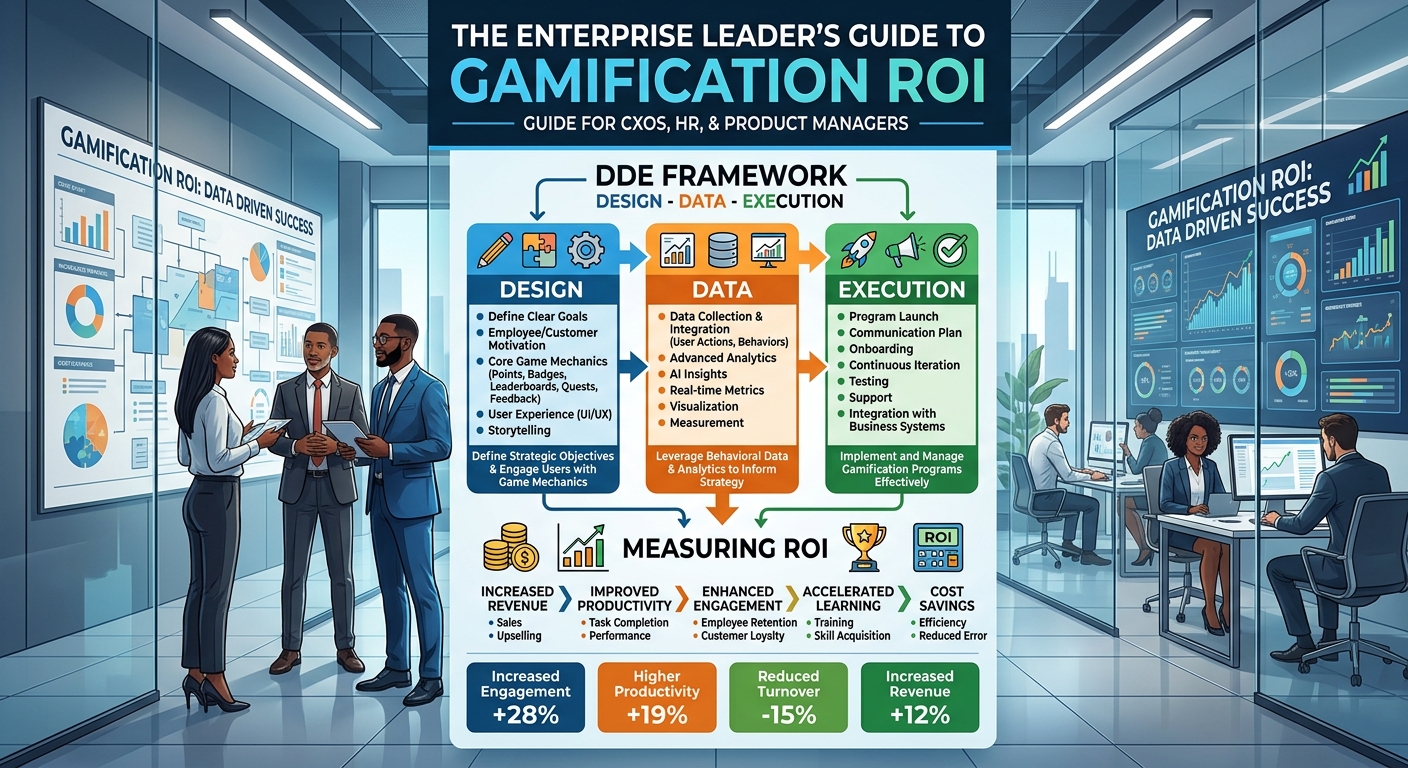
In today's dynamic enterprise landscape, where talent development directly impacts bottom-line results, Learning & Development leaders are constantly seeking innovative strategies to boost engagement, knowledge retention, and ultimately, performance. Gamification has emerged as a powerful solution, transforming mundane training into immersive, motivating experiences. However, the critical question often remains: How do we prove its return on investment (ROI)? This guide demystifies the process, introducing the robust Design, Deploy, Evaluate (DDE) Framework – your blueprint for achieving measurable gamification ROI.
The DDE Framework, when implemented with a sophisticated Microlearning LMS, provides a structured approach to not only design engaging learning experiences but also to meticulously track their impact, ensuring that your gamification initiatives translate into tangible business value across diverse sectors like Compliance, Sales, Banking, Finance, Insurance, Retail, Pharma, Healthcare, Hospitality, Oil and Gas, and Mining.
Cracking the Code: What is the DDE Framework?
The DDE Framework offers a comprehensive lifecycle for enterprise learning initiatives, ensuring that every gamified program is strategic, well-executed, and effectively measured.
1. Design: Strategizing for Success
The foundation of any successful gamified learning program lies in its design. This phase is about meticulous planning, aligning learning objectives with organizational goals, and crafting an experience that resonates with your specific audience.
-
Define Clear Objectives: What specific behaviors do you want to change? What knowledge gaps need to be filled? For instance, in banking, it might be reducing compliance errors; in sales, it could be increasing product knowledge leading to higher conversion rates.
-
Understand Your Audience: A personalized approach is key. Consider the demographics, existing skill sets, and motivational triggers of your employees. This informs the choice of game mechanics, narratives, and reward systems.
-
Select Appropriate Game Mechanics: Points, badges, leaderboards, challenges, progress bars, virtual rewards – these are the building blocks. An Adaptive Learning strategy can ensure the difficulty scales with individual learner progress, keeping them continually challenged and engaged. Leveraging an AI Powered Authoring Tool can significantly streamline the creation of diverse and relevant content tailored to these mechanics.
-
Align with Business Goals: Every gamified element should tie back to a measurable business outcome. For compliance training in Pharma, it means reducing regulatory violations; for retail, it might mean improved customer service scores.
2. Deploy: Seamless Execution and Engagement
Once designed, the program needs to be deployed effectively, ensuring maximum reach, accessibility, and user engagement. A robust learning management system (LMS) is crucial here.
-
Leverage a Powerful Gamified LMS: A dedicated Gamified LMS is non-negotiable. It provides the infrastructure to host your content, track progress, manage leaderboards, and deliver rewards. Features like intuitive navigation, mobile accessibility, and social learning capabilities are paramount for sustained engagement.
-
Communicate and Promote: Launching a gamified program requires effective communication. Highlight the benefits, explain the rules, and foster a sense of excitement and healthy competition among participants.
-
Monitor and Iterate: The deployment phase isn't static. Continuously monitor user activity, gather feedback, and be prepared to make adjustments to optimize the experience. This agility ensures the program remains fresh and relevant.
3. Evaluate: Measuring Impact and ROI
This is where the rubber meets the road – proving the tangible value of your gamification investment. The evaluation phase quantifies the impact of your efforts, directly linking learning outcomes to business performance.
-
Track Key Metrics: Beyond completion rates, look at knowledge retention scores, skill application in real-world scenarios, and changes in employee behavior. A modern learning content management system will provide comprehensive analytics.
-
Connect to Business Outcomes: For a financial institution, gamified Risk-focused Training should lead to a reduction in audit findings. For a sales organization, increased product knowledge from gamified modules should correlate with higher sales figures or faster deal closures.
-
Calculate ROI: Quantify the improvements. Examples include reduced error rates, increased productivity, lower employee turnover (due to improved engagement and skill development), and decreased training delivery costs. Compare these gains against the investment in the gamified program and the underlying learning management software.
The AI Advantage: Elevating Gamification ROI
Artificial intelligence is not just a buzzword; it's a transformative force that significantly amplifies the effectiveness and measurable return of gamified learning programs, providing unparalleled insights and personalization.
How does intelligent technology enhance personalized gamified learning experiences?
AI can dynamically adapt the learning journey for each individual. Imagine an Gamified LMS that uses machine learning to analyze a learner's performance, preferences, and even emotional state to suggest the next challenge, adjust difficulty, or offer specific remedial content. This hyper-personalization, delivered through an Microlearning LMS, ensures that content is always relevant and engaging, whether for new hires in hospitality or seasoned engineers in oil and gas. It moves beyond one-size-fits-all, optimizing the learning path to maximize individual skill development and motivation.
Where can advanced analytics optimize gamification strategies for specific organizational needs?
Advanced analytics, powered by AI, can uncover hidden patterns and predict outcomes, allowing L&D leaders to fine-tune their gamification strategies. For example, AI can identify which game mechanics lead to the highest engagement for sales teams in specific regions, or which types of challenges are most effective in improving compliance understanding within the pharmaceutical industry. By analyzing vast amounts of learner data, an AI Powered Authoring Tool can even suggest content adjustments or new game elements that are statistically likely to boost desired behaviors. This data-driven optimization ensures resources are allocated to the most impactful aspects of the gamified program.
What are the measurable impacts of artificial intelligence on proving gamification's return on investment?
AI directly enhances ROI measurability by providing deeper, more accurate insights. It can automate the correlation between gamified performance and real-world business metrics, such as linking higher badge attainment in retail training to reduced checkout errors, or superior leaderboard positions in finance training to fewer customer complaints. AI-driven predictive analytics can even forecast potential compliance risks or sales performance trends based on learning engagement, allowing for proactive interventions. This precise data, automatically gathered and analyzed by a sophisticated learning management system, makes the ROI of gamification undeniable to stakeholders.
Gamification Across Industries: Tailored Success
The versatility of gamification, especially when supported by a robust cloud based learning management system, makes it applicable and highly effective across a wide array of industries:
-
Compliance & Regulation (Banking, Finance, Pharma, Healthcare, Oil & Gas, Mining): Transform dry regulatory content into interactive scenarios, quizzes, and simulations. This boosts understanding and adherence, significantly reducing audit risks and costly violations. Risk-focused Training becomes more engaging and memorable.
-
Sales & Retail: Drive product knowledge mastery, improve sales techniques, and enhance customer service skills through competitive challenges, virtual sales pitches, and role-playing scenarios. This directly impacts revenue growth and customer satisfaction.
-
Hospitality: Train staff on service standards, operational procedures, and guest interaction protocols with interactive games that simulate real-world situations, leading to improved guest experiences and operational efficiency.
-
Enterprise-wide Onboarding & Skill Development: Accelerate new hire ramp-up time, foster company culture, and continuously upskill existing employees across all departments. An LMS or learning management system that is gamified makes learning a continuous, enjoyable journey.
Your Partner in Gamified ROI: MaxLearn LMS
To truly unlock the power of gamification and achieve a demonstrable ROI through the DDE Framework, you need an enterprise learning management solution that integrates seamlessly into your organizational goals. MaxLearn LMS is purpose-built for the modern enterprise, offering a comprehensive suite of features designed to maximize engagement and prove value.
As a leading learning management system, MaxLearn provides a fully Gamified LMS experience, robust analytics for the 'Evaluate' phase, and supports Adaptive Learning paths that personalize content for every user. With an AI Powered Authoring Tool and a focus on Microlearning LMS delivery, MaxLearn enables L&D leaders to efficiently design, deploy, and evaluate high-impact training. It's more than just a learning management software; it's a strategic partner in your journey to quantifiable learning success. MaxLearn represents the forefront of learning management solutions, offering an LCMS that truly empowers your enterprise learning.
The Future of Enterprise Learning is Gamified
For Vice Presidents, Directors, and Senior Managers in L&D, the DDE Framework offers a clear, actionable path to leveraging gamification not just as an engagement tool, but as a strategic investment with significant, measurable ROI. By meticulously designing engaging experiences, deploying them through a powerful lms learning management system like MaxLearn, and rigorously evaluating their impact, you can transform your organization's learning culture and drive tangible business outcomes. Embrace the DDE Framework and let gamification elevate your enterprise to new heights of performance and profitability.
```


Comments
Post a Comment