The Business Case for Multimodal Microlearning: Boosting Skill Application and Knowledge Retention
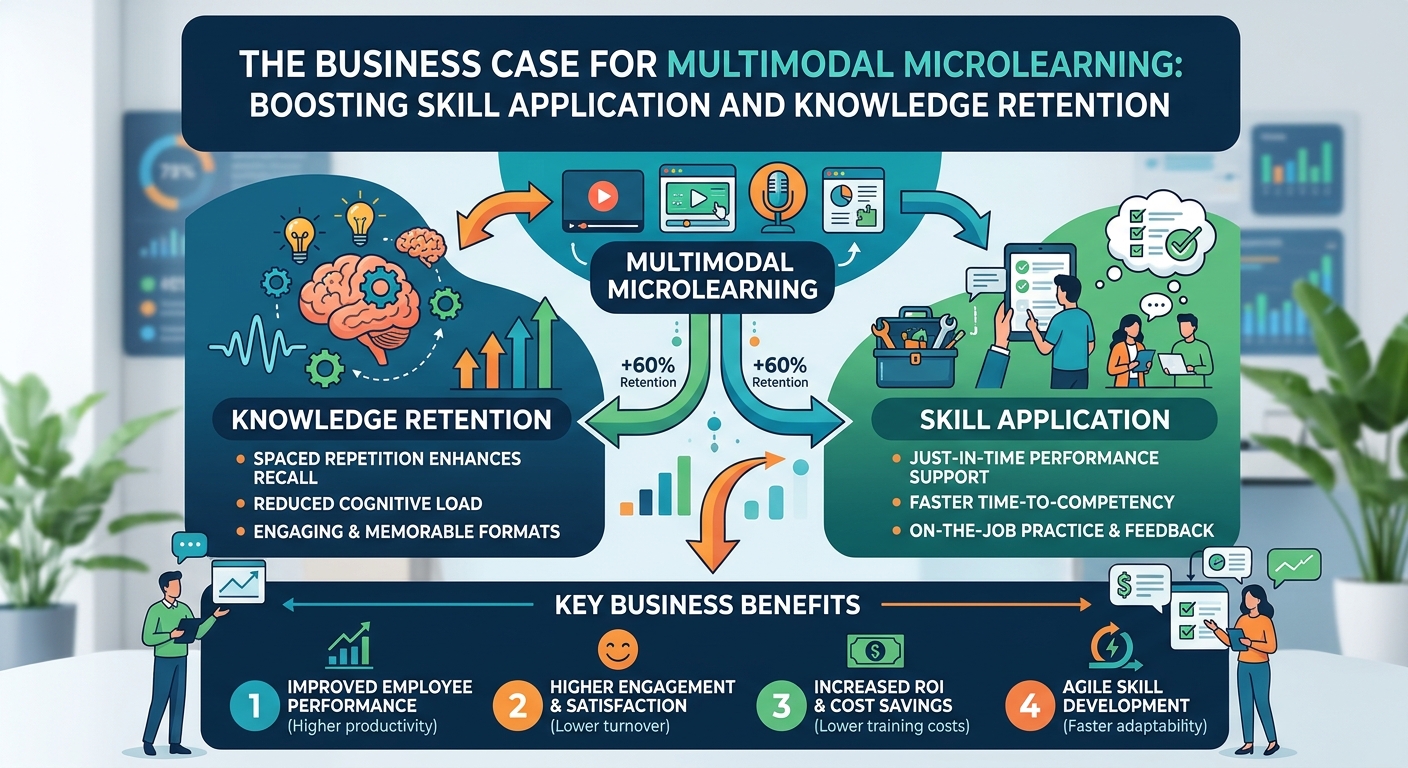
The Business Case for Multimodal Microlearning: Boosting Skill Application and Knowledge Retention
In today's fast-paced corporate landscape, the adage "knowledge is power" has evolved to "applied knowledge is power." For Vice Presidents, Directors, and Senior Managers in Learning & Development, the core challenge isn't just delivering content, but ensuring that knowledge truly sticks and translates into tangible skills and improved performance. Traditional, lengthy training modules often struggle with the twin adversaries of the modern learner: shrinking attention spans and the pervasive "forgetting curve." This is where multimodal microlearning emerges as a strategic imperative, offering a powerful, agile, and effective solution to elevate skill application and knowledge retention across your organization.
The imperative to maintain a highly skilled and adaptable workforce has never been greater. Industries ranging from compliance and sales to banking, healthcare, and oil & gas demand continuous learning, often under intense time pressure. The business case for investing in learning management solutions that genuinely deliver measurable impact is undeniable. Multimodal microlearning isn't just another trend; it's a meticulously crafted approach designed to meet these exact needs.
Why Traditional Learning Falls Short
For decades, corporate training relied on long-form courses, annual seminars, and comprehensive e-learning modules. While these formats have their place, their limitations in an era of constant change and information overload are increasingly apparent. Learners often face cognitive overload, leading to superficial engagement and rapid knowledge decay.
The Forgetting Curve & Attention Spans
Hermann Ebbinghaus’s "forgetting curve" illustrates how quickly we forget new information if not reinforced. Within hours, a significant portion of newly acquired knowledge can be lost. Coupled with an average adult attention span reportedly dwindling, expecting employees to absorb and retain vast amounts of information from a single, lengthy session is increasingly unrealistic. This results in a significant gap between learning initiatives and actual skill application, impacting productivity, compliance, and ultimately, the bottom line.
Understanding Multimodal Microlearning
At its heart, multimodal microlearning is a strategic blend of two powerful pedagogical concepts:
Microlearning
This refers to the delivery of learning content in small, focused bursts, typically ranging from 2 to 10 minutes. Each module addresses a single learning objective, making it easy to consume, digest, and recall. This approach respects the learner's time and attention, allowing them to fit learning seamlessly into their daily workflow.
Multimodal
This component involves presenting information through various media formats. Instead of just text, learners engage with videos, interactive simulations, audio snippets, infographics, quizzes, and even short gamified scenarios. This caters to diverse learning styles, enhances engagement, and reinforces concepts through multiple sensory pathways.
The synergy between microlearning and multimodal delivery creates an exceptionally potent learning experience. It's not just about breaking down content; it's about enriching each bite-sized piece with varied, engaging media that solidifies understanding and memory.
The Core Business Benefits
For L&D leaders seeking to demonstrate tangible ROI, multimodal microlearning presents a compelling business case:
Enhanced Knowledge Retention
By delivering information in short, digestible chunks and reinforcing it through varied media, multimodal microlearning directly combats the forgetting curve. Repetition through different formats (e.g., watching a video, then answering a quiz, then reviewing an infographic) embeds knowledge more deeply. Platforms employing Adaptive Learning methodologies can further personalize this reinforcement, ensuring learners revisit areas where they need more support, leading to superior recall and long-term retention.
Improved Skill Application
The ultimate goal of training is improved performance. Microlearning modules can be designed to address specific job-relevant tasks or challenges, providing "just-in-time" learning support. For a sales professional, a 3-minute video on handling a specific objection immediately before a call can be transformative. For a healthcare worker, a quick simulation on a new protocol can reduce errors. This immediacy bridges the knowing-doing gap, allowing learners to apply new skills almost instantly.
Increased Engagement & Motivation
Monotonous, text-heavy training leads to disengagement. Multimodal content is inherently more stimulating, capturing attention through visual, auditory, and interactive elements. The variety keeps learners motivated, and the short duration prevents fatigue. Incorporating elements from a Gamified LMS, such as points, badges, and leaderboards for completing micro-modules, can further boost participation and a sense of achievement.
Reduced Training Time & Costs
While content creation might require an initial investment, the overall training time for employees is significantly reduced. They can learn at their own pace, on their own schedule, minimizing disruption to operational workflows. This efficiency translates into substantial cost savings related to instructor-led training, travel, and lost productivity.
Agility and Adaptability
In industries like compliance, finance, or pharma, regulations and product specifications can change overnight. Multimodal microlearning content is far easier and faster to create, update, and deploy than lengthy courses. This agility ensures your workforce always has access to the most current and relevant information, maintaining competitive edge and compliance integrity.
Better Compliance & Risk Mitigation
For highly regulated sectors, consistent, up-to-date training is not just good practice, it's a legal necessity. Short, targeted modules on specific policies or safety procedures ensure critical information is absorbed and understood, reducing the likelihood of errors, accidents, or non-compliance. Integrating Risk-focused Training within a multimodal microlearning framework allows organizations to proactively address potential vulnerabilities and foster a culture of vigilance.
Implementing Multimodal Microlearning Effectively
To fully harness these benefits, a robust technological infrastructure is essential.
Leveraging Technology
A specialized Microlearning LMS is key. Such a platform should not only host diverse content types but also track learner progress, provide analytics, and offer features conducive to microlearning delivery. Consider how a comprehensive LMS or a cloud based learning management system can serve as the central hub for all your learning content management system needs. An enterprise learning management system that includes an AI Powered Authoring Tool can dramatically speed up the creation and modification of rich, multimodal content. This kind of learning management software simplifies the process, allowing L&D teams to focus on strategy rather than cumbersome development.
For leaders evaluating learning management solutions, the capabilities of the system are paramount. Does the learning management system support rich media? Can it deliver content to mobile devices? Is it an efficient LCMS for managing your vast array of bite-sized modules? A modern MaxLearn LMS is designed to answer these crucial questions.
The Intelligent Advantage
As L&D leaders look to the future, the integration of advanced technology into learning platforms becomes a central consideration. Can learning platforms use machine intelligence to predict individual learning gaps? Absolutely. By analyzing performance data, completion rates, and specific interactions with micro-modules, intelligent systems can pinpoint exactly where a learner struggles, allowing for targeted remediation.
How can advanced algorithms personalize the content delivery for each learner? Imagine a system that recommends specific micro-modules or different media formats based on an individual's past performance, role, and even preferred learning style. This level of personalization dramatically increases engagement and effectiveness.
Will smart learning systems automatically update content based on industry changes? With AI-driven authoring tools, content can be dynamically updated, suggested, and even partially generated to reflect the latest regulations or product features, ensuring your workforce is always armed with the most current information without manual intervention becoming a bottleneck.
Conclusion
The transition to multimodal microlearning is not merely a pedagogical shift; it's a strategic business decision that directly impacts an organization's agility, competitive advantage, and bottom line. For VPs, Directors, and Senior Managers in L&D, embracing this approach means moving beyond traditional metrics to demonstrate tangible improvements in skill application, knowledge retention, and overall employee performance.
By investing in a robust lms learning management system that supports multimodal microlearning, you're not just delivering training; you're building a resilient, knowledgeable, and highly skilled workforce ready to navigate the complexities of today's business environment. It’s time to empower your employees with learning that truly sticks, adapts, and performs.


Comments
Post a Comment