Strategic L&D: Building High-Impact Gamified Modules with DDE Principles
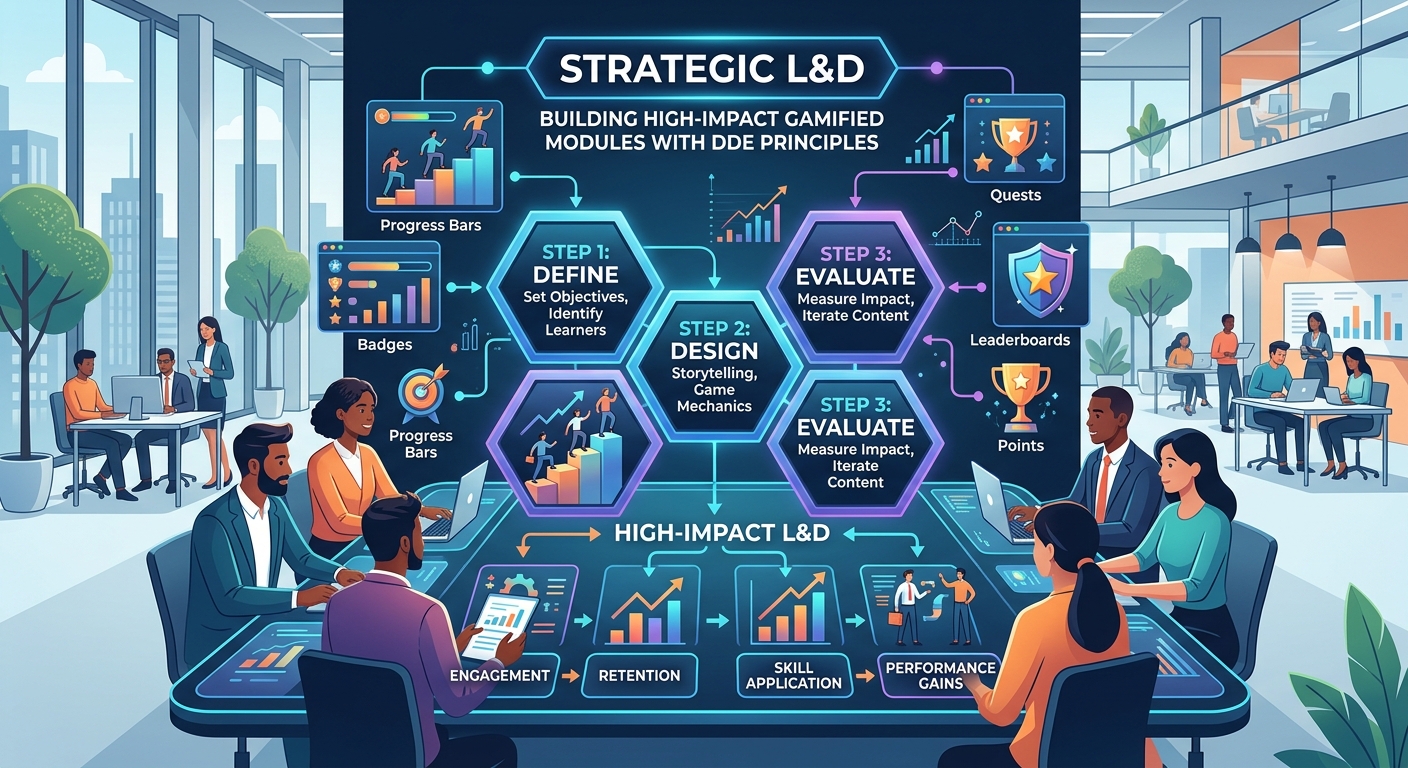
Strategic L&D: Building High-Impact Gamified Modules with DDE Principles
In today’s rapidly evolving corporate landscape, traditional learning and development (L&D) approaches often fall short of meeting the dynamic needs of employees and the strategic objectives of the business. Vice Presidents, Directors, and Senior Managers of L&D are under immense pressure to deliver programs that not only engage but also demonstrably impact performance and foster a culture of continuous learning. This is particularly true across diverse sectors like compliance, sales, banking, finance, insurance, retail, pharma, healthcare, hospitality, oil and gas, and mining, where effective training can directly influence operational efficiency, regulatory adherence, and competitive advantage.
The answer lies in strategic L&D, leveraging innovative methodologies like gamification and robust frameworks such as DDE Principles (Discovery, Design, Evaluation) to create truly high-impact learning modules. When integrated with a sophisticated Microlearning LMS, this approach transforms learning from a passive requirement into an active, engaging, and measurable journey.
The Imperative for Strategic L&D and Gamification
Strategic L&D moves beyond mere training delivery; it aligns learning initiatives directly with organizational goals, fostering competencies that drive business outcomes. However, even the best-designed content struggles with engagement. Here, gamification emerges as a powerful ally. By applying game-like elements and mechanics to non-game contexts, gamification taps into intrinsic human motivators such as achievement, competition, collaboration, and immediate feedback.
For L&D leaders, the objective is clear: how do we build learning experiences that are not only effective but also captivating? A Gamified LMS offers the infrastructure, but the true impact comes from a thoughtful application of strategy. This is where the DDE Principles become invaluable.
Unpacking DDE Principles for Gamified L&D
The DDE Principles — Discovery, Design, and Evaluation — provide a structured, iterative framework for developing learning interventions. Applying these principles to gamified modules ensures that the learning experience is purposeful, well-crafted, and ultimately effective.
1. Discovery: Unearthing Needs and Opportunities
The Discovery phase is foundational. Before a single game element is conceived, L&D leaders must thoroughly understand the learning landscape.
- Performance Gaps & Business Objectives: What specific skills or knowledge gaps are hindering performance? How does addressing these gaps contribute to the company's strategic goals (e.g., increased sales, better compliance, reduced incidents)?
- Audience Analysis: Who are the learners? What are their prior knowledge levels, learning preferences, technological savviness, and motivations? For a global enterprise, understanding cultural nuances is also critical.
- Content Inventory & Existing Resources: What content already exists? Can it be adapted or needs to be created from scratch? This phase might identify the need for an advanced learning content management system to streamline content creation and updates.
- Gamification Opportunities: Where would gamification be most impactful? Is it for complex compliance training, sales onboarding, or leadership development?
By conducting a thorough Discovery, L&D teams ensure that the gamified modules address genuine needs, making them inherently more strategic and impactful.
2. Design: Crafting Engaging Learning Journeys
With a clear understanding from Discovery, the Design phase focuses on translating learning objectives into an engaging, gamified experience. This is where creativity meets pedagogy.
- Learning Objectives & Outcomes: Define specific, measurable learning objectives. How will learners demonstrate mastery?
- Gamification Mechanics & Dynamics: Select appropriate game elements (points, badges, leaderboards, levels, quests, narratives, challenges, avatars) that align with learning objectives and learner profiles. The goal isn't just to add points, but to build a compelling narrative and progression.
- Content Integration: Integrate core learning content seamlessly within the game structure. Microlearning principles often work well here, delivering content in bite-sized, manageable chunks within game levels or challenges.
- User Experience (UX) & Interface (UI): Design an intuitive, visually appealing interface that encourages interaction and reduces cognitive load.
- Feedback Loops & Progression: Build immediate, constructive feedback mechanisms and clear progression paths to keep learners motivated. This is where Adaptive Learning principles can be vital, adjusting the challenge based on learner performance.
An effective design considers both the learning science and the psychology of play, ensuring the gamified module is not just fun, but fundamentally educational.
3. Evaluation: Measuring Impact and Iterating for Success
The Evaluation phase is crucial for demonstrating ROI and ensuring continuous improvement. Strategic L&D demands data-driven insights.
- Key Performance Indicators (KPIs): Define metrics beyond completion rates. How will you measure actual behavior change, skill acquisition, and business impact (e.g., reduced errors in compliance, improved sales figures, higher customer satisfaction)? This might involve tracking metrics within a learning management software.
- Feedback Collection: Gather qualitative and quantitative feedback from learners through surveys, interviews, and built-in rating systems.
- Data Analytics: Utilize the robust analytics offered by a comprehensive learning management system to track learner progress, engagement levels, pain points, and areas of excellence. An enterprise learning management solution often provides deep insights into these metrics.
- Continuous Improvement: Based on evaluation data, iterate and refine the gamified modules. This iterative process is key to long-term success and adapting to evolving business needs. For instance, insights might lead to developing more Risk-focused Training modules.
Evaluation closes the loop, transforming insights into actionable improvements and proving the strategic value of gamified L&D initiatives.
Integrating AI for Enhanced Gamified Learning
The synergy between gamification, DDE, and Artificial Intelligence (AI) presents unparalleled opportunities for L&D leaders. AI can significantly amplify the impact of gamified modules, making them more personalized, engaging, and measurable.
How does AI personalize learning experiences in gamified modules?
AI algorithms analyze individual learner data – performance history, preferences, interaction patterns, and progress within the gamified module. This enables the system to dynamically adjust the difficulty, content, and even the narrative path of the game. For example, if a learner struggles with a particular concept, AI can trigger remedial micro-challenges or provide additional resources. Conversely, a high-performing learner can be presented with advanced challenges, keeping them engaged and preventing boredom. This level of personalization, supported by a sophisticated LMS, optimizes the learning journey for every individual, ensuring that each learner receives the right challenge at the right time.
Can AI help in creating more engaging gamified content?
Absolutely. AI can revolutionize content creation for gamified modules. An AI Powered Authoring Tool can assist instructional designers by generating scenario ideas, quiz questions, interactive challenges, or even tailoring the game's narrative to resonate with specific learner groups. AI can also analyze existing successful gamified content to identify patterns and elements that drive high engagement, providing designers with data-backed insights to enhance their creations. This accelerates development cycles and ensures the content is consistently fresh and captivating.
What role does AI play in measuring the effectiveness of gamified L&D?
AI significantly enhances the evaluation phase by providing deeper, more predictive analytics. Beyond basic completion rates, AI can analyze complex patterns in learner behavior within the gamified module – identifying engagement bottlenecks, predicting potential knowledge gaps, and even forecasting future performance based on current interactions. This predictive capability allows L&D managers to intervene proactively, adjust strategies, and precisely measure the impact of learning on real-world business outcomes. An advanced learning management system (LMS) with AI capabilities transforms raw data into actionable intelligence, demonstrating clear ROI and optimizing future learning initiatives.
Building High-Impact Gamified Modules: A Practical Approach
For L&D professionals seeking to implement this strategic approach, consider the following steps:
- Define Strategic Alignment: Start by linking every gamified module to a specific business objective. What problem are you solving? What opportunity are you seizing?
- Embrace a Robust Learning Management System: Choose a cloud based learning management system (or LCMS) that supports gamification natively, offers powerful analytics, and integrates seamlessly with other enterprise systems. MaxLearn LMS is an excellent example of a learning management solution designed for this purpose.
- Pilot and Iterate: Begin with a pilot program. Gather feedback, analyze data, and refine the module before a full rollout. Remember, continuous improvement is key.
- Champion a Culture of Learning: Use gamified modules not just for training, but to foster a culture where continuous skill development is rewarded and celebrated.
- Leverage AI Tools: Explore how an AI Powered Authoring Tool can streamline content creation and how AI analytics can deepen insights into learning effectiveness.
Conclusion
Strategic L&D, propelled by the DDE Principles and enhanced with gamification and AI, is not merely a trend; it's a necessity for organizations aiming for sustainable growth and a competitive edge. By systematically discovering needs, meticulously designing engaging experiences, and rigorously evaluating impact, L&D leaders can build high-impact gamified modules that transform learning from a compliance checkbox into a powerful driver of individual and organizational success. Embracing an advanced Microlearning LMS or Gamified LMS with Adaptive Learning capabilities is the strategic move to future-proof your L&D initiatives across all industries.


Comments
Post a Comment