Spaced Repetition Meets Multiple Intelligences: The Science of Overcoming the Forgetting Curve
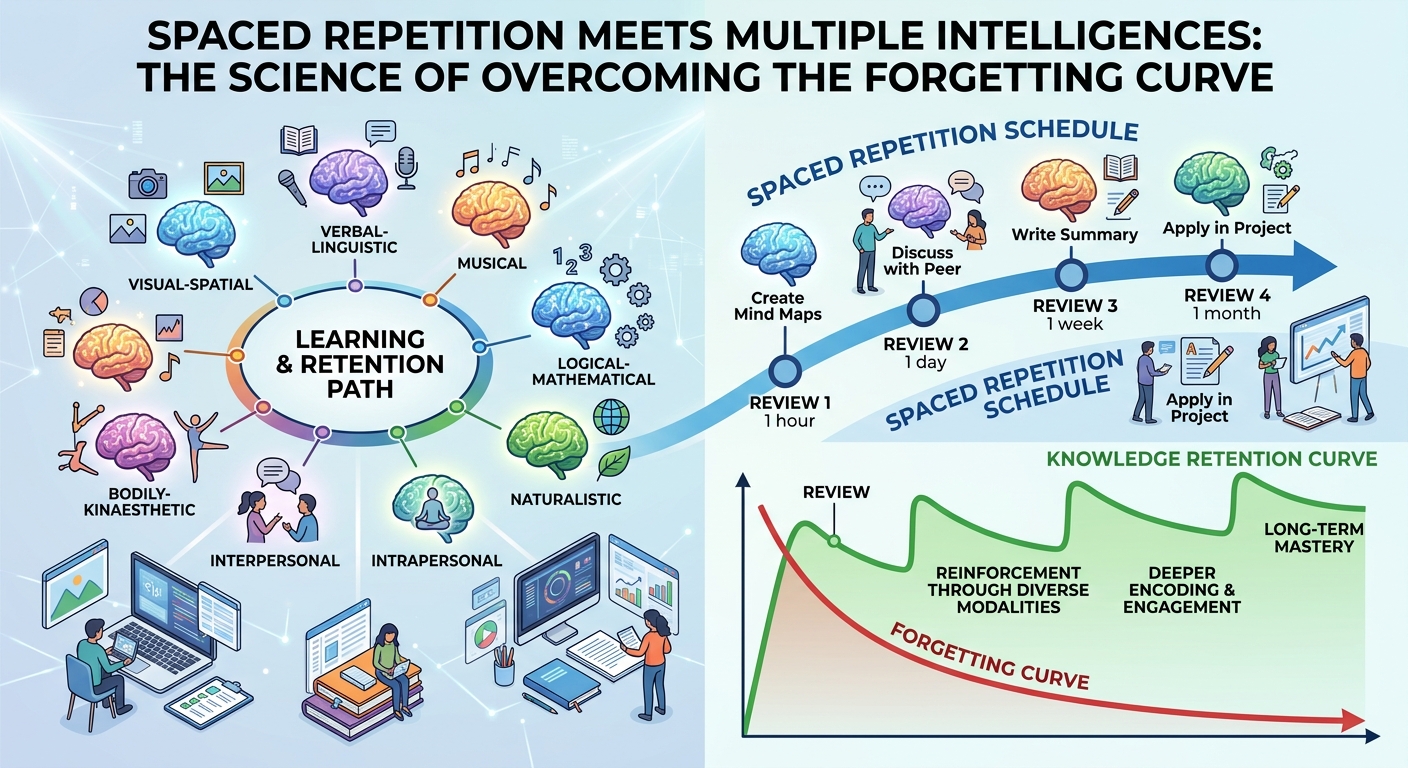
Spaced Repetition Meets Multiple Intelligences: The Science of Overcoming the Forgetting Curve
For Learning & Development leaders, the battle against the forgetting curve is a perpetual challenge. Millions are invested annually in corporate training, yet a significant portion of learned information dissipates within days or weeks. This isn't just an efficiency problem; it's a strategic impediment, particularly in sectors like Compliance, Banking, Finance, Healthcare, and Oil & Gas, where knowledge retention directly impacts risk mitigation, performance, and revenue. What if there was a scientifically-backed approach that not only combats forgetting but also significantly amplifies engagement and efficacy across diverse workforces?
Enter the powerful synergy of Spaced Repetition and Multiple Intelligences. By combining these two robust frameworks, L&D professionals can design learning experiences that are not only deeply embedded but also profoundly personalized, catering to the unique cognitive profiles of every learner. This article will delve into the science behind this approach and provide actionable insights for transforming your enterprise learning strategies.
The Forgetting Curve: A Persistent L&D Challenge
In 1885, German psychologist Hermann Ebbinghaus introduced the concept of the "forgetting curve," demonstrating that human memory rapidly declines over time if no attempt is made to retain the information. His research showed that within just an hour, people forget about 50% of new information, and within a day, roughly 70% is lost. For busy professionals in high-stakes environments like Retail, Pharma, or Mining, this curve can be even steeper due to cognitive load and competing demands.
The implications for corporate training are stark:
- Reduced ROI on training investments.
- Decreased proficiency and skill application post-training.
- Increased risk due to knowledge gaps, especially in areas like Compliance or Safety.
- Lower employee confidence and engagement with learning initiatives.
Spaced Repetition: The Brain's Best Friend for Retention
Spaced repetition is an evidence-based learning technique that involves reviewing previously learned material at increasing intervals over time. The key is to re-expose learners to information just before they are about to forget it, strengthening memory consolidation each time. This method capitalizes on the brain's natural memory processes, moving information from short-term to long-term memory more effectively.
How Spaced Repetition Works:
- Active Recall: Instead of passively re-reading, learners are prompted to actively retrieve information from memory. This effortful recall strengthens neural pathways.
- Adaptive Scheduling: Algorithms determine the optimal time for review based on a learner's past performance (e.g., if an answer was correct, the next review is scheduled further out; if incorrect, sooner).
- Cognitive Efficiency: It ensures that learners focus their attention on the information they are most likely to forget, optimizing study time and reducing cognitive overload.
Unlocking Potential with Multiple Intelligences
While spaced repetition addresses the 'when' of learning, Howard Gardner's theory of Multiple Intelligences (MI) addresses the 'how'. Gardner proposed that intelligence is not a single, monolithic entity, but rather comprises several distinct abilities or "intelligences" that work in concert. A learner might excel in one intelligence but struggle in another, yet traditional training often favors linguistic and logical-mathematical approaches.
Gardner's Eight Intelligences:
- Linguistic: Word smart (reading, writing, storytelling)
- Logical-Mathematical: Number/reasoning smart (problem-solving, patterns)
- Spatial: Picture smart (visualizing, drawing, navigating)
- Bodily-Kinesthetic: Body smart (doing, moving, hands-on)
- Musical: Music smart (rhythm, sound, melody)
- Interpersonal: People smart (understanding others, collaborating)
- Intrapersonal: Self smart (self-awareness, reflection)
- Naturalistic: Nature smart (understanding natural world, categorizing)
The Synergistic Power: Spaced Repetition + Multiple Intelligences
The true power emerges when spaced repetition is combined with learning activities tailored to Multiple Intelligences. This approach not only ensures information is revisited optimally but also that it's presented in a way that resonates most deeply with each individual's unique cognitive strengths.
Imagine a scenario in a global enterprise where employees are undergoing Risk-focused Training. Instead of just text-based quizzes, the system could:
- For Linguistic learners: Offer short-form case studies and policy summaries for spaced review.
- For Logical-Mathematical learners: Provide interactive scenario analysis tools and data-driven problem sets.
- For Spatial learners: Utilize visual flowcharts, animated explanations of processes, and virtual walkthroughs of potential risk areas.
- For Bodily-Kinesthetic learners: Incorporate gamified simulations where learners "act out" proper procedures or decision-making in a safe environment.
- For Interpersonal learners: Facilitate moderated discussion forums and peer-to-peer review challenges at spaced intervals.
Practical Implementation in Corporate eLearning
Implementing this dual strategy requires a modern, flexible learning content management system that supports diverse content types and intelligent delivery mechanisms. A robust LMS is no longer just a content repository; it's a dynamic ecosystem for continuous development.
Key Technologies and Strategies:
- Microlearning LMS Integration: Deliver learning in bite-sized modules, making it easier to integrate spaced repetition prompts and cater to specific intelligences (e.g., a 5-minute visual explainer for spatial learners, followed by a quick quiz).
- Gamified LMS Features: Leverage game mechanics (points, badges, leaderboards) for Bodily-Kinesthetic and Interpersonal learners, making spaced review fun and competitive.
- Adaptive Learning Paths: Utilize an intelligent learning management software that dynamically adjusts content and review schedules based on learner performance and identified intelligence profiles. This allows for truly personalized delivery.
- AI Powered Authoring Tool: Employ advanced authoring tools that can help L&D teams rapidly create varied content formats (videos, simulations, interactive quizzes, audio summaries) to appeal to different intelligences, and even suggest optimal review schedules for content elements.
- Robust Analytics: An enterprise learning management solution or MaxLearn LMS should provide detailed analytics on learner engagement and retention, allowing L&D teams to refine their spaced repetition intervals and content types.
Frequently Asked Questions About Advanced Learning Technologies
Q1: How can sophisticated algorithms personalize learning paths for diverse learners?
Modern learning platforms leverage data analytics and machine learning to analyze a learner's performance, preferred learning styles, and even their intrinsic motivations. Based on this, they can dynamically recommend content formats (e.g., video, text, interactive simulation), adjust the difficulty of challenges, and schedule review sessions at optimal intervals, ensuring the learning experience is uniquely tailored to each individual's needs and strengths.
Q2: What is the benefit of using intelligent systems to predict knowledge gaps in compliance training?
Intelligent systems can analyze vast amounts of data from past training, assessments, and even real-world performance to identify patterns and predict where learners are most likely to struggle or develop knowledge gaps in critical areas like compliance. This predictive capability allows L&D teams to proactively intervene with targeted, reinforced learning modules, significantly reducing risks, ensuring regulatory adherence, and preventing costly errors before they occur.
Q3: How do smart learning platforms enhance content delivery across global teams?
Smart learning platforms utilize context-aware capabilities to deliver relevant content globally. This includes automatic localization of content into multiple languages, adapting examples and scenarios to cultural contexts, and tailoring delivery methods to local infrastructure capabilities (e.g., optimizing for low bandwidth areas). This ensures a consistent yet culturally sensitive learning experience, fostering global team cohesion and competence.
Conclusion
Overcoming the forgetting curve is no longer an insurmountable task. By strategically integrating Spaced Repetition with the principles of Multiple Intelligences, L&D leaders can construct a learning ecosystem that is scientifically optimized for retention, deeply engaging, and genuinely inclusive. This dual approach transforms corporate training from a mere checkbox exercise into a powerful engine for sustained knowledge, enhanced performance, and robust organizational resilience across all sectors, from Sales to Banking to Healthcare.
Embrace the science of learning. Invest in a learning management system that empowers you to deliver personalized, intelligent, and highly effective training. The future of your workforce’s expertise depends on it.


Comments
Post a Comment