Smarter Reskilling: Aligning Workforce Agility with Gardner’s Multiple Intelligences
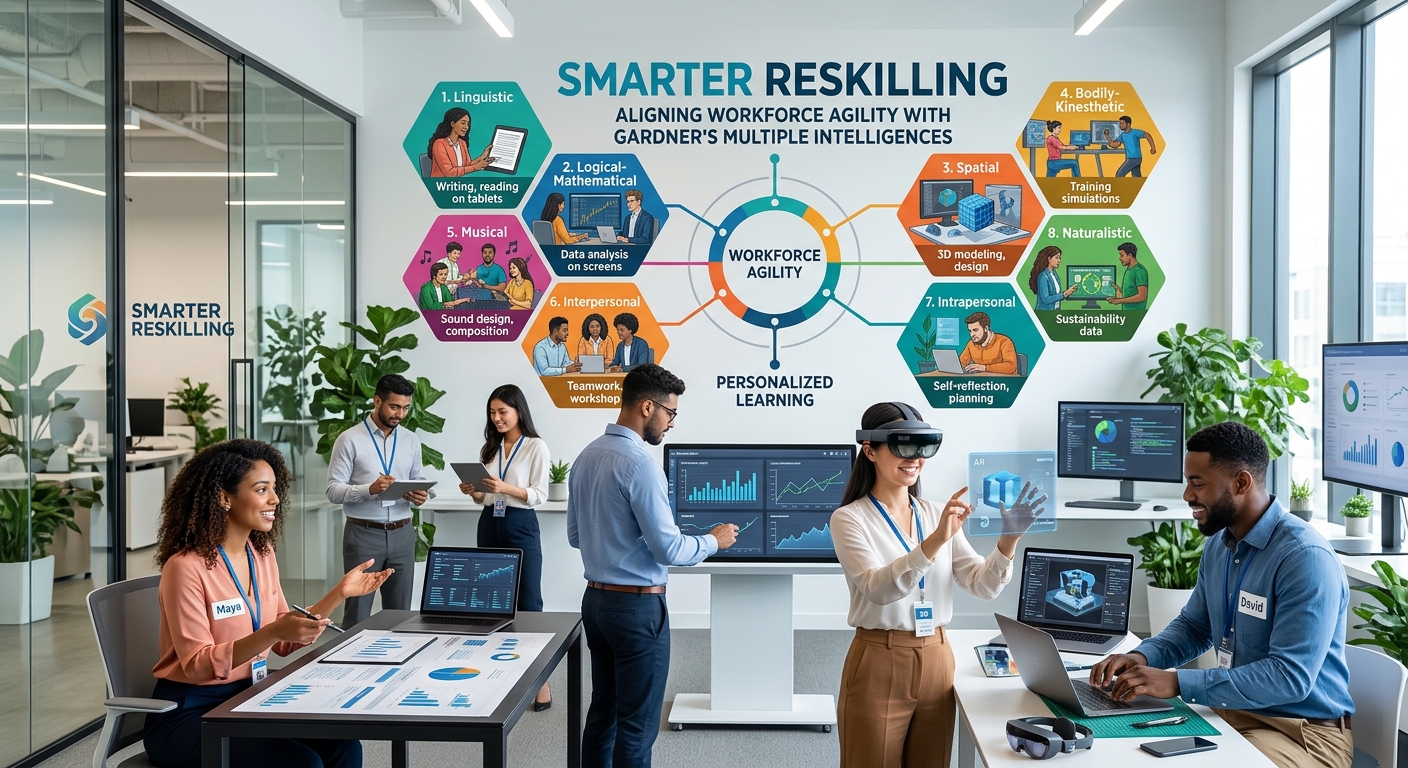
Smarter Reskilling: Aligning Workforce Agility with Gardner’s Multiple Intelligences
In today's dynamic business landscape, workforce agility isn't just a buzzword; it's a strategic imperative. Vice Presidents, Directors, and Managers of Learning & Development across sectors like Compliance, Sales, Banking, Finance, Insurance, Retail, Pharma, Healthcare, Hospitality, Oil and Gas, and Mining face the constant challenge of upskilling and reskilling their teams to meet evolving demands. Traditional, one-size-fits-all training often falls short, leading to disengagement and inefficient skill acquisition. The answer lies in a more intelligent, personalized approach: aligning reskilling strategies with Gardner’s Multiple Intelligences theory.
Imagine a workforce where every employee's unique cognitive strengths are not just recognized but leveraged to accelerate learning and foster adaptability. This isn't a futuristic dream; it's achievable by integrating modern eLearning solutions with a deeper understanding of human intelligence. By moving beyond conventional metrics, L&D leaders can unlock unprecedented levels of workforce potential and ensure their organizations remain competitive and resilient.
The Imperative for Agile and Effective Reskilling
The pace of change in every industry necessitates a workforce that can rapidly adapt, acquire new skills, and even pivot roles entirely. Whether it's a new regulatory framework in Finance, innovative sales techniques in Retail, digital transformation in Banking, or advanced medical procedures in Healthcare, the need for continuous learning is undeniable. Organizations that fail to cultivate an agile workforce risk falling behind, impacting everything from compliance adherence to market share.
However, traditional reskilling initiatives often treat all learners the same, delivering content through uniform methods. This overlooks the fundamental truth that individuals learn differently. A successful reskilling program requires more than just content delivery; it demands an understanding of how each person processes information and applies knowledge. This is where the profound insights of Dr. Howard Gardner's Multiple Intelligences theory become invaluable.
Gardner's Multiple Intelligences: A Foundation for Personalized Learning
Dr. Gardner proposed that human intelligence is not a single, monolithic entity but rather a collection of distinct intelligences, each representing a different way of processing information and interacting with the world. While the exact number of intelligences has evolved, key types include:
- Linguistic Intelligence: The ability to think in words and to use language to express and appreciate complex meanings.
- Logical-Mathematical Intelligence: The ability to calculate, quantify, consider propositions and hypotheses, and carry out complex mathematical operations.
- Spatial Intelligence: The ability to think in three dimensions, allowing for navigation, visualization, and interpretation of graphical information.
- Bodily-Kinesthetic Intelligence: The capacity to manipulate objects and use a variety of physical skills, often involving a sense of timing and coordination.
- Musical Intelligence: The capacity to discern pitch, rhythm, timbre, and tone, as well as to produce and appreciate music.
- Interpersonal Intelligence: The ability to understand and interact effectively with others, sensing their moods, motivations, and desires.
- Intrapersonal Intelligence: The capacity to understand oneself—one's feelings, fears, and motivations.
- Naturalistic Intelligence: The ability to recognize and categorize species of flora and fauna in one's environment.
By recognizing these diverse strengths, L&D professionals can move beyond generic training and design learning experiences that resonate deeply with individual learners, enhancing engagement and effectiveness. A modern LMS is key to facilitating this personalized approach.
Applying Multiple Intelligences to Modern Reskilling Strategies
Tailored Pathways for Maximum Impact
Understanding an employee's dominant intelligences allows for the creation of truly tailored reskilling pathways. For instance, a learner strong in Logical-Mathematical intelligence might excel with data analytics simulations, while someone with high Interpersonal intelligence would thrive in collaborative problem-solving scenarios for sales or customer service training. This targeted approach transforms skill gaps into opportunities for growth, ensuring that learning resources are optimally utilized. Many organizations are now seeking a robust learning management system that supports such customization.
Diverse Modalities for Engaged Learning
Modern `learning management software` provides a wealth of tools to cater to diverse intelligences:
- For Linguistic learners: Rich textual content, case studies, and opportunities for written communication.
- For Spatial learners: Interactive simulations, virtual reality modules, and visual aids.
- For Bodily-Kinesthetic learners: Hands-on labs, role-playing exercises, and practical demonstrations.
- For Interpersonal learners: Group projects, peer-to-peer coaching, and collaborative discussions.
- For Intrapersonal learners: Reflective journals, self-paced modules, and personalized feedback.
These varied approaches can be delivered efficiently via a `cloud based learning management system`, allowing for accessibility and flexibility. Solutions like a Microlearning LMS can break down complex topics into digestible, intelligence-aligned modules, ensuring learners grasp concepts effectively.
Leveraging Technology for Intelligent Reskilling
How can intelligent systems optimize learning pathways for individual employees?
Modern eLearning platforms, especially those incorporating machine learning, can analyze individual skill gaps, prior knowledge, and even inferred learning styles (informed by MI principles). These platforms recommend hyper-personalized learning modules, adjust content difficulty in real-time, and offer diverse multimedia options. This makes the `lms learning management system` a truly powerful tool for individualized development.
The capabilities of an `enterprise learning management` solution are critical here. An advanced `learning content management system` (LCMS) paired with an `AI Powered Authoring Tool` can rapidly generate and adapt content to suit different intelligence profiles, ensuring that your team in Pharma, for example, receives highly specific, relevant information tailored to their learning preferences. For industries like Compliance and Banking, where `Risk-focused Training` is paramount, tailoring the delivery method to individual cognitive strengths can significantly improve comprehension and retention of critical information.
Achieving Agility with Advanced eLearning Solutions
In what specific industries or contexts is advanced workforce development making the most significant impact?
While pervasive, industries facing rapid technological shifts like Finance, Healthcare, and advanced Manufacturing, particularly in global innovation hubs, are seeing profound transformations. These sectors benefit immensely from strategies that integrate multiple intelligence theory with adaptive technology. For example, a Gamified LMS can motivate Logical-Mathematical and Bodily-Kinesthetic learners through challenges and simulations, making complex topics more engaging for teams in Oil and Gas or Mining.
The true power lies in the ability of an advanced learning management solutions provider like MaxLearn LMS to integrate these approaches. Their methodologies emphasize Adaptive Learning, which continuously adjusts to a learner's progress and preferred learning style. This ensures that every employee, whether in Hospitality or Sales, receives the most effective training for their specific needs, enhancing overall workforce agility.
What immediate steps should L&D leaders take to implement intelligent, individually-aligned workforce development programs?
Begin by conducting a comprehensive assessment of your current workforce's skills and, if possible, identify their predominant intelligence profiles through self-assessment tools or observations. Next, research and pilot `LMS` solutions that offer `Adaptive Learning` capabilities and AI-driven content recommendations. Focus on critical roles or high-impact training areas first, such as new product training for Sales or compliance updates for Finance, to demonstrate immediate ROI and build momentum for broader implementation.
The Tangible Benefits of Smarter Reskilling
By aligning reskilling with Gardner's Multiple Intelligences, organizations can expect:
- Increased Engagement and Motivation: Learners are more invested when content is presented in a way that resonates with their natural strengths.
- Faster Skill Acquisition: Personalized pathways reduce learning friction, leading to quicker mastery of new competencies.
- Higher Knowledge Retention: Deeper, more meaningful learning experiences translate into longer-lasting knowledge and skill application.
- Enhanced Workforce Agility: Employees are better equipped to adapt to new roles and technologies, future-proofing your talent pool.
- Improved Business Outcomes: A more skilled and adaptable workforce directly contributes to innovation, efficiency, and competitive advantage across all industries.
Conclusion
The future of L&D is personalized, adaptive, and intelligent. For Vice Presidents, Directors, and Managers leading learning initiatives, embracing Gardner's Multiple Intelligences theory, combined with cutting-edge eLearning technology, offers a clear path to building a truly agile and future-ready workforce. It's time to move beyond the conventional and invest in smarter reskilling that celebrates and leverages the diverse brilliance within your organization. The shift to an `enterprise learning management` system that embraces these principles isn't just an upgrade; it's a strategic transformation for sustainable growth.


Comments
Post a Comment