Scaling Employee Competency: DDE Framework and Microlearning Technology
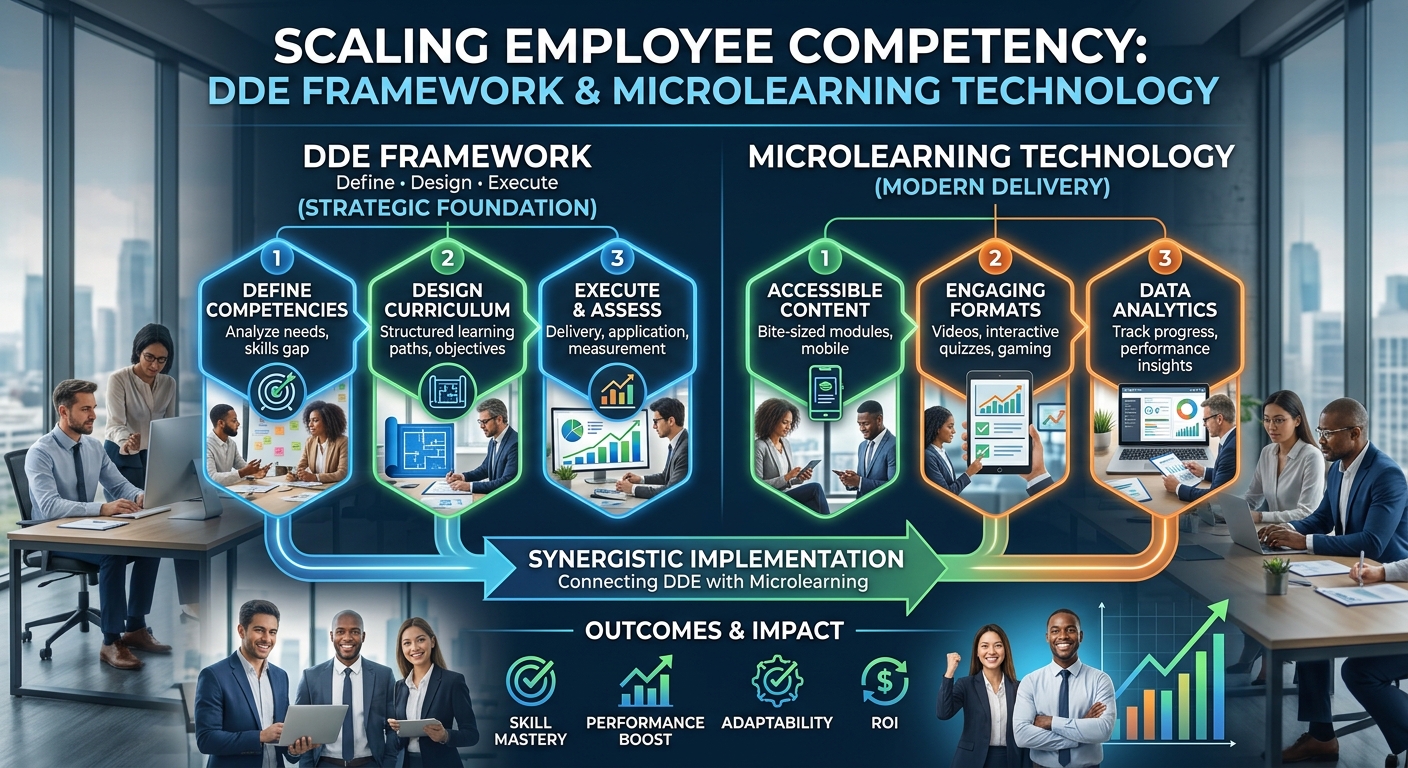
Scaling Employee Competency: The DDE Framework and Microlearning Technology
In today's rapidly evolving business landscape, organizations across sectors—from Risk-focused Training in Banking and Finance to specialized skill development in Pharma and Oil & Gas—face a critical challenge: effectively scaling employee competency. The demand for new skills emerges at unprecedented speed, often leaving traditional training methods struggling to keep pace. For L&D Vice Presidents, Directors, and Managers, the imperative is clear: develop agile, impactful learning strategies that not only close immediate skill gaps but also future-proof the workforce.
This article explores the powerful synergy between the Define, Develop, Evaluate (DDE) framework and cutting-edge microlearning technology. Together, they offer a robust solution for building a highly competent, adaptable workforce ready for tomorrow’s challenges.
The Dynamic Competency Gap: A Pervasive Challenge
Every industry, from Retail and Hospitality to Health Care and Mining, grapples with the continuous need to update and expand employee skills. Compliance regulations shift, sales strategies evolve, technological advancements disrupt processes, and customer expectations soar. This creates a perpetual competency gap that, if not addressed strategically, can hinder innovation, reduce productivity, and erode competitive advantage.
Traditional, lengthy training programs are often inefficient, costly, and lead to poor knowledge retention. The modern learner, accustomed to on-demand information, demands a more dynamic approach.
Introducing the DDE Framework for Strategic Competency Development
The Define, Develop, Evaluate (DDE) framework provides a structured, iterative approach to strategic competency scaling. It ensures learning initiatives are proactive, purposeful, and closely aligned with both business objectives and individual growth paths.
Define: Pinpointing Essential Competencies
The first DDE step is to clearly define competencies critical for current and future success. This involves thorough analysis of:
- Business Goals: Identifying skills needed to achieve strategic objectives.
- Role Requirements: Determining specific knowledge, skills, and abilities (KSAs) for each role.
- Industry Trends: Anticipating how emerging technologies (e.g., AI in Banking) or market shifts will impact required competencies.
- Performance Gaps: Locating current skill deficiencies impacting productivity or quality.
Accurately defining these competencies sets the stage for targeted, effective, and purposeful learning interventions directly contributing to organizational success.
Develop: Building Skills with Precision and Engagement
Once competencies are defined, the next phase is to develop them. This is where Microlearning LMS and its integrated technologies become indispensable. Microlearning delivers bite-sized, focused learning modules, typically 2-10 minutes long. This approach aligns with modern learning preferences and busy work schedules, making knowledge acquisition efficient and highly retentive.
- Targeted Content: Microlearning modules precisely address specific competencies identified.
- Increased Engagement: Short content, often delivered through a Gamified LMS, keeps learners motivated via points, badges, and leaderboards.
- Improved Retention: Spaced repetition inherent in microlearning, combined with immediate application, significantly boosts knowledge retention.
- Accessibility and Flexibility: Learners access content anytime, anywhere, on any device, integrating learning into their workflow.
An effective learning content management system is crucial for easy creation, deployment, and updating of microlearning modules. A robust learning management software supporting an Adaptive Learning approach further personalizes development based on individual progress and needs.
Evaluate: Measuring Impact and Iterating for Growth
The final, continuous phase of DDE is evaluation. This measures learning effectiveness and guides iteration. Evaluation extends beyond completion rates, focusing on:
- Knowledge Transfer: Are learners applying new knowledge on the job?
- Performance Improvement: Is there a measurable impact on individual and team performance metrics?
- Business Outcomes: Are initiatives contributing to defined business goals (e.g., increased sales, reduced compliance breaches)?
An advanced learning management system provides analytics and reporting tools to track progress, identify improvements, and demonstrate ROI. This data-driven approach allows L&D leaders to refine strategies, ensuring competency development remains dynamic and impactful.
Microlearning Technology: The Engine for Scalability
Microlearning is a pedagogical approach empowered by technology. An enterprise learning management solution built around microlearning principles transforms training delivery. A modern LMS enables:
- Rapid content creation, often facilitated by an AI Powered Authoring Tool, significantly reducing development time and costs.
- Seamless deployment of tailored learning paths.
- Real-time tracking of learner progress and engagement.
- Integration with other HR and business systems for a holistic view.
When seeking a cloud based learning management system, prioritize platforms offering comprehensive learning management solutions designed for agility and scale. A top-tier learning management system should foster a continuous learning culture.
Synergizing DDE and Microlearning for Scalable Competency
The DDE framework provides the strategic blueprint, while microlearning technology offers the efficient, engaging delivery mechanism. For global organizations in sectors like Health Care or multi-national Retail chains, this synergy is crucial for consistent competency scaling across diverse geographies and workforces.
- Precision Training: DDE identifies exact skill gaps; microlearning delivers precise content to fill them.
- Continuous Development: DDE's iterative nature and microlearning's accessibility foster ongoing learning.
- Data-Driven Optimization: Evaluation data from the learning management software informs DDE phases, creating a feedback loop for constant improvement.
Intelligent Insights: Answering Your L&D Technology Questions
As L&D leaders navigate digital transformation, common questions arise regarding advanced technology in learning:
How can modern learning platforms predict future skill needs and tailor content?
Sophisticated learning management solutions leverage data analytics and machine learning to analyze performance trends, industry shifts, and individual learner data. By identifying patterns and forecasting requirements, an Adaptive Learning platform proactively recommends and even generates relevant microlearning modules. This predictive capability ensures training is always one step ahead, preparing employees for what’s next.
Can digital learning environments personalize pathways across diverse global teams?
Absolutely. A cutting-edge learning management system, especially a cloud based learning management system, is designed for global reach and personalization. With multi-language support, cultural localization, and adaptive algorithms, it creates unique learning journeys for individuals within diverse global teams. Each employee, regardless of location or prior knowledge, receives content optimized for their specific needs, learning style, and role, ensuring equitable and effective development across the entire enterprise.
What is the measurable return on investment for adopting intelligent learning systems?
The return on investing in an enterprise learning management system with intelligent features like an AI Powered Authoring Tool and Gamified LMS elements can be substantial. Beyond efficiency gains in content creation and delivery, expect improved employee retention, reduced time-to-competency for new hires, enhanced productivity, and a direct impact on business KPIs such as sales performance, customer satisfaction, and compliance adherence. Data from the learning management software provides clear metrics to demonstrate this impact, transforming L&D into a strategic business driver.
Practical Applications Across Industries
- Compliance: For Banking, Finance, and Pharma, Risk-focused Training via microlearning keeps employees updated on regulations, reducing exposure.
- Sales: In Retail, microlearning rapidly deploys product knowledge, sales techniques, and objection handling. An AI Powered Authoring Tool quickly creates sales training scenarios.
- Health Care: Microlearning provides critical, just-in-time information (e.g., new equipment protocols) without disrupting demanding schedules.
- Oil & Gas/Mining: Safety protocols and operational procedures are reinforced regularly through micro-modules, improving workplace safety and efficiency.
Choosing the Right Learning Management System
To fully harness DDE and microlearning, selecting the right learning management software is paramount. Look for a robust LMS that offers:
- Seamless creation and management of a learning content management system.
- Support for microlearning, gamification, and adaptive learning methodologies.
- Scalability for enterprise learning management needs.
- Comprehensive analytics and reporting capabilities.
- Excellent user experience, crucial for adoption across diverse workforces.
A cutting-edge solution like MaxLearn LMS embodies these features, offering advanced learning management solutions that drive real results.
Conclusion
Scaling employee competency is a strategic imperative. By adopting the DDE framework—Define, Develop, Evaluate—and integrating it with advanced microlearning technology, L&D leaders can build a responsive, highly skilled workforce. This powerful combination ensures learning is precise, engaging, measurable, and continuously aligned with an organization's evolving needs. Invest in smart learning management systems, embrace microlearning, and empower your teams to thrive in any future landscape.


Comments
Post a Comment