Next-Gen LMS Architecture: Combining Howard Gardner’s Theory with AI Knowledge Mapping
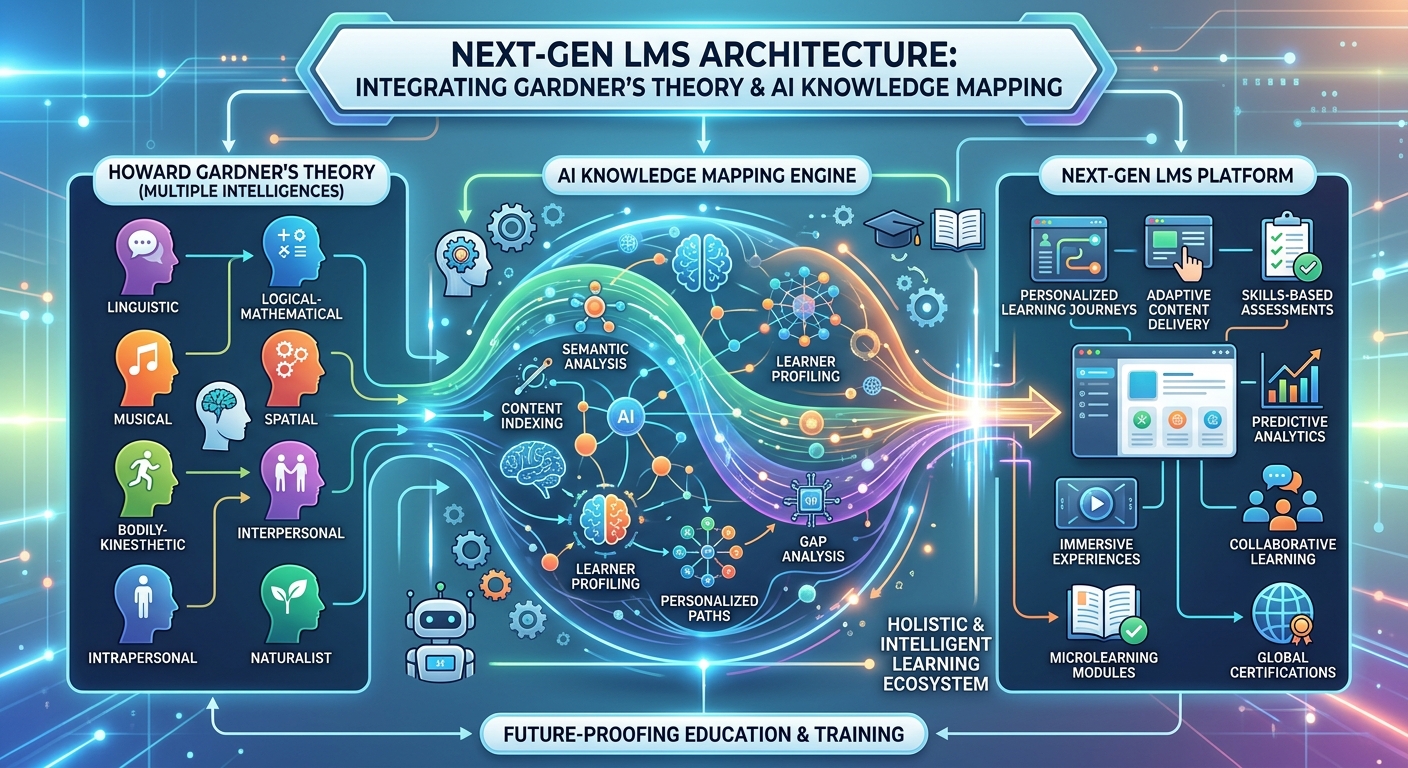
Next-Gen LMS Architecture: Combining Howard Gardner’s Theory with AI Knowledge Mapping
For L&D leaders navigating the complexities of modern workforce development, the pursuit of truly effective training is a perpetual quest. Traditional one-size-fits-all approaches often fall short, struggling to resonate with diverse learning styles and individual needs. Imagine an LMS that doesn't just deliver content but understands how each employee learns best, adapting its approach dynamically. This isn't a futuristic pipe dream; it's the imminent reality of next-gen learning management system architecture, where the profound insights of Howard Gardner's Theory of Multiple Intelligences converge with the analytical power of AI Knowledge Mapping.
In industries as varied as Compliance, Sales, Banking, Finance, Insurance, Retail, Pharma, Health care, Hospitality, Oil and Gas, and Mining, the demand for precise, impactful training is non-negotiable. An intelligent learning management software isn't just an advantage; it's a strategic imperative for skill development, retention, and competitive edge. This article explores how combining these two powerful concepts creates an unparalleled learning experience, elevating the role of the learning content management system to a truly transformative tool.
The Foundational Insight: Howard Gardner’s Theory of Multiple Intelligences
In 1983, psychologist Howard Gardner challenged the conventional view of intelligence, proposing that rather than a single, monolithic entity, human intelligence comprises multiple distinct modalities. His theory outlines eight (and sometimes more) specific intelligences:
- Linguistic: Word smart (reading, writing, storytelling).
- Logical-Mathematical: Number/reasoning smart (problem-solving, logical analysis).
- Spatial: Picture smart (visualizing, navigating spaces).
- Bodily-Kinesthetic: Body smart (physical movement, hands-on learning).
- Musical: Music smart (rhythm, sound patterns).
- Interpersonal: People smart (understanding others, collaboration).
- Intrapersonal: Self smart (self-awareness, introspection).
- Naturalistic: Nature smart (understanding patterns in nature, classifying).
For L&D professionals, Gardner's theory offers a critical lens through which to view learner diversity. It explains why some employees thrive with written manuals, others excel with interactive simulations, and yet others grasp concepts best through collaborative discussions. A truly effective enterprise learning management solution must cater to this inherent diversity, moving beyond generic content delivery.
The Engine of Personalization: AI Knowledge Mapping
Enter Artificial Intelligence, particularly in the realm of knowledge mapping. AI knowledge mapping is the process by which algorithms identify, categorize, and establish relationships between different pieces of information, skills, and learning objectives within a vast data landscape. In an lms learning management system context, this means:
- Content Analysis: AI can analyze all available learning content (videos, articles, simulations, quizzes) and tag it with metadata describing its format, cognitive demands, and the intelligences it caters to.
- Learner Profiling: Through interaction data, assessment results, and even declared preferences, AI can build a dynamic profile of each learner, inferring their dominant intelligences, preferred learning styles, and existing knowledge gaps.
- Path Recommendation: By matching learner profiles with content attributes, AI can recommend highly personalized learning paths, ensuring that each piece of content aligns with the individual's optimal way of learning.
How can artificial intelligence truly personalize employee training?
Artificial intelligence personalizes employee training by analyzing individual learning patterns, historical performance data, and declared preferences to construct adaptive learning paths. It identifies which content formats (e.g., visual for spatial learners, interactive for kinesthetic) and difficulty levels are most effective for each person, continuously adjusting recommendations based on progress and engagement. This goes far beyond simple branching scenarios, creating a truly dynamic and responsive learning journey within an advanced learning management system.
The Synergy: Unlocking Adaptive Learning with Gardner and AI
The magic happens when Gardner's framework informs AI's mapping capabilities. A next-gen LCMS isn't just delivering information; it's orchestrating a symphony of learning experiences tailored to each individual's unique cognitive strengths. Consider these practical applications:
- Dynamic Content Curation: If an employee's profile suggests strong linguistic intelligence, the cloud based learning management system might prioritize detailed textual explanations, case studies, and reading materials. For a bodily-kinesthetic learner in a manufacturing setting, it would surface interactive simulations or hands-on virtual lab exercises.
- Multi-Modal Pathways: For a critical compliance topic, the system might offer multiple pathways – a detailed legal brief (linguistic), an animated explainer video (spatial), or a role-playing scenario (interpersonal/bodily-kinesthetic). Learners choose or are guided to the most effective path for them. This is the essence of Adaptive Learning.
- Skill Gap to Intelligence Mapping: When a skill gap is identified (e.g., in a sales representative needing to improve negotiation tactics), the AI-powered learning management system doesn't just suggest generic sales training. It recommends modules delivered in formats best suited to that individual's dominant intelligences, perhaps a collaborative role-play for an interpersonal learner or a data-driven analysis of negotiation outcomes for a logical-mathematical type.
What kind of geographic impact does an intelligent learning platform have on a global workforce?
An intelligent learning platform significantly reduces geographic barriers by providing culturally relevant and language-localized content tailored to specific regions. Its ability to personalize based on implicit learning preferences ensures that employees across diverse cultures, from urban centers to remote sites in Oil and Gas or Mining, receive training that resonates. It streamlines content delivery and management for global teams, making a unified yet customized approach to learning, accessible from any location via a cloud based learning management system.
Benefits for Forward-Thinking L&D Leaders
Implementing such a sophisticated learning management system offers tangible advantages:
- Enhanced Engagement and Retention: When learning feels natural and effective, learners are more motivated, leading to higher completion rates and better knowledge retention. Features like a Gamified LMS further boost engagement.
- Accelerated Skill Acquisition: By optimizing the learning pathway for each individual, organizations can close skill gaps faster, leading to quicker upskilling and reskilling across all departments.
- Demonstrable ROI: Personalized, effective training directly translates to improved performance metrics, whether it's compliance adherence in Pharma, sales quotas in Retail, or operational efficiency in Hospitality. This provides clear data to justify L&D investments.
- Future-Proofing Your Workforce: In rapidly evolving sectors, the ability to quickly and effectively train employees on new skills is paramount. An intelligent learning management system fosters a culture of continuous learning.
- Tailored Industry Solutions: For Compliance, Risk-focused Training can be delivered in the most impactful way for each employee, ensuring critical understanding. For Sales, an AI Powered Authoring Tool can quickly generate relevant, personalized Microlearning LMS content.
Beyond basic personalization, what advanced intelligent capabilities should L&D look for in a modern learning platform?
Beyond basic personalization, L&D leaders should seek advanced capabilities like predictive analytics to foresee skill gaps, generative AI Powered Authoring Tool for rapid content creation, sophisticated natural language processing for dynamic feedback, and robust integration with other HR systems for a holistic view of talent development. Additionally, a platform capable of deep learner behavioral analysis to refine recommendations and even suggest optimal learning times, integrated within an enterprise learning management suite, is key.
The MaxLearn Approach: A Glimpse into the Future
Leading platforms like MaxLearn LMS are at the forefront of this architectural revolution. By leveraging cutting-edge AI and a deep understanding of pedagogical theories like Gardner's, they are transforming the landscape of corporate learning. Imagine an LMS where every learner feels understood, where every module is optimized for their success, and where L&D initiatives drive measurable business outcomes. This is the promise of combining human-centric learning theory with machine intelligence.
The future of employee training is not just digital; it's intelligent, adaptive, and profoundly human-centered. For L&D leaders ready to transcend traditional boundaries and unlock the full potential of their workforce, exploring next-gen learning management solutions that embrace this philosophy is the next logical step. The synergy of Howard Gardner's insights and AI knowledge mapping is not merely an enhancement; it's a paradigm shift towards truly transformative learning.


Comments
Post a Comment