Multimodal Instructional Design: Leveraging Verbal, Mathematical, and Spatial Pathways
Multimodal Instructional Design: Leveraging Verbal, Mathematical, and Spatial Pathways for Peak Performance
In today's fast-evolving corporate landscape, the effectiveness of learning and development programs is a critical differentiator. As L&D leaders, you're constantly seeking innovative strategies to not only disseminate knowledge but to foster deep understanding, skill mastery, and measurable impact. Enter multimodal instructional design—a sophisticated approach that strategically harnesses verbal, mathematical, and spatial pathways to create rich, engaging, and exceptionally effective learning experiences.
This methodology moves beyond the traditional text-and-talk model, recognizing that learners acquire, process, and retain information more efficiently when engaged through multiple senses and cognitive channels. By tapping into these distinct yet interconnected pathways, organizations across industries—from Compliance and Sales to Banking, Healthcare, and Oil & Gas—can significantly elevate their training outcomes, driving both individual and organizational growth.
The Cognitive Power of Multimodality
Our brains are wired for multimodality. Research in cognitive science consistently demonstrates that presenting information through diverse channels enhances learning, memory, and transfer. When learners engage with content verbally (through text or audio), mathematically (through data and logic), and spatially (through visuals and interactions), they create stronger neural connections. This deeper encoding leads to better recall, more robust problem-solving abilities, and a richer, more contextualized understanding of complex topics.
Verbal Pathways: The Foundation of Understanding
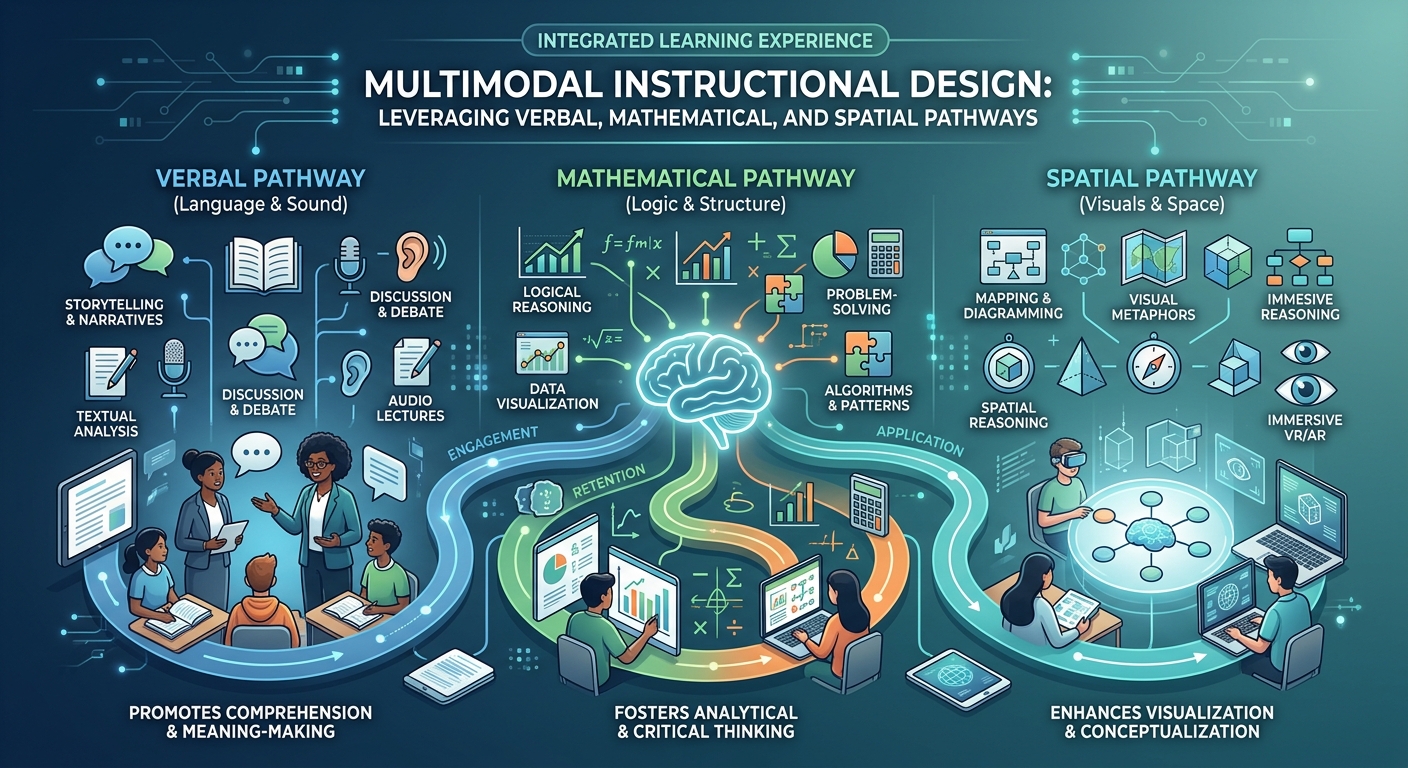
The verbal pathway is perhaps the most familiar. It encompasses all forms of spoken and written language, from concise instructions and detailed explanations to storytelling, case studies, and interactive discussions. For L&D, this means crafting clear, unambiguous narratives, providing rich contextual information, and facilitating guided dialogues.
- Clear Explanations: Articulating complex concepts in digestible language.
- Storytelling: Engaging learners through relatable scenarios and experiences, especially effective in Microlearning LMS environments.
- Interactive Discussions: Fostering critical thinking and collaborative problem-solving.
- Audio Content: Podcasts, voice-overs, and interviews for flexible learning.
While foundational, verbal input alone can sometimes be insufficient for grasping intricate processes or abstract ideas. Its power is amplified when combined with other modalities.
Mathematical Pathways: Precision and Logic
The mathematical pathway involves the processing of numerical data, logical sequences, patterns, algorithms, and quantitative relationships. This modality is crucial for understanding metrics, analyzing performance, making data-driven decisions, and grasping cause-and-effect relationships.
- Data Visualization: Presenting statistics, financial reports, or compliance metrics.
- Problem-Solving Exercises: Challenging learners to apply logical reasoning to real-world scenarios, common in Risk-focused Training.
- Algorithmic Thinking: Understanding workflows, processes, and decision trees.
- Forecasting and Analysis: Interpreting trends and predicting outcomes.
In industries like Finance, Pharma, and Oil & Gas, the ability to interpret and apply mathematical reasoning is indispensable. Leveraging this pathway ensures precision and fosters a deeper, analytical understanding.
Spatial Pathways: Visualization and Context
Spatial pathways engage our ability to perceive, process, and interpret visual and environmental information. This includes diagrams, flowcharts, maps, simulations, virtual reality, and interactive elements that allow learners to explore and manipulate objects or environments.
- Diagrams and Infographics: Illustrating relationships, hierarchies, and processes.
- Simulations and VR/AR: Providing immersive, hands-on experience in safe environments, an excellent application for a Gamified LMS.
- Interactive Maps and Timelines: Contextualizing data and events geographically or chronologically.
- Flowcharts and System Schematics: Visualizing operational procedures or system architectures.
Spatial learning is particularly potent for teaching complex operations, physical layouts, or abstract concepts that benefit from visual representation. It provides context and allows learners to "see" the bigger picture.
Integrating the Pathways: A Synergy for Superior Learning
The true power of multimodal instructional design lies in the intelligent integration of these pathways. It's not about overwhelming learners with all modalities simultaneously, but about strategically combining them to reinforce learning and cater to diverse cognitive preferences. For instance:
- A financial analyst learning about market trends might engage with verbal explanations of economic theory, analyze numerical data sets (mathematical), and visualize these trends on interactive charts and graphs (spatial).
- A healthcare professional practicing a new surgical procedure could read detailed protocols (verbal), review anatomical diagrams (spatial), and then perform the procedure in a high-fidelity simulation that provides real-time performance metrics (mathematical feedback, spatial interaction).
Modern learning platforms, including robust LMS solutions, facilitate this integration, often offering features for Adaptive Learning that can personalize the blend of modalities based on individual learner progress and preferences.
The Multimodal Advantage in Key Industries
The versatility of multimodal design makes it invaluable across a spectrum of industries:
- Compliance: Verbalizing policy nuances, visualizing regulatory frameworks, and using statistical risk assessments to highlight implications.
- Sales: Engaging in role-playing (verbal), analyzing CRM data (mathematical), and practicing product demonstrations through interactive modules (spatial).
- Banking & Finance: Explaining complex financial products (verbal), constructing predictive models (mathematical), and simulating market scenarios (spatial).
- Healthcare: Describing treatment protocols (verbal), calculating dosages (mathematical), and exploring human anatomy via 3D models (spatial).
- Retail: Training on customer service scripts (verbal), managing inventory levels (mathematical), and optimizing store layouts or product placement (spatial).
- Oil & Gas / Mining: Understanding safety procedures (verbal), interpreting sensor data (mathematical), and navigating complex machinery or geological formations through simulations (spatial).
Addressing Common Queries with Intelligent Systems
As L&D leaders navigate the complexities of modern corporate training, questions arise regarding optimization and reach. Advanced learning systems can provide insights into these challenges:
Question: How can we ensure our training resonates with diverse learners across different roles and experience levels within the organization?
Answer: By dynamically tailoring content delivery across verbal, mathematical, and spatial modalities, organizations can cater to individual cognitive preferences and prior knowledge. This approach maximizes engagement for every learner, ensuring that a learning management system adapts to individual needs rather than a one-size-fits-all model.
Question: What strategies can optimize learning impact for a globally distributed workforce, considering varying cultural contexts and operational environments?
Answer: Focus on creating culturally agnostic spatial visualizations (e.g., universal symbols, clear process flows), localizing verbal explanations where necessary, and standardizing mathematical principles. Offering flexible access through a cloud based learning management system ensures equitable access and consistent quality globally.
Question: Beyond basic knowledge transfer, how can our instructional design foster deeper problem-solving skills and accelerate skill mastery?
Answer: By dynamically presenting challenges that require learners to synthesize information from verbal instructions, analyze data using mathematical reasoning, and interact with simulated environments using spatial awareness, we cultivate higher-order thinking and practical application. This is where an AI Powered Authoring Tool can be instrumental in creating such rich, interactive content within an enterprise learning management system like MaxLearn LMS.
Effective instructional design, supported by a robust learning management software or LCMS, becomes a strategic asset. Leveraging a comprehensive lms learning management system provides the framework to deploy these rich learning experiences, making the most of your learning content management system capabilities and finding the right learning management solutions.
Implementing Multimodal Design: A Strategic Imperative
For L&D leaders, embracing multimodal instructional design is no longer an option but a strategic imperative. It empowers your workforce with a more profound, practical, and enduring understanding of critical skills and knowledge. By thoughtfully integrating verbal, mathematical, and spatial pathways, you can create training that truly sticks, driving enhanced performance, innovation, and competitive advantage across your organization.
Conclusion
The future of corporate learning is multimodal. By strategically designing learning experiences that engage verbal, mathematical, and spatial pathways, L&D leaders can unlock unprecedented levels of learner engagement, retention, and performance. This holistic approach not only caters to the diverse cognitive needs of your workforce but also equips them with the adaptable skills necessary to thrive in an increasingly complex and data-driven world. Invest in multimodal instructional design, and transform your L&D initiatives into a powerful engine for business success.


Comments
Post a Comment