Measuring Training Impact: How Personalizing for Intelligences Reduces Time-to-Competence
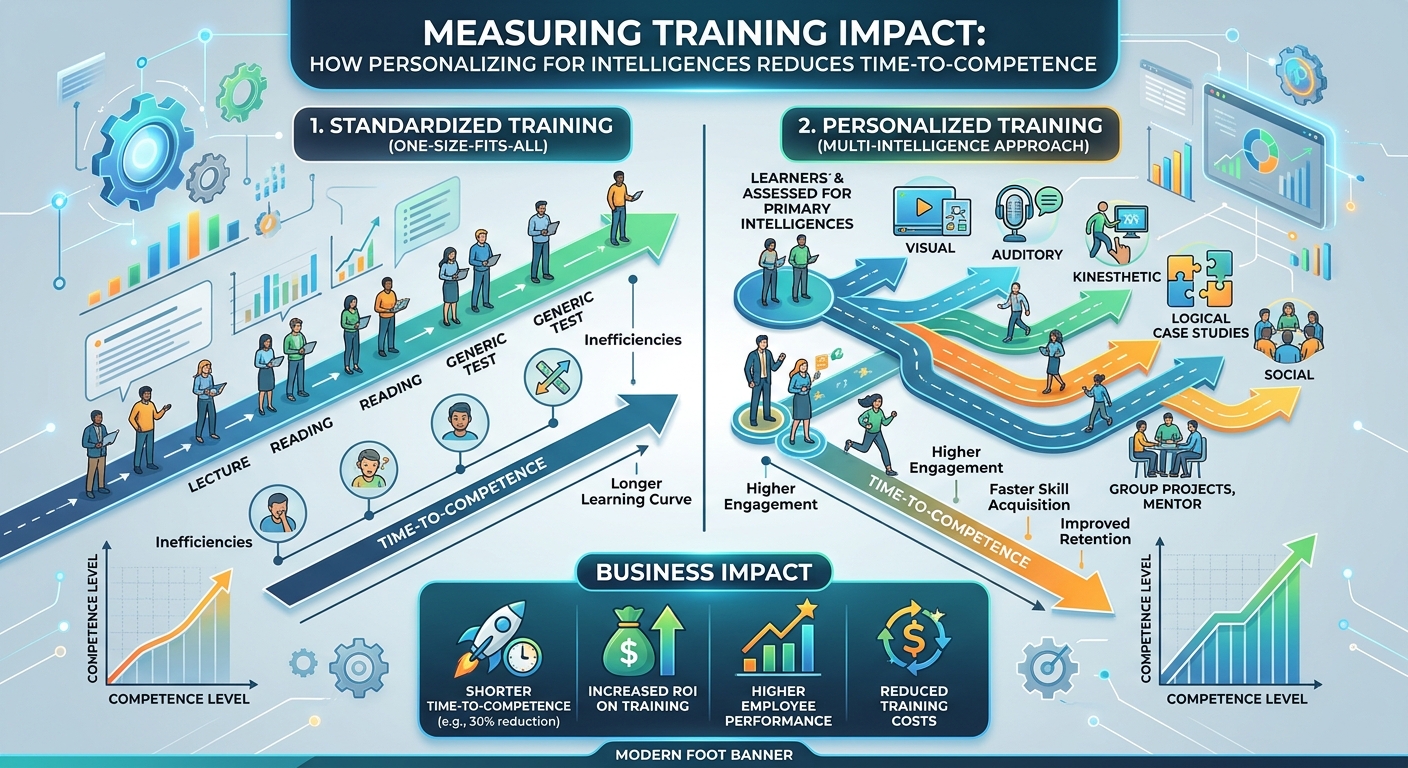
Measuring Training Impact: How Personalizing for Intelligences Reduces Time-to-Competence
For Vice Presidents, Directors, and Senior Managers in Learning & Development, the elusive quest for measurable training impact often feels like navigating a labyrinth. In an era where every budget line is scrutinized, demonstrating tangible ROI from learning initiatives is paramount. One of the most critical metrics for L&D leaders is Time-to-Competence (TTC) – the duration it takes for an employee to achieve the necessary skill level to perform their job effectively. Reducing TTC directly translates to significant business advantages, from accelerated productivity to enhanced compliance and revenue generation.
The conventional "one-size-fits-all" training approach, however, often falls short. It overlooks the fundamental truth that individuals learn differently. By personalizing training for diverse intelligences – recognizing and catering to the unique cognitive strengths and preferences of each learner – organizations can dramatically cut down TTC, leading to a more efficient, engaged, and competent workforce across all sectors, from Compliance and Sales to Banking, Healthcare, and Oil & Gas.
The Imperative of Reducing Time-to-Competence (TTC)
Time-to-Competence isn't just an HR metric; it's a strategic business indicator. A prolonged TTC means:
- Lost Productivity: New hires or upskilling employees are not contributing at full capacity, impacting team output.
- Increased Costs: Extended training periods incur higher expenses related to instructor time, resources, and reduced early-stage output.
- Compliance Risks: In regulated industries like Banking, Finance, Pharma, and Healthcare, delays in achieving competency can expose organizations to significant compliance breaches and penalties.
- Delayed Revenue: In Sales and Retail, slower ramp-up times for product knowledge or sales techniques directly delay revenue generation.
- Employee Frustration: Ineffective training can lead to disengagement, lower morale, and higher turnover rates, particularly damaging in talent-scarce industries like Hospitality and Mining.
Modern organizations need robust learning management solutions that streamline the path to proficiency. An effective learning management system (LMS) can become the cornerstone of reducing TTC, providing the framework for targeted and efficient training delivery.
The Pitfalls of Generic Training Approaches
Imagine a global enterprise learning management system attempting to train thousands of employees on complex financial regulations or intricate medical procedures with a single, standardized curriculum. While seemingly efficient, this often results in:
- Cognitive Overload: Learners are forced to consume information not aligned with their processing styles.
- Disengagement: Monotonous content fails to capture attention, especially for those whose primary intelligence isn't activated.
- Ineffective Knowledge Retention: Information not presented in an individually optimal way is quickly forgotten.
- Extended Learning Curves: Employees struggle to grasp concepts, leading to multiple retakes or remedial training, thereby extending TTC.
This is where the power of personalized learning, powered by an advanced LMS and thoughtful content design, truly shines.
Personalizing for Intelligences: A Strategic Advantage
The concept of multiple intelligences suggests that individuals possess different cognitive strengths – some are visual learners, others auditory, some excel with logical reasoning, while others learn best through hands-on experience or social interaction. By identifying and catering to these diverse intelligences, L&D professionals can craft learning experiences that resonate deeply with each employee.
- Visual Learners: Benefit from infographics, videos, simulations, and interactive diagrams provided by a rich Learning content management system.
- Auditory Learners: Thrive with podcasts, narrated presentations, and discussion forums within the learning management software.
- Kinesthetic/Practical Learners: Excel with hands-on exercises, scenario-based training, virtual labs, and interactive elements often found in a Gamified LMS.
- Logical-Mathematical Learners: Appreciate data-driven insights, problem-solving challenges, and structured frameworks.
- Interpersonal Learners: Engage effectively through collaborative projects, peer coaching, and group discussions facilitated by the enterprise learning management system.
When training is tailored to these individual strengths, learners grasp concepts faster, retain information longer, and are more motivated to complete their training. This direct alignment between content delivery and individual learning style is the cornerstone of reducing TTC.
Leveraging Technology for Intelligent Personalization
Implementing personalized training at scale requires sophisticated technology. A modern lms learning management system provides the tools necessary to make this vision a reality:
- Microlearning LMS: Delivers bite-sized, focused content that can be easily customized and consumed based on specific learning needs and intelligence types. This is particularly effective for busy professionals in industries like Finance and Pharma.
- Adaptive Learning Paths: Intelligent platforms analyze learner performance and engagement, dynamically adjusting the learning path, content, and pace. This ensures each individual receives precisely what they need, optimizing their journey to competence.
- AI Powered Authoring Tool: Enables L&D teams to rapidly create diverse content formats (videos, interactive quizzes, simulations, text) to cater to different intelligences, making content development scalable and efficient.
- Gamified LMS: Boosts engagement and motivation, especially for competitive or social learners, by incorporating elements like points, badges, leaderboards, and challenges.
- Data Analytics: A robust cloud based learning management system collects vast amounts of data on learner interactions, allowing L&D leaders to identify patterns, optimize content, and prove the efficacy of their personalized approaches.
- Risk-focused Training: For high-stakes environments like Oil & Gas or Healthcare, personalization ensures that critical safety protocols and complex procedures are mastered by every individual, minimizing human error and ensuring compliance.
Platforms like MaxLearn LMS exemplify how a modern LCMS can integrate these features to deliver a superior, personalized learning experience.
Measuring the Impact: Quantifying Reduced TTC
To demonstrate ROI, L&D leaders must establish clear metrics for reduced TTC. This involves:
- Baseline Measurement: Document the current TTC for specific roles or competencies using existing training methods.
- Defining Competence: Clearly outline what "competent" means for each role – e.g., passing specific assessments, achieving performance targets (Sales), demonstrating proficiency in simulations (Healthcare, Mining), or achieving zero compliance errors (Banking, Insurance).
- Tracking Progress: Utilize the data analytics capabilities of your learning management system to monitor individual learner progress, completion times, and assessment scores.
- Post-Training Performance: Measure on-the-job performance metrics after training. Is the new sales team hitting quotas faster? Are customer service agents in Retail resolving issues more quickly? Are compliance errors in Pharma or Finance reduced?
- Calculating ROI: Translate reduced TTC into tangible business value – e.g., earlier project completion, faster time-to-market for products, reduced onboarding costs, fewer operational errors, and increased revenue.
By consistently measuring these indicators, L&D departments can directly attribute the reduction in TTC to their personalized training strategies, proving their strategic value to the organization.
AI-Driven Insights for L&D Leaders
How can an advanced learning platform dynamically adjust content presentation to suit an individual's preferred cognitive processing style, thereby enhancing engagement?
Modern learning platforms leverage sophisticated algorithms to analyze a learner's past performance, interactions, and explicit preferences. They can then automatically recommend or present content in formats that align with identified cognitive strengths. For instance, if a learner excels with visual aids, the platform might prioritize video tutorials and infographics. Conversely, if practical application leads to better retention, it could offer more simulations and interactive exercises. This continuous adaptation ensures the content remains highly relevant and engaging, leading to more effective knowledge transfer and accelerated skill acquisition.
In what ways can a sophisticated digital learning environment ensure consistent and rapid skill development across a globally distributed workforce, considering varied cultural and regulatory landscapes?
A cutting-edge digital learning environment achieves this through localization, adaptive content delivery, and robust tracking. It can offer content in multiple languages, adjust examples to be culturally relevant, and tailor regulatory training based on the learner's geographical location. A cloud based learning management system provides scalable access globally, ensuring all employees receive consistent, high-quality training regardless of location. Performance dashboards then allow L&D leaders to monitor skill development uniformly, ensuring compliance and competency benchmarks are met across all regions, from manufacturing plants to remote sales teams.
What is the transformative potential of artificial intelligence in crafting unique and accelerated learning pathways for each employee, leading to significantly faster competence attainment?
Artificial intelligence has the transformative potential to move beyond simple personalization to truly individualized learning. AI can analyze vast datasets of learning behavior, identify nuanced knowledge gaps, and even predict potential areas of difficulty for a learner. It can then dynamically recommend specific modules, resources, or even peer mentors, creating a "smart tutor" experience. This real-time, data-driven optimization of the learning journey ensures that every minute spent training is maximized for effectiveness, eliminating redundant content and focusing precisely on what the individual needs to master, thereby dramatically shortening the time-to-competence.
Conclusion
For L&D VPs, Directors, and Managers, the goal is clear: deliver impactful training that accelerates skill development and contributes directly to business objectives. By strategically shifting from generic approaches to personalized learning that honors diverse intelligences, organizations can achieve a significant reduction in Time-to-Competence.
This isn't just about making learning more enjoyable; it's about making it demonstrably more effective and efficient. Investing in an advanced learning management system that supports adaptive learning, microlearning, gamification, and AI-powered content creation is no longer a luxury but a strategic imperative. The result is a workforce that reaches competence faster, operates at a higher level of proficiency, and delivers a measurable ROI to the business, ensuring your L&D initiatives are seen as a powerful engine for growth and competitive advantage across all industries.


Comments
Post a Comment