Howard Gardner’s 9 Intelligences vs. Fleming’s VARK Model: What Modern L&D Gets Wrong
Howard Gardner’s 9 Intelligences vs. Fleming’s VARK Model: What Modern L&D Gets Wrong
In the dynamic world of corporate learning and development, the quest for truly effective training solutions is relentless. L&D leaders, from VPs to managers, constantly seek methodologies that resonate, engage, and drive measurable performance improvements. Yet, a fundamental misunderstanding often persists, rooted in the contrasting philosophies of how individuals learn and demonstrate competence. This article delves into a critical disparity: the pervasive, yet often misapplied, Fleming’s VARK model versus the richer, more comprehensive framework of Howard Gardner’s Multiple Intelligences. We'll explore why modern L&D, despite advancements in Microlearning LMS and learning management solutions, often misses the mark by clinging to outdated paradigms.
The Enduring Appeal of VARK: A Misguided Simplicity
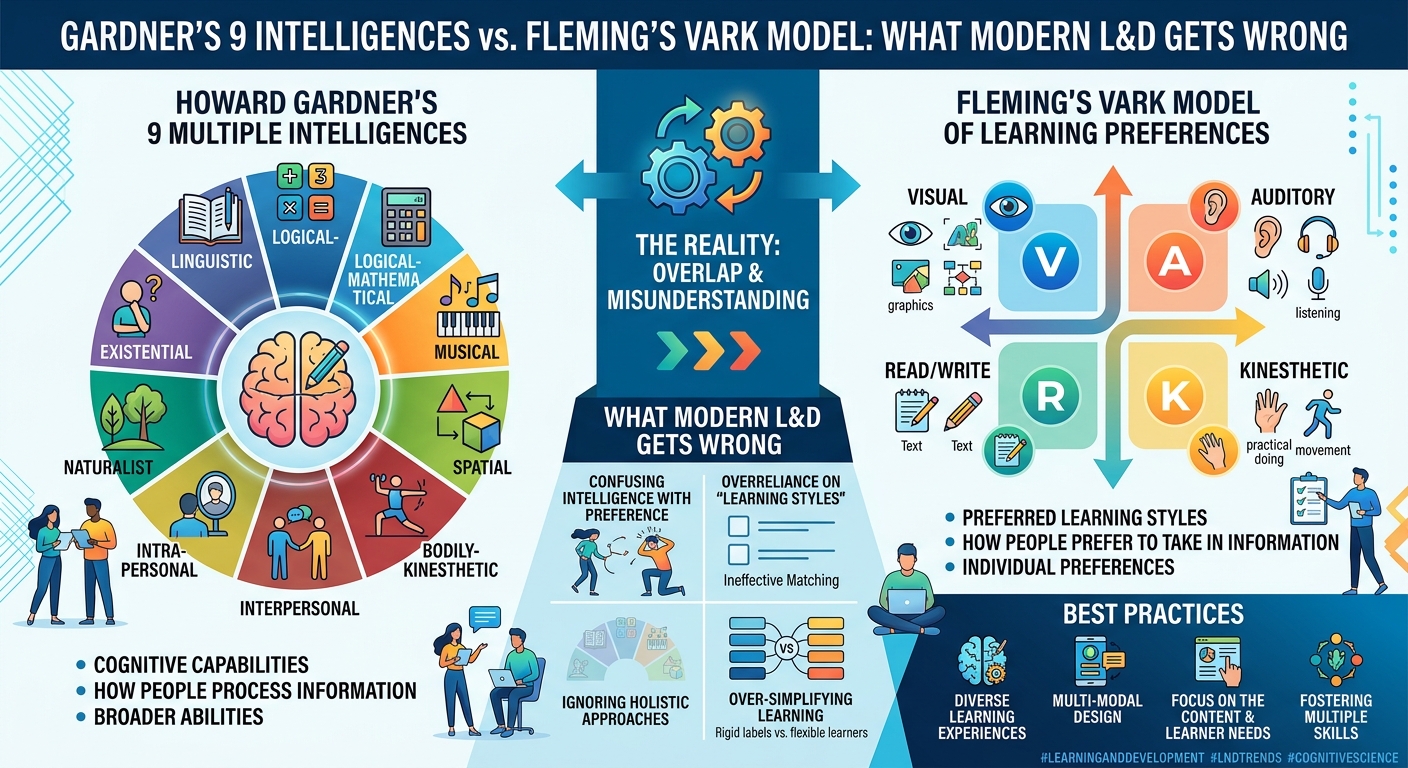
For decades, Fleming’s VARK model has captivated L&D professionals with its apparent simplicity. Categorizing learners into Visual, Auditory, Read/Write, and Kinesthetic preferences, VARK offered an intuitive framework to "personalize" training. The idea was straightforward: identify a learner’s preferred style and then deliver content in that mode. This seemed like a breakthrough for companies striving for better employee engagement, especially in diverse sectors like retail or hospitality.
The allure is understandable. Implementing a VARK-based approach feels proactive and learner-centric. It’s easy to administer quick self-assessments and then design specific modules – a video for visual learners, a podcast for auditory, text documents for read/write, and hands-on simulations for kinesthetic. Many an LMS has been configured to tag content by these styles, making it seem like a truly adaptive learning management system.
However, the foundational flaw lies in its empirical validity. Extensive research has consistently failed to provide robust evidence that teaching to a preferred learning style actually improves learning outcomes. In fact, studies suggest that people learn better when exposed to content in *multiple* modalities, regardless of their professed preference. Over-reliance on VARK can inadvertently limit a learner's exposure to different ways of processing information, hindering their overall cognitive flexibility.
Consider the implications: If an organization in banking, for example, strictly delivers compliance training based on a VARK assessment, are they truly optimizing knowledge retention and application of critical Risk-focused Training, or simply catering to a preference without verifiable benefit? One might ask, how might an intelligent system inadvertently reinforce outdated learning style classifications, even with access to vast datasets on learner interactions? The answer often lies in the quality and theoretical soundness of the data it’s trained on.
Howard Gardner’s Multiple Intelligences: A Holistic Perspective
In stark contrast to VARK's focus on sensory input, Howard Gardner's theory of Multiple Intelligences (MI), first proposed in 1983 and later expanded to nine, offers a profoundly richer understanding of human cognitive capabilities. Gardner posits that intelligence is not a single, monolithic entity, but rather a spectrum of distinct intellectual strengths. These include:
- Linguistic intelligence: Word smart (writers, speakers)
- Logical-Mathematical intelligence: Number/reasoning smart (scientists, mathematicians)
- Spatial intelligence: Picture smart (artists, architects, navigators)
- Bodily-Kinesthetic intelligence: Body smart (dancers, athletes, surgeons)
- Musical intelligence: Music smart (musicians, composers)
- Interpersonal intelligence: People smart (leaders, counselors, sales professionals)
- Intrapersonal intelligence: Self smart (philosophers, psychologists)
- Naturalistic intelligence: Nature smart (biologists, ecologists)
- Existential intelligence: Life smart (those pondering deep questions)
Crucially, Gardner emphasized that individuals possess all these intelligences to varying degrees, and they work in concert. They are not styles to be catered to, but rather cognitive strengths that can be leveraged and developed. For an enterprise learning management strategy, this perspective shifts the focus from pigeonholing learners to designing comprehensive experiences that stimulate a wide array of cognitive processes.
Imagine designing sales training in the pharmaceutical industry. Instead of just a visual presentation (VARK), a Gardner-informed approach would involve role-playing (interpersonal, bodily-kinesthetic), data analysis for market trends (logical-mathematical), understanding product narratives (linguistic), and even empathy exercises to connect with patient needs (intrapersonal). If an advanced analytical model were to truly assess individual strengths, how would its recommendations for a personalized learning pathway differ from a simple learning style assessment? It would likely recommend diverse challenges that build on existing strengths while also developing weaker areas.
The Modern L&D Misstep: Conflating Styles with Strengths
The core problem in modern L&D is the misapplication of a powerful theory (Gardner's) due to the seductive simplicity of a less robust one (VARK). Many organizations, while nodding to personalization and engagement, create content that is still primarily VARK-driven. They build a learning content management system that offers visual content, audio content, text, and perhaps a simple simulation, and believe they are addressing individual needs. However, this often falls short of truly harnessing the multifaceted capabilities of their workforce.
This approach leads to:
- Superficial Engagement: Learners might prefer a certain style, but true engagement comes from challenging multiple intelligences simultaneously.
- Limited Skill Development: By sticking to a "style," L&D may inadvertently neglect the development of other critical intelligences vital for complex tasks in industries like oil and gas or healthcare.
- Ineffective Knowledge Transfer: Complex concepts, especially in compliance or finance, require processing through various cognitive lenses, not just one preferred sensory input. A deep understanding of financial risk, for example, calls for logical-mathematical, linguistic, and even intrapersonal intelligence to assess personal biases.
When an LMS learning management system is designed without this deeper understanding, it risks becoming a mere repository of content rather than a dynamic engine for growth. The lack of true Adaptive Learning capabilities means learners are passively consuming, rather than actively building on their diverse intellectual strengths.
Reimagining L&D: From Learning Styles to Cognitive Strengths
The path forward for L&D leaders demands a pivot. Instead of asking "What is their learning style?", we should be asking "What are their cognitive strengths, and how can we design experiences that challenge and develop a full spectrum of intelligences?" Here’s how modern L&D, equipped with advanced learning management software, can get it right:
Embrace True Adaptive Learning: Move beyond simple content tagging. A sophisticated cloud based learning management system should use performance data and pre-assessments to truly tailor learning paths, not just based on preferred input, but on demonstrated mastery and the need to develop specific intelligences. For instance, in mining operations, a safety module might require spatial intelligence for equipment navigation and logical-mathematical for risk assessment. MaxLearn LMS provides tools for this granular personalization.
Design Multi-Modal, Intelligence-Aware Content: L&D content creators, supported by an AI Powered Authoring Tool, can develop learning experiences that engage multiple intelligences simultaneously. This means more than just a video; it means a video combined with interactive simulations (bodily-kinesthetic, spatial), collaborative problem-solving (interpersonal), reflective journaling (intrapersonal), and analytical challenges (logical-mathematical). Think about complex compliance training in Pharma – it needs more than just reading policy documents; it needs case studies, ethical dilemmas, and practical application exercises.
Leverage Gamified LMS for Broader Engagement: Gamification can be a powerful tool to tap into different intelligences. Strategic puzzles engage logical-mathematical intelligence, team-based missions foster interpersonal skills, and narrative-driven scenarios appeal to linguistic and even existential intelligences. This is crucial for sectors like insurance, where understanding complex policies and client needs requires a holistic intellectual approach.
Focus on Experiential Learning: Hands-on projects, simulations, virtual reality environments, and real-world challenges are not just for "kinesthetic" learners. They are powerful tools for developing bodily-kinesthetic, spatial, logical-mathematical, and interpersonal intelligences. For hospitality staff, practical scenarios in customer service activate multiple intelligences far more effectively than merely watching a training video.
Utilize Data Analytics to Uncover Strengths: A modern MaxLearn LMS goes beyond completion rates. It tracks how learners interact with different types of content and challenges, identifying patterns that reveal their latent intelligences. This data can inform future content development and career development paths within an organization. How can sophisticated algorithmic models help learning designers create experiences that genuinely cater to a spectrum of human capabilities, rather than just preferred sensory inputs?
The future of effective L&D lies in moving beyond the simplistic and empirically weak VARK model towards a sophisticated understanding of human potential as illuminated by Gardner's Multiple Intelligences. By embracing this richer perspective, and leveraging the power of modern learning management system technologies, L&D leaders can design truly transformative learning experiences.
It's time for an enterprise learning management strategy that acknowledges the full spectrum of human capabilities. By integrating MaxLearn LMS solutions that support Microlearning LMS, Adaptive Learning, and a holistic approach to intelligence, organizations across all industries – from manufacturing to healthcare – can foster a more skilled, engaged, and adaptable workforce. This isn't just about better training; it's about unlocking human potential.


Comments
Post a Comment