How Does Spaced Repetition in Microlearning Stop Employee Skill Fade?
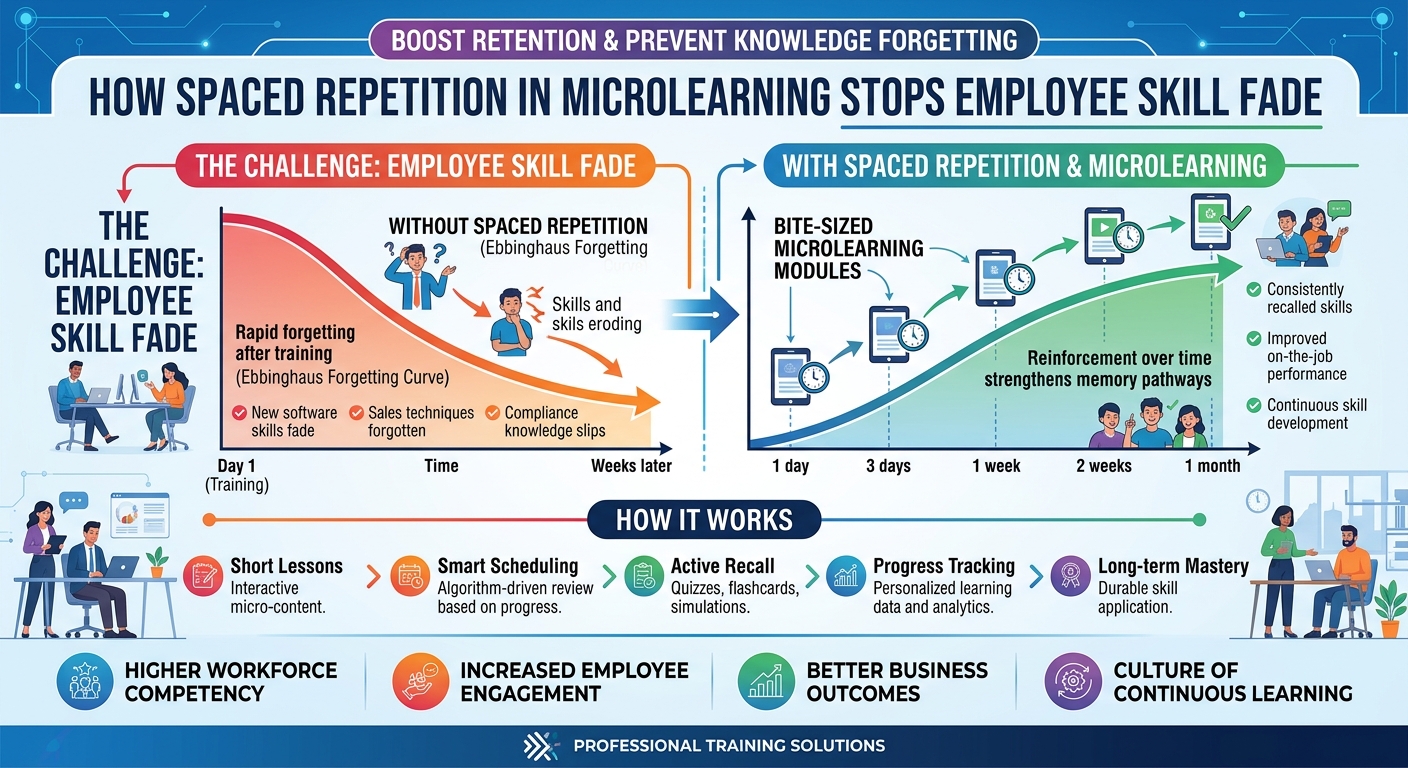
How Does Spaced Repetition in Microlearning Stop Employee Skill Fade?
In today's rapidly evolving corporate landscape, the adage "the only constant is change" rings truer than ever. For Vice Presidents, Directors, and Managers in Learning & Development, this constant flux presents a critical challenge: ensuring employees possess up-to-date, relevant skills. However, the human brain, left to its own devices, has a knack for forgetting. This phenomenon, known as skill fade, erodes training investments and compromises organizational performance across all sectors, from intricate financial regulations in banking to critical safety protocols in oil and gas.
Imagine the implications for compliance training, where a lapsed understanding of a single regulation could lead to significant penalties. Or in sales, where forgetting a product's key differentiator costs a deal. The good news is that L&D leaders have a powerful, scientifically-backed antidote: the strategic combination of spaced repetition within a Microlearning LMS framework. This article will delve into how this dynamic duo effectively combats skill fade, driving sustained competency and measurable business growth.
Understanding the Silent Threat: Employee Skill Fade
Skill fade is the gradual decline in an individual's knowledge or ability over time, particularly when that skill is not regularly practiced or reinforced. It's a natural cognitive process described by Hermann Ebbinghaus's forgetting curve, which illustrates that we tend to forget a significant portion of newly learned information within days, or even hours, if it's not revisited.
For businesses, skill fade isn't just an inconvenience; it's a tangible risk. In high-stakes industries like healthcare and pharmaceuticals, procedural lapses due to skill fade can have severe consequences. For retail and hospitality, forgotten customer service best practices can damage brand reputation. The cost of skill fade manifests in various ways:
- Reduced productivity and efficiency
- Increased errors and compliance breaches
- Missed sales opportunities
- Lower employee confidence and morale
- Wasted investment in initial training programs
Combatting this requires more than just one-off training events. It demands a sustained, strategic approach that aligns with how the brain actually learns and retains information.
The Power of Microlearning: Bites of Knowledge for Busy Minds
Microlearning is an approach to learning that delivers content in small, focused bursts, typically lasting anywhere from 2 to 10 minutes. Unlike traditional, lengthy training modules, microlearning modules are designed to be easily digestible and highly targeted, addressing a single learning objective per unit. This methodology is particularly well-suited for the modern workforce, characterized by demanding schedules and shorter attention spans.
The benefits of incorporating microlearning into your learning management software are significant:
- Increased Engagement: Shorter modules are less daunting and more appealing, leading to higher completion rates.
- Improved Retention: Focusing on one concept at a time prevents cognitive overload.
- On-Demand Accessibility: Employees can access relevant information precisely when they need it, whether on a desktop or mobile device.
- Flexibility: Microlearning content can be easily updated and adapted to reflect new policies, products, or regulations.
When delivered through a robust enterprise learning management system, microlearning makes knowledge acquisition an integrated, seamless part of the workday, rather than a disruptive event.
The Science of Retention: How Spaced Repetition Works
Spaced repetition is a learning technique that involves reviewing previously learned material at increasing intervals over time. Instead of cramming, which leads to short-term recall, spaced repetition leverages the brain's natural memory consolidation processes to move information from short-term to long-term memory.
The core principle is simple: as you recall a piece of information, your brain strengthens the neural connections associated with it. If you recall it just before you're about to forget it, the effort required reinforces the memory more effectively. An intelligent learning management system can track individual performance, identifying knowledge gaps and scheduling optimal review times. This isn't just about repetition; it's about *intelligent* repetition, tailored to each learner's unique forgetting curve.
The Synergy: Spaced Repetition in a Microlearning LMS
Combining spaced repetition with microlearning creates a potent strategy for skill development and retention. Here’s why this pairing is so effective:
- Optimal Reinforcement: Microlearning provides the bite-sized content, while spaced repetition dictates when and how often that content should be revisited. This ensures knowledge is reinforced at the most impactful moments.
- Reduced Overwhelm: Instead of re-doing an entire course, learners revisit a 5-minute module. This reduces the cognitive load and makes reinforcement feel less like a chore.
- Personalized Learning Journeys: An advanced learning management system can track individual mastery, pushing out specific microlearning modules for review only when needed. This Adaptive Learning approach ensures efficiency and relevance.
- Continuous Skill Development: This integrated approach transforms training from a periodic event into a continuous cycle of learning and reinforcement, directly addressing the dynamic needs of industries like banking, healthcare, and manufacturing.
Imagine a sales professional receiving a 3-minute refresher on a competitor's new feature just before a client meeting, or a healthcare worker reviewing a crucial patient safety protocol two weeks after initial training. This is the power of a combined approach.
Implementing a Successful Strategy Across Industries
For L&D leaders, integrating spaced repetition within a microlearning framework, often powered by a cloud based learning management system, offers immense strategic value:
- Compliance: In finance, insurance, and pharma, ensuring up-to-date knowledge of regulations is paramount. Spaced repetition microlearning can deliver short, frequent compliance updates and assessments, minimizing legal and financial risks. Consider Risk-focused Training to address the most critical areas.
- Sales & Retail: Sales teams can benefit from regular, quick refreshers on product features, objection handling, or new sales techniques. This boosts confidence and closing rates. A Gamified LMS can further enhance engagement.
- Healthcare & Hospitality: For critical procedures or customer service standards, spaced repetition ensures that essential information stays top-of-mind, directly impacting patient safety and guest satisfaction.
- Oil & Gas/Mining: Safety protocols are non-negotiable. Short, frequent reminders of critical safety steps delivered via a specialized LCMS can significantly reduce workplace incidents.
The key is having an intelligent learning management software that supports the delivery and tracking of this dynamic learning experience, making it a viable and scalable solution for large enterprises.
Leveraging Intelligent Technology for Enhanced Learning
The effectiveness of spaced repetition and microlearning is greatly amplified by modern learning technology. A sophisticated Microlearning LMS serves as the backbone, managing learning content management system functions and delivering personalized experiences.
Many contemporary platforms now feature an AI Powered Authoring Tool, which can help L&D teams rapidly create engaging microlearning content. These tools can even suggest optimal timing for review based on learning analytics, taking the guesswork out of spaced repetition scheduling.
Advanced Insights: Leveraging Digital Intelligence
L&D leaders are increasingly looking to innovative solutions to optimize training outcomes. Here are some common considerations:
- How can intelligent technology personalize learning paths for each employee?
Advanced algorithms within modern learning management solutions analyze individual performance data, learning styles, and job roles. This allows the system to automatically recommend specific microlearning modules, adjust the frequency of spaced repetitions, and suggest related content to close unique skill gaps, ensuring a truly tailored educational journey.
- Can digital platforms tailor content for specific regional regulations or cultural nuances?
Yes, robust enterprise learning management systems are designed with geo-flexibility. Content can be segmented and delivered based on an employee's location, ensuring that training on compliance, product specifications, or customer interactions is always relevant to local laws, market conditions, and cultural contexts. This is crucial for global organizations.
- How can advanced algorithms ensure training directly impacts business outcomes and not just knowledge retention?
Beyond tracking completion rates and quiz scores, sophisticated learning management systems integrate with HR and business intelligence tools. By correlating learning activities and skill development with performance metrics—such as sales figures, incident rates, or customer satisfaction scores—these algorithms can demonstrate the tangible return on investment of training programs, providing clear insights into how learning drives business success.
The Future is Continuous: MaxLearn LMS and Your Strategy
For L&D professionals seeking to cultivate a workforce that is not just trained but continuously skilled, the integration of spaced repetition and microlearning is indispensable. It's a strategic move that acknowledges how humans learn best and leverages technology to support that process efficiently and at scale. A leading lms learning management system like MaxLearn LMS empowers organizations to deploy this powerful methodology, transforming intermittent training into sustained excellence.
By preventing skill fade, your organization can ensure its most valuable asset—its people—remain competent, confident, and capable of driving innovation and growth in an ever-changing world. Invest in the future of learning; invest in sustained skill mastery.


Comments
Post a Comment