How Does Bloom's Taxonomy Guide AI-Generated Assessment Questions?
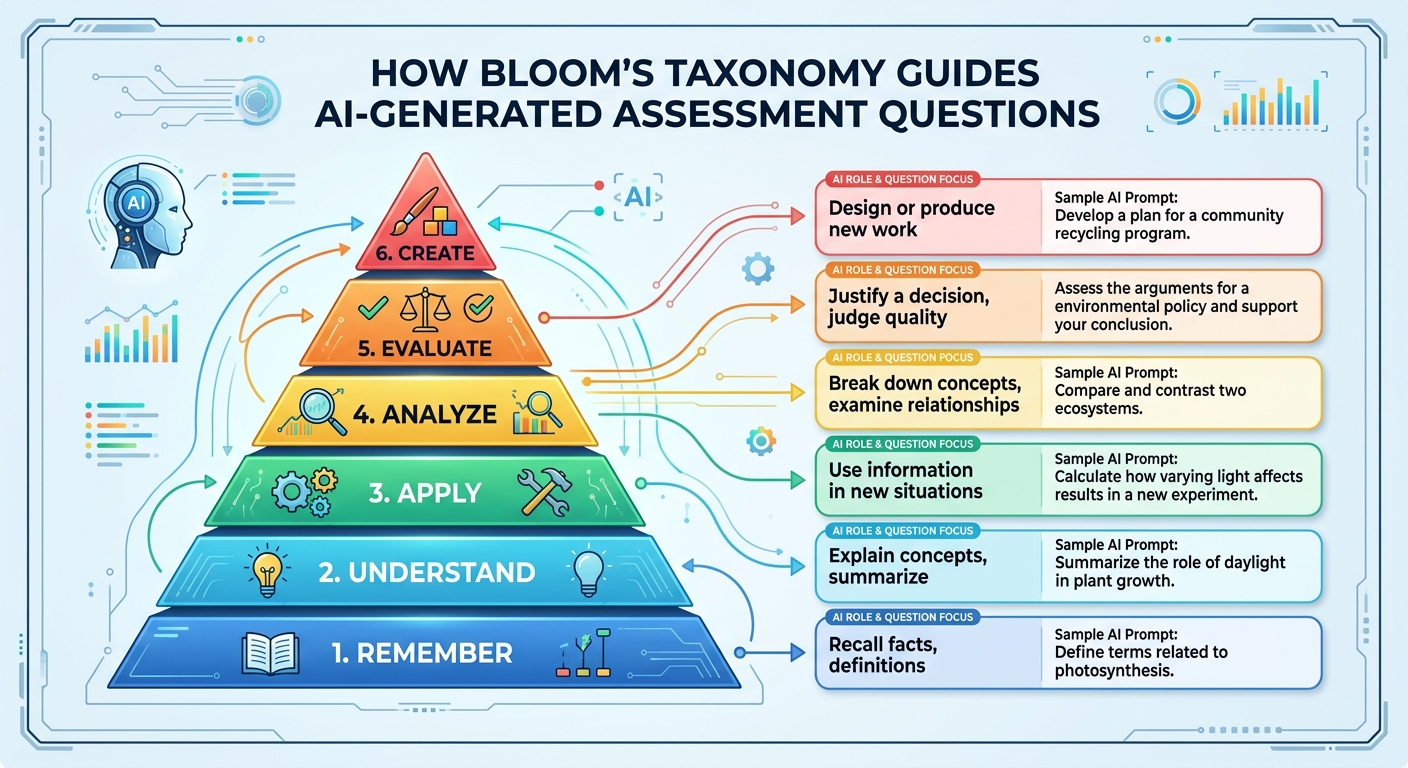
How Does Bloom's Taxonomy Guide AI-Generated Assessment Questions?
In the dynamic world of corporate learning and development, ensuring that training programs genuinely cultivate higher-order thinking skills is paramount. As L&D leaders, you're constantly seeking innovative ways to assess understanding, measure competency, and drive real business impact. The convergence of time-tested pedagogical frameworks like Bloom's Taxonomy with cutting-edge artificial intelligence (AI) offers a powerful solution, transforming how we approach assessment design.
This article delves into how Bloom's Taxonomy acts as the guiding intelligence for AI in generating assessment questions, leading to more robust, precise, and effective evaluations across diverse industries such as Compliance, Sales, Banking, Finance, Insurance, Retail, Pharma, Healthcare, Hospitality, Oil and Gas, and Mining.
Understanding Bloom's Taxonomy in L&D
Developed by educational psychologist Benjamin Bloom in 1956 and later revised, Bloom's Taxonomy is a hierarchical classification system that categorizes cognitive skills into six levels of complexity. It provides a structured way to think about learning objectives and, by extension, how to assess whether those objectives have been met.
The Six Levels of Cognitive Learning
- Remembering: Recalling facts, terms, basic concepts, or answers without necessarily understanding what they mean. (e.g., "What are the three core principles of data privacy?")
- Understanding: Explaining ideas or concepts. Interpreting, summarizing, or classifying information. (e.g., "Describe how data privacy regulations impact customer interaction.")
- Applying: Using information in new situations. Solving problems using acquired knowledge, facts, techniques, and rules. (e.g., "Given a customer scenario, identify the appropriate data handling protocol.")
- Analyzing: Breaking information into parts to explore relationships and connections. Differentiating, organizing, and attributing. (e.g., "Compare and contrast two different compliance frameworks and their implications for our organization.")
- Evaluating: Justifying a decision or course of action. Appraising, critiquing, judging, or selecting based on criteria and standards. (e.g., "Assess the effectiveness of our current risk mitigation strategy against industry best practices.")
- Creating: Producing new or original work. Designing, constructing, planning, or inventing. (e.g., "Develop a new training module that addresses emerging cybersecurity threats.")
For L&D professionals, Bloom's Taxonomy is indispensable for crafting clear learning objectives and ensuring that assessments match the intended depth of learning. However, manually designing a comprehensive suite of questions across all these levels, especially for large organizations, can be incredibly time-consuming and resource-intensive, often falling short of delivering truly adaptive and personalized experiences within a traditional LMS.
The AI Revolution in Assessment Design
Enter Artificial Intelligence. AI is rapidly transforming the landscape of corporate training, offering unprecedented capabilities for personalization, efficiency, and scalability. In the realm of assessments, AI goes far beyond simple question banks; it can dynamically generate questions, provide instant feedback, and even adapt learning paths based on individual performance.
AI's Role in Question Generation
At its core, AI-driven question generation involves algorithms trained on vast datasets of learning materials, instructional design principles, and, critically, pedagogical frameworks like Bloom's Taxonomy. This allows an AI Powered Authoring Tool to understand not just the content but also the cognitive level at which that content should be assessed. When integrated with a modern Microlearning LMS or a comprehensive Gamified LMS, this capability transforms assessment from a static hurdle into a dynamic learning experience.
Marrying Bloom's Taxonomy with AI for Smarter Assessments
The true power lies in the synergy. By embedding Bloom's Taxonomy within AI algorithms, we empower systems to create assessments that are not only efficient to generate but also intellectually rigorous and precisely aligned with learning objectives. This is crucial for any learning management software looking to deliver real value.
Enhancing Question Quality and Variety
AI, guided by Bloom's, can generate a diverse range of question types tailored to specific cognitive levels. For example, if the learning objective is to "understand the principles of ethical conduct in banking," the AI can create multiple-choice questions for "Remembering" (recall principles), scenario-based questions for "Understanding" (interpret ethical dilemmas), and case studies requiring learners to "Apply" ethical frameworks to complex situations. This ensures a thorough evaluation of comprehension, not just memorization, within any robust learning management system.
Dynamic Difficulty Adjustment
One of the most powerful features of AI is its ability to adapt. When combined with Bloom's Taxonomy, AI can dynamically adjust the difficulty of assessment questions based on a learner's real-time performance. If a learner consistently answers "Remembering" questions correctly, the AI can progress to "Understanding" or "Applying" questions. Conversely, if a learner struggles, the AI can present more foundational questions or recommend remedial content, a core component of effective Adaptive Learning. This ensures that assessments are challenging yet supportive, optimizing the learning journey.
Addressing Specific Learning Outcomes
AI, leveraging Bloom's, ensures that every learning outcome, from basic recall to complex problem-solving, is adequately covered. For L&D teams managing an enterprise learning management system, this means they can confidently assert that their training effectively addresses all necessary competencies.
Consider these questions about AI's capabilities:
-
How does artificial intelligence optimize learning pathways?
By analyzing learner performance on Bloom's-aligned questions, AI identifies specific knowledge gaps and recommends personalized learning resources, optimizing the learner's journey towards mastery. This intelligent guidance ensures the most effective use of training time and resources, particularly for continuous professional development.
-
Can artificial intelligence generate detailed explanations for incorrect answers?
Absolutely. When a learner answers incorrectly, AI can provide instant, context-rich feedback and detailed explanations, helping them understand why their answer was wrong and guiding them to the correct understanding. This immediate and comprehensive feedback loop is crucial for reinforcing learning and preventing the perpetuation of misunderstandings, making it a valuable feature for any learning content management system.
-
How does AI intelligently adapt the learning experience?
AI continuously monitors learner progress, performance across different Bloom's levels, and engagement. It then dynamically adjusts the sequence of learning modules, the difficulty of subsequent questions, and the type of content presented. This responsive orchestration creates a truly personalized and effective learning journey, ensuring that each learner receives the support and challenge they need to succeed within the overall learning management solutions.
Practical Applications Across Industries
The benefits of AI-driven, Bloom's-guided assessments resonate across virtually every industry:
- Compliance: In sectors like Banking, Finance, Insurance, and Pharma, understanding complex regulations is critical. AI can generate scenario-based questions at the "Analyze" and "Evaluate" levels, ensuring employees can apply compliance rules to real-world situations, rather than just recalling them. This approach is fundamental for effective Risk-focused Training.
- Sales: For sales teams, the ability to "Apply" and "Create" solutions for customers is key. AI can generate role-play prompts or case studies that test strategic thinking and objection handling, moving beyond basic product knowledge. A modern AI Powered Authoring Tool can be invaluable here.
- Healthcare: Medical professionals need to "Analyze" symptoms and "Evaluate" treatment options. AI can create simulated patient cases that require high-level cognitive skills for accurate diagnosis and care planning.
- Oil & Gas/Mining: Safety procedures often involve "Applying" complex protocols and "Analyzing" potential hazards. AI can craft questions that test decision-making in critical situations, ensuring robust understanding and recall.
- Retail/Hospitality: Customer service excellence requires "Understanding" guest needs and "Applying" service standards. AI-generated scenarios can assess problem-solving skills in customer interactions.
Implementing such advanced assessments requires a robust lms learning management system, ideally a cloud based learning management system that can seamlessly integrate these AI capabilities. An effective LCMS, or learning content management system, can then manage the vast array of content and assessments generated.
The Future of Learning with AI and Bloom's
As AI technology continues to evolve, its synergy with Bloom's Taxonomy will only deepen. We can anticipate even more sophisticated AI models capable of generating highly nuanced, context-aware assessment questions across all cognitive levels. This will further personalize learning paths, provide hyper-targeted feedback, and ultimately lead to more competent and confident workforces.
Platforms like MaxLearn LMS are at the forefront of this revolution, integrating advanced AI capabilities to empower L&D leaders with the tools needed to design future-ready training programs. The move towards an LMS that intelligently adapts and assesses will redefine how organizations approach skill development and talent management. The future of learning management software is intrinsically linked to these intelligent systems.
Conclusion
The marriage of Bloom's Taxonomy and AI is not just an academic exercise; it's a strategic imperative for L&D leaders striving to build highly skilled, adaptable, and high-performing teams. By guiding AI to generate assessment questions across all cognitive levels, we ensure that training is not merely consumed but truly understood, applied, and mastered. This approach delivers tangible benefits: improved learning outcomes, enhanced employee performance, and a stronger competitive edge for your organization.
Embrace this powerful combination to unlock the full potential of your corporate training initiatives and drive meaningful business impact through intelligent, data-driven assessments. The modern learning management system is now a strategic partner in this endeavor, providing the foundation for innovation.


Comments
Post a Comment