How Does AI Automate Knowledge Gap Identification for Frontline Workers?
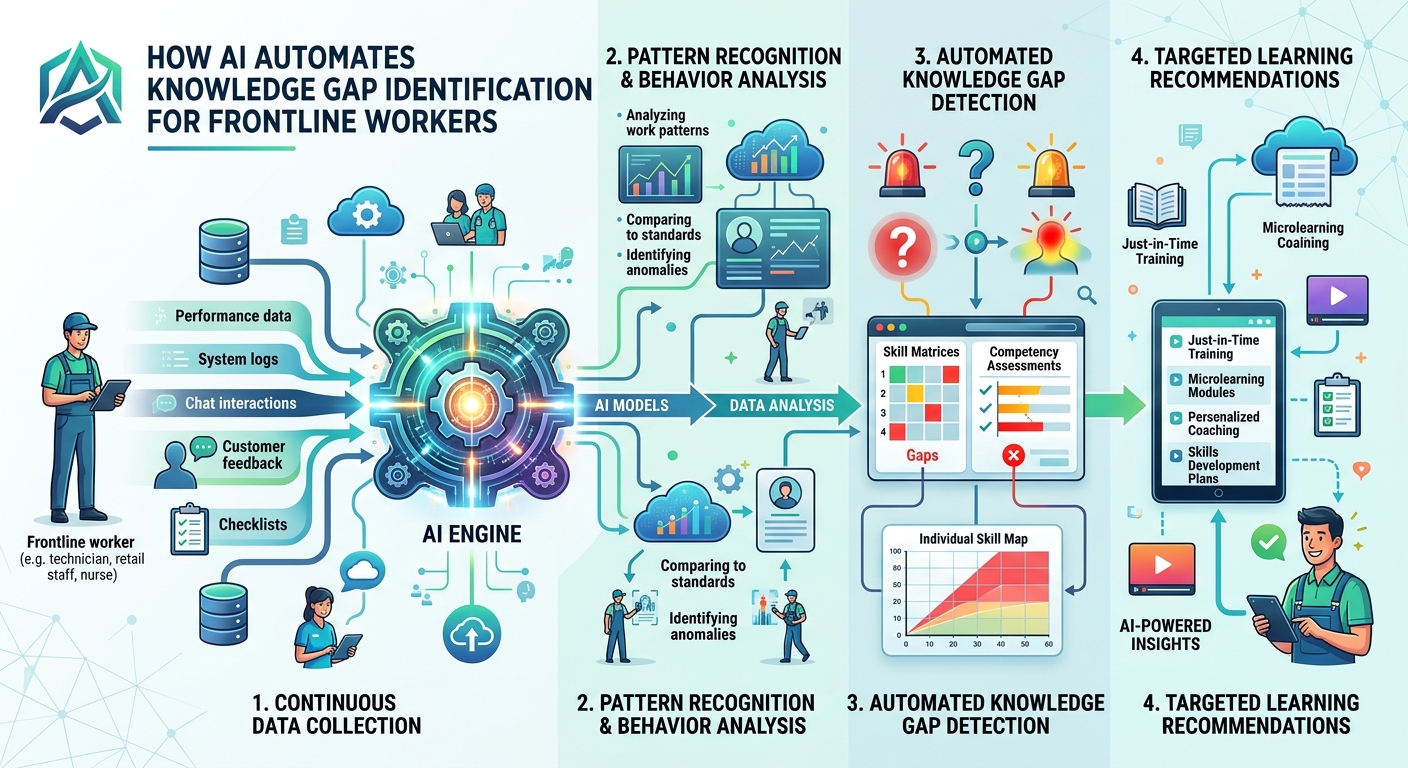
How Does AI Automate Knowledge Gap Identification for Frontline Workers?
In today's fast-paced business environment, the performance of frontline workers is paramount. From sales associates closing deals to healthcare providers delivering critical care and compliance officers ensuring adherence to regulations, these individuals are the direct interface between your organization and its customers, clients, or the public. However, knowledge gaps – those critical deficiencies in skills or information – can severely impede their effectiveness, leading to compliance breaches, lost sales, reduced customer satisfaction, and even safety hazards. For Vice Presidents, Directors, and Senior Managers in Learning & Development (L&D), identifying and addressing these gaps swiftly and efficiently is a perennial challenge. This is where Artificial Intelligence (AI) emerges as a transformative solution, automating the once-laborious process of knowledge gap identification.
The Criticality of Frontline Knowledge
Frontline workers operate at the coal face, often making rapid decisions under pressure. In industries like banking, finance, insurance, retail, pharma, and healthcare, a single knowledge deficit can have significant repercussions. A sales team member unfamiliar with a new product feature might miss a crucial upsell opportunity. A healthcare professional lacking the latest protocol update could compromise patient safety. A compliance officer unaware of a recent regulatory change could expose the company to legal risks. Traditionally, pinpointing these exact gaps has been a reactive and time-consuming endeavor, relying heavily on manual observation, periodic assessments, and post-incident analysis.
The traditional approach often involves:
- Annual performance reviews that might miss immediate needs.
- Subjective feedback from supervisors, which can be inconsistent.
- Post-training assessments that only measure retention, not application in real-world scenarios.
- Reliance on critical incidents to reveal deficiencies, by which point damage may already be done.
These methods are slow, often inexact, and fail to provide the granular, real-time insights needed for truly proactive L&D strategies. This is precisely where AI steps in, transforming how enterprises approach workforce development and training.
AI: The Proactive Engine for Identifying Knowledge Gaps
AI's power lies in its ability to process vast amounts of data at speeds and scales impossible for humans. For L&D professionals, this means moving beyond reactive training to a proactive, predictive model. AI doesn't just identify that a problem exists; it pinpoints why and where a knowledge gap is occurring, often before it significantly impacts performance.
How does artificial intelligence improve employee training?
AI improves employee training by providing data-driven insights into individual and team performance. It analyzes various data points to detect where employees struggle, allowing L&D teams to create highly targeted and relevant training interventions. This moves away from generic programs to personalized learning paths that directly address identified weaknesses, significantly increasing the efficiency and effectiveness of training.
The Mechanisms of AI-Powered Gap Identification
AI leverages several sophisticated mechanisms to automate the identification of knowledge gaps:
- Performance Data Analysis: AI algorithms can analyze operational data such as sales figures, customer satisfaction scores, incident reports, compliance audit results, and production metrics. By correlating performance indicators with individual or team activities, AI can identify patterns. For example, if a specific product line consistently has lower sales conversions or higher customer complaints among a group of sales agents, AI can flag a potential knowledge gap related to that product's features or benefits.
- Interaction Analysis (Natural Language Processing - NLP): In customer-facing roles, AI-powered NLP can analyze call transcripts, chat logs, email communications, and even recorded conversations. It identifies common questions frontline workers struggle to answer, instances where incorrect information is provided, or where employees exhibit hesitation or uncertainty. This provides direct evidence of specific knowledge deficits that can be addressed through targeted training interventions.
- Learning Data Analysis within an LMS: When integrated with a robust learning management system, AI can track how employees engage with training content. It can identify modules frequently failed, sections skipped, quizzes consistently performed poorly, or areas where learners spend an unusually long time. This allows L&D teams using a Microlearning LMS to pinpoint exactly which learning objectives are not being met by individuals or groups, facilitating immediate adjustments to content or delivery.
- Predictive Analytics: Beyond identifying current gaps, AI can predict future knowledge needs or potential weaknesses based on emerging trends, changes in regulations, new product launches, or shifts in market dynamics. This enables L&D to prepare and deliver proactive Risk-focused Training before new challenges arise.
What are the benefits of automation in identifying skill gaps?
The benefits are profound: automation brings unparalleled accuracy, speed, and scalability to skill gap identification. It eliminates human bias, provides real-time insights, and allows L&D teams to allocate resources more effectively. This leads to significantly more impactful training programs, better employee performance, and a stronger bottom line.
Transformative Benefits for L&D Leaders
For L&D VPs, Directors, and Managers, integrating AI into knowledge gap identification offers a wealth of strategic advantages:
- Highly Targeted Training: AI moves L&D away from generic training to hyper-personalized learning paths. Instead of a one-size-fits-all approach, training is delivered only where and when it's needed, maximizing ROI on L&D spend.
- Proactive Intervention: Gaps are identified and addressed before they lead to poor performance, compliance issues, or customer dissatisfaction. This shifts L&D from a reactive cost center to a proactive business driver.
- Operational Efficiency: Automating the identification process frees up L&D professionals to focus on designing engaging content and strategic initiatives, rather than spending countless hours on manual analysis. This includes streamlining content creation using tools like an AI Powered Authoring Tool.
- Enhanced Compliance and Risk Mitigation: Especially crucial in regulated industries like banking, finance, pharma, and healthcare, AI ensures that compliance-related knowledge gaps are quickly identified and resolved, significantly reducing organizational risk.
- Improved Employee Engagement and Retention: When employees receive relevant, timely training that directly helps them succeed, their job satisfaction and loyalty increase. Gamified LMS features can further boost engagement with these targeted learning interventions.
- Data-Driven Decision Making: L&D strategies are no longer based on intuition but on solid, empirical data, demonstrating clear business impact and value.
Can machine learning help L&D teams create better training programs?
Absolutely. Machine learning, a subset of AI, is instrumental in not only identifying gaps but also in recommending appropriate learning content. By understanding individual learning styles and performance patterns, machine learning can power Adaptive Learning experiences, ensuring learners receive the most effective training. Furthermore, it helps L&D teams optimize training design by highlighting content effectiveness and areas for improvement.
Implementing AI for a Smarter L&D Strategy
For organizations looking to harness this power, the path involves integrating AI capabilities with their existing learning content management system or investing in an advanced enterprise learning management solution. A robust cloud based learning management system like MaxLearn LMS can serve as the central hub, collecting and analyzing data from various sources to provide actionable insights. The goal is to create a continuous feedback loop where AI constantly monitors performance, identifies gaps, and recommends or delivers the precise training needed.
What are the first steps to using AI for training needs analysis?
Begin by defining your key performance indicators and identifying the data sources available within your organization (e.g., existing learning management software, CRM, call center records). Next, evaluate learning management solutions that offer integrated AI capabilities or can seamlessly integrate with AI tools. Start with a pilot program in a specific department or for a particular skill set to demonstrate ROI before scaling across the organization.
Where is AI most effectively used for workforce development?
AI is most effective in high-volume, repetitive tasks where data is abundant, and in roles where consistent performance and compliance are critical. This includes customer service, sales, IT support, manufacturing, and regulated industries. Any area where quick, accurate information delivery by frontline staff is crucial stands to benefit immensely from AI-driven workforce development.
Conclusion: The Future of Frontline Excellence is AI-Driven
The imperative for L&D leaders today is to empower frontline workers with the precise knowledge they need, exactly when they need it. AI automates the identification of knowledge gaps, moving beyond guesswork to data-driven precision. It transforms how organizations approach training, making it more efficient, effective, and ultimately, more impactful on business outcomes. By adopting AI-powered solutions, L&D departments can ensure their frontline teams are always at the peak of their performance, safeguarding compliance, driving sales, and elevating the customer experience. Embrace the future of learning with advanced lms learning management system technology and unlock the full potential of your workforce.


Comments
Post a Comment