How Do Push Nudges and Daily Scenarios Improve On-the-Job Decision Making?
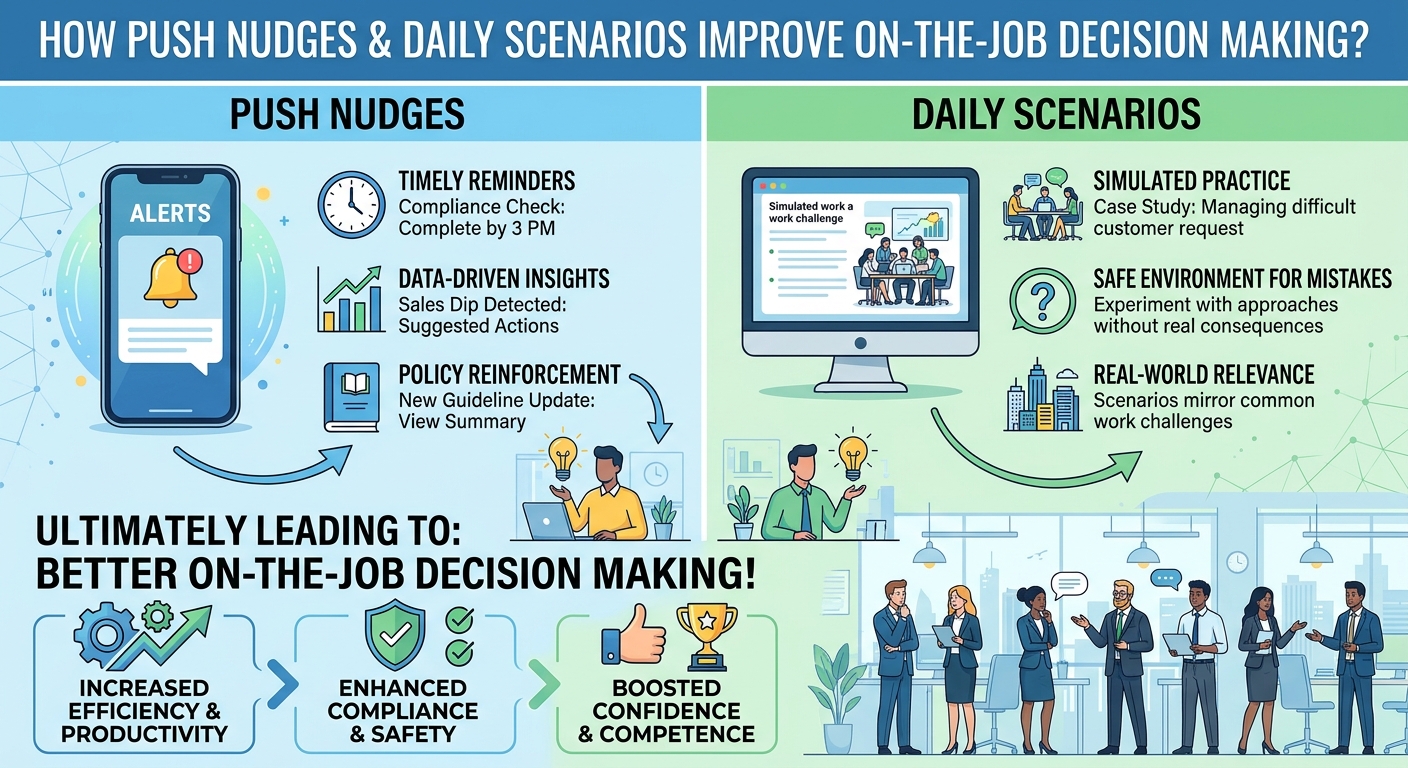
How Push Nudges and Daily Scenarios Sharpen On-the-Job Decision Making for L&D Leaders
In today’s fast-evolving business landscape, effective decision-making isn't just a desirable skill; it's a critical competitive advantage. For Vice Presidents, Directors, and Managers of Learning and Development, the challenge lies in equipping employees, from the frontline to senior leadership, with the acumen to make optimal choices, especially under pressure. Traditional training often falls short in translating theoretical knowledge into practical, real-time application. This is where the innovative combination of push nudges and daily scenarios steps in, transforming how organizations foster superior on-the-job decision-making.
Push nudges are timely, concise, and context-sensitive prompts delivered directly to an employee at their moment of need. Think of them as intelligent micro-interventions. Daily scenarios, on the other hand, immerse learners in realistic work situations, allowing them to practice critical thinking and problem-solving in a safe, simulated environment. Together, these strategies create a powerful learning ecosystem that transcends traditional methods, ensuring that knowledge isn't just acquired, but effectively applied when it matters most.
The Cognitive Edge: Understanding Why Nudges and Scenarios Work
At the heart of better decision-making lies a deep understanding of human cognition. Our brains are prone to biases, memory decay, and information overload, all of which can lead to suboptimal choices. Push nudges and daily scenarios are designed to counteract these inherent challenges.
Overcoming Cognitive Biases with Timely Prompts
Cognitive biases like anchoring, confirmation bias, or availability heuristic can cloud judgment. A well-placed push nudge can serve as an immediate reminder of best practices, ethical guidelines, or critical data points, prompting a more rational and informed decision. For instance, a sales professional about to offer a discount might receive a nudge reminding them of profit margin goals or upselling opportunities.
Reinforcing Knowledge Through Contextual Practice
Learning science confirms that active recall and contextual practice are far more effective than passive consumption. Daily scenarios provide the ideal platform for this. By confronting realistic dilemmas, employees engage multiple cognitive functions – analysis, synthesis, evaluation – solidifying their understanding and building confidence in their ability to navigate complex situations. This approach significantly enhances the value of any Microlearning LMS by offering immediate practical application.
Push Nudges: Precision at the Point of Need
Imagine an employee in compliance, finance, or healthcare needing to make a decision that carries significant risk. A push nudge can be the critical difference between a costly error and a correct action. These digital interventions can take various forms:
- Compliance Alerts: Reminders about regulatory requirements before processing a transaction.
- Best Practice Prompts: Quick tips on handling customer objections during a sales call.
- Safety Checks: Notifications about standard operating procedures before operating machinery in manufacturing or mining.
- Ethical Dilemma Cues: Gentle guidance on company values when facing a moral choice.
Such timely prompts are not intrusive but act as intelligent guardrails, ensuring adherence to protocols and promoting best practices. They are particularly effective when delivered via a robust LMS or learning management system.
Question: How can intelligent prompts enhance real-time performance across diverse industries?
Answer: Intelligent prompts, or push nudges, enhance real-time performance by delivering critical, context-aware information directly to an employee at their moment of need. For instance, in healthcare, a nurse might receive a protocol reminder during medication administration, or in retail, a sales associate could get a product feature highlight when assisting a customer. This immediate, relevant information helps mitigate cognitive overload, reduces errors, and ensures decisions align with organizational goals, whether in banking, hospitality, or oil and gas.
Daily Scenarios: Experiential Learning in Real-Time
While nudges offer immediate guidance, daily scenarios build the foundational decision-making muscles. These simulations provide a safe sandbox for employees to experiment, fail, learn, and grow without real-world consequences. Examples include:
- Customer Service Simulations: Practicing handling difficult customer interactions.
- Sales Negotiation Role-plays: Developing effective objection handling and closing techniques.
- Crisis Management Drills: Simulating responses to unexpected events in hospitality or retail.
- Ethical Decision Labs: Navigating complex moral quandaries in finance or pharma.
The power of scenarios is amplified when coupled with immediate, constructive feedback. This experiential learning fosters critical thinking, problem-solving, and the ability to adapt to unforeseen circumstances. A Gamified LMS can significantly boost engagement in these scenarios, making learning both effective and enjoyable.
Question: What impact does context-aware content delivery have on professional development in specific operational settings?
Answer: Context-aware content delivery, especially through daily scenarios, profoundly impacts professional development by ensuring that learning is directly applicable to an employee's specific operational environment. For a banking associate, a scenario simulating a fraudulent activity report within their actual system interface is far more effective than generic training. Similarly, for a healthcare professional, practicing emergency protocols relevant to their specific unit's equipment and patient demographics leads to deeper understanding and better readiness. This highly relevant practice translates directly into improved on-the-job decision-making and performance across segments like mining, insurance, and pharma.
Synergy: Nudges and Scenarios Working Together
The true magic happens when push nudges and daily scenarios are integrated into a cohesive learning strategy. Scenarios build the initial skill and confidence, while nudges provide the reinforcement and immediate guidance needed to apply those skills consistently in real-world situations. This creates a continuous learning loop:
- Scenario Practice: Develops decision-making frameworks.
- On-the-Job Application: Utilizes learned frameworks.
- Push Nudge Intervention: Corrects or guides decisions in real-time.
- Feedback Loop: Informs future scenario design and nudge refinement.
This dynamic interplay is the essence of Adaptive Learning, where the system continuously learns from employee performance to optimize the learning journey. Such a holistic approach leverages a learning content management system (LCMS) to deliver highly personalized and effective training.
Industry-Specific Applications and Leveraging Technology
The adaptability of push nudges and daily scenarios makes them invaluable across various industries:
- Compliance: For highly regulated sectors like banking, finance, pharma, and healthcare, Risk-focused Training through scenarios and nudges helps employees navigate complex regulations and ethical considerations, minimizing costly errors and legal repercussions.
- Sales: In retail and B2B sales, scenarios can simulate complex negotiations, while nudges can provide real-time competitive intel or product information, enhancing effectiveness. An AI Powered Authoring Tool can rapidly create dynamic sales training content.
- Healthcare: Doctors and nurses can practice critical decision-making in patient care scenarios, with nudges reminding them of drug interactions or patient-specific protocols.
- Hospitality: Frontline staff can practice handling difficult guest situations through scenarios, with nudges guiding them on upselling opportunities or service recovery protocols.
- Oil and Gas & Mining: Safety-critical decision-making can be honed through simulated high-risk scenarios, reinforced by immediate safety nudges during operations.
Modern learning platforms, such as a cloud based learning management system or an enterprise learning management solution like MaxLearn LMS, are essential for deploying these sophisticated strategies. They provide the infrastructure for delivering lms learning management system solutions, tracking progress, and analyzing impact.
Question: How do sophisticated algorithms personalize learning pathways for improved outcomes across a global workforce?
Answer: Sophisticated algorithms, often powered by advanced analytics and machine learning, personalize learning pathways by continuously analyzing individual learner performance, preferences, and job role requirements. This enables an LMS to dynamically recommend specific nudges, suggest relevant daily scenarios, or adapt the complexity of content. For a global workforce, this ensures that each employee receives training that is not only individually tailored but also culturally and regionally appropriate, leading to significantly improved decision-making capabilities and overall professional development, regardless of their location or industry.
Conclusion
For L&D leaders looking to elevate their organization's decision-making capabilities, integrating push nudges and daily scenarios into their learning strategy is not just an enhancement—it's a paradigm shift. These strategies move beyond passive learning, creating an active, responsive, and highly effective environment for skill development and application. By leveraging intelligent technology and a deep understanding of cognitive processes, organizations can empower their employees to make better, more confident, and ultimately, more impactful decisions on the job, driving growth and resilience across every sector.


Comments
Post a Comment