How Do Gardner’s 9 Intelligences Improve Employee Training Retention?
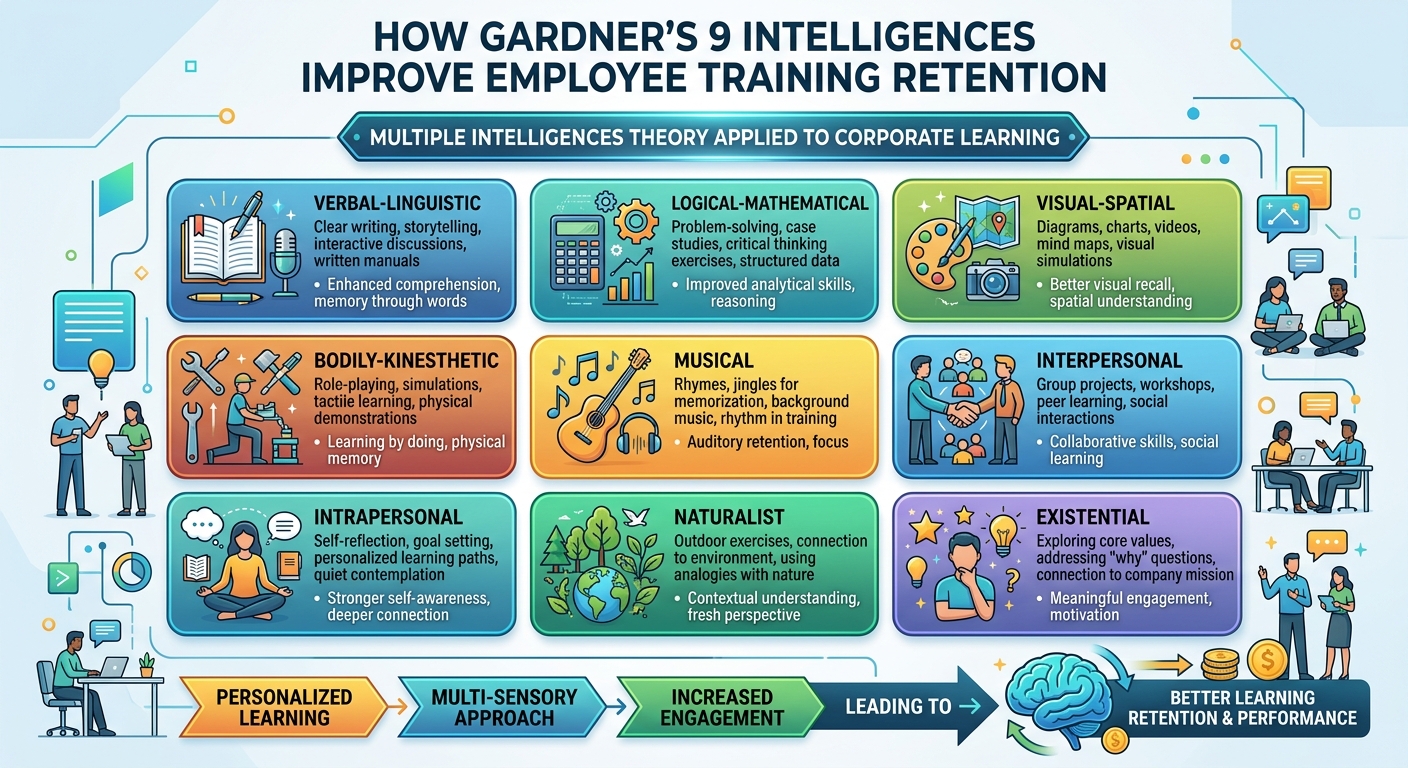
How Gardner’s 9 Intelligences Revolutionize Employee Training Retention
In today's fast-paced corporate world, where industries from Compliance and Sales to Banking, Finance, Insurance, Retail, Pharma, Healthcare, Hospitality, Oil and Gas, and Mining face constant evolution, effective employee training is paramount. Yet, the challenge isn't merely delivering content; it's ensuring that knowledge sticks, skills are applied, and behaviors are adopted. Training retention remains a significant hurdle for L&D leaders. Traditional, one-size-fits-all approaches often fall short, leaving employees disengaged and learning outcomes fleeting.
Enter Howard Gardner's theory of Multiple Intelligences. While often discussed in educational settings, its application in corporate learning and development offers a powerful framework for dramatically improving employee training retention. By acknowledging that individuals possess diverse cognitive strengths, L&D professionals can design more personalized, engaging, and ultimately, more effective learning experiences. This shift from generic training to a tailored approach, often powered by advanced learning management system (LMS) platforms, is key to unlocking sustained employee growth and business success.
Understanding Gardner's 9 Intelligences in the L&D Context
Gardner initially proposed seven intelligences, later expanding to nine. Each represents a distinct way individuals perceive, process, and apply information. Recognizing these in your workforce allows for strategic content design and delivery:
- Linguistic Intelligence: The ability to think in words and use language to express meaning.
- Logical-Mathematical Intelligence: The capacity to carry out mathematical operations and to reason logically.
- Spatial Intelligence: The ability to think in three dimensions, visualize, and mentally manipulate objects.
- Bodily-Kinesthetic Intelligence: The capacity to manipulate objects and use a variety of physical skills.
- Musical Intelligence: The ability to discern pitch, rhythm, timbre, and tone.
- Interpersonal Intelligence: The ability to understand and interact effectively with others.
- Intrapersonal Intelligence: The ability to understand oneself, including one’s own emotions and motivations.
- Naturalistic Intelligence: The ability to recognize and categorize patterns in nature.
- Existential Intelligence: The capacity to tackle deep questions about human existence, such as the meaning of life and death.
By designing training that caters to a blend of these intelligences, organizations can create a more inclusive and impactful learning environment, leading to better knowledge transfer and higher retention rates.
Tailoring Training for Enhanced Retention Across Intelligences
Linguistic Intelligence: Crafting Compelling Narratives
For those strong in linguistic intelligence, training should emphasize reading, writing, storytelling, and discussions. This includes well-structured documentation, case studies, written reports, and engaging verbal presentations. Leveraging an LCMS (Learning Content Management System) that supports rich text, interactive documents, and discussion forums can be highly effective here. Think about compliance training presented as a series of real-world scenarios or sales training delivered through persuasive communication exercises.
Logical-Mathematical Intelligence: Data-Driven and Problem-Solving
Learners with high logical-mathematical intelligence thrive on data, patterns, problem-solving, and logical reasoning. Training should incorporate analytics, simulations, problem-solving exercises, coding challenges, and strategic games. An Gamified LMS with puzzles, logic-based challenges, and performance metrics can significantly boost engagement and retention for this group, particularly in finance, banking, or complex technical roles.
Spatial Intelligence: Visual and Interactive Learning
Individuals with strong spatial intelligence learn best through visuals, diagrams, maps, charts, videos, and virtual simulations. Incorporating infographics, virtual reality (VR) walkthroughs of equipment (for Oil & Gas or Healthcare), interactive 3D models, and flowcharts into your lms learning management system can transform complex concepts into digestible insights. This is invaluable for fields like engineering, retail merchandising, or surgical training.
Bodily-Kinesthetic Intelligence: Learning by Doing
Hands-on experience, role-playing, practical demonstrations, and simulations are crucial for kinesthetic learners. For instance, customer service training might involve role-playing difficult scenarios, while pharma representatives could practice detailing products. An enterprise learning management system that facilitates scenario-based training and tracks practical application can bridge the gap between theory and practice, ensuring skills are ingrained.
Musical Intelligence: Rhythm and Recall
While less common in corporate training, musical intelligence can be leveraged through mnemonic devices, jingles, background music, or rhythmic presentation of information. In unique contexts, such as memorizing complex compliance procedures or safety protocols, integrating a rhythmic element or a memorable jingle could unexpectedly boost retention.
Interpersonal Intelligence: Collaborative and Social Learning
Team projects, group discussions, peer coaching, and collaborative problem-solving are ideal for those strong in interpersonal intelligence. This fosters a sense of community and allows learners to exchange perspectives. Modern learning management software often includes social learning features, forums, and group assignment functionalities, crucial for industries like sales and hospitality where teamwork is key.
Intrapersonal Intelligence: Self-Reflection and Personalized Paths
Individuals with high intrapersonal intelligence benefit from self-paced learning, journaling, reflection exercises, and personalized goal setting. Offering choice in learning paths and providing opportunities for introspection can enhance engagement. Adaptive Learning platforms are particularly effective here, allowing learners to control their pace and focus on areas most relevant to their individual development.
Naturalistic Intelligence: Pattern Recognition and Environmental Context
This intelligence can be tapped by connecting learning to real-world contexts, ecological patterns, or systematic observations. For example, presenting market trends in retail, supply chain patterns in manufacturing, or the life cycle of a product in pharma training can resonate deeply. Using case studies that mirror real business environments helps these learners see the "big picture."
Existential Intelligence: Connecting to Purpose and Meaning
For those with existential intelligence, connecting training content to broader organizational goals, ethical considerations, societal impact, or the 'why' behind their work is vital. Risk-focused Training, for instance, can be framed not just as avoiding penalties but as safeguarding customer trust and the company’s mission, providing a deeper sense of purpose for employees in banking, finance, or healthcare.
Leveraging Modern eLearning for Diverse Intelligences
The practical application of Gardner's theory in corporate L&D is significantly amplified by advanced eLearning technologies. A robust cloud based learning management system empowers L&D professionals to create, deliver, and manage diverse content formats that cater to every intelligence.
How can artificial intelligence personalize learning paths based on diverse learner profiles?
Artificial intelligence is at the forefront of revolutionizing personalization. By analyzing learner performance data, preferences, and interactions, AI can dynamically adjust content delivery, recommend relevant modules, and even predict learning gaps. This ensures that a linguistic learner receives more text-based content, a spatial learner gets more visuals, and a logical-mathematical individual is challenged with problem-solving scenarios, all without manual intervention. The result is a truly individualized learning journey that optimizes retention by playing to each employee's strengths. This capability is foundational to effective Adaptive Learning methodologies.
What advanced tools are essential for developing varied and impactful training content?
To cater to the full spectrum of intelligences, L&D teams need versatile content creation tools. An AI Powered Authoring Tool, for instance, can quickly generate diverse content types—from interactive quizzes and video scripts to scenario-based simulations and infographics—all tailored to specific learning objectives and intelligence profiles. Integrating Gamified LMS elements adds another layer of engagement, turning complex topics into interactive challenges. Furthermore, a Microlearning LMS allows for breaking down information into small, digestible chunks, making it easier to integrate diverse formats and cater to varying attention spans and learning preferences across industries like retail and sales.
In what ways can a robust learning platform support a global workforce with varying learning needs?
A sophisticated MaxLearn LMS is designed to meet the demands of a diverse global workforce. Such a platform can host multilingual content, provide localized learning paths, and offer flexible access across different time zones and devices. It allows L&D managers to segment learners by role, region, or intelligence profile and assign specific training modules. For instance, Risk-focused Training for compliance in banking can be adapted with country-specific regulations, delivered visually for spatial learners, and reinforced with logical scenarios for others, all managed centrally. This ensures that every employee, regardless of their location or dominant intelligence, receives relevant and effective training, enhancing overall enterprise learning management.
The Benefits for L&D Leaders
Implementing a training strategy informed by Gardner's Multiple Intelligences, supported by a modern learning management system, offers significant advantages for VPs, Directors, and Senior Managers of L&D:
- Increased Retention: By aligning training with natural learning styles, knowledge is absorbed more deeply and remembered longer.
- Higher Engagement: Personalized and varied content keeps learners interested and motivated.
- Improved Performance: Better retention translates directly to improved on-the-job performance and productivity.
- Enhanced Compliance: Especially critical in regulated industries, tailored training ensures comprehensive understanding of policies and procedures.
- Better ROI: More effective training means less wasted time and resources on ineffective programs.
- Inclusive Learning Environment: Recognizing diverse intelligences creates a more equitable and supportive learning culture.
Conclusion
The era of generic corporate training is swiftly fading. For L&D leaders striving to elevate employee training retention, embracing Gardner's 9 Intelligences offers a visionary path forward. By leveraging the power of personalization, enabled by advanced learning management solutions and AI-driven platforms, organizations can move beyond mere content delivery to truly transformative learning experiences. This strategic shift not only improves individual employee capabilities but also strengthens the entire organization, driving innovation, compliance, and sustained growth across all industries.


Comments
Post a Comment