How DDE Game Architecture Solves Employee Disengagement in Corporate Training
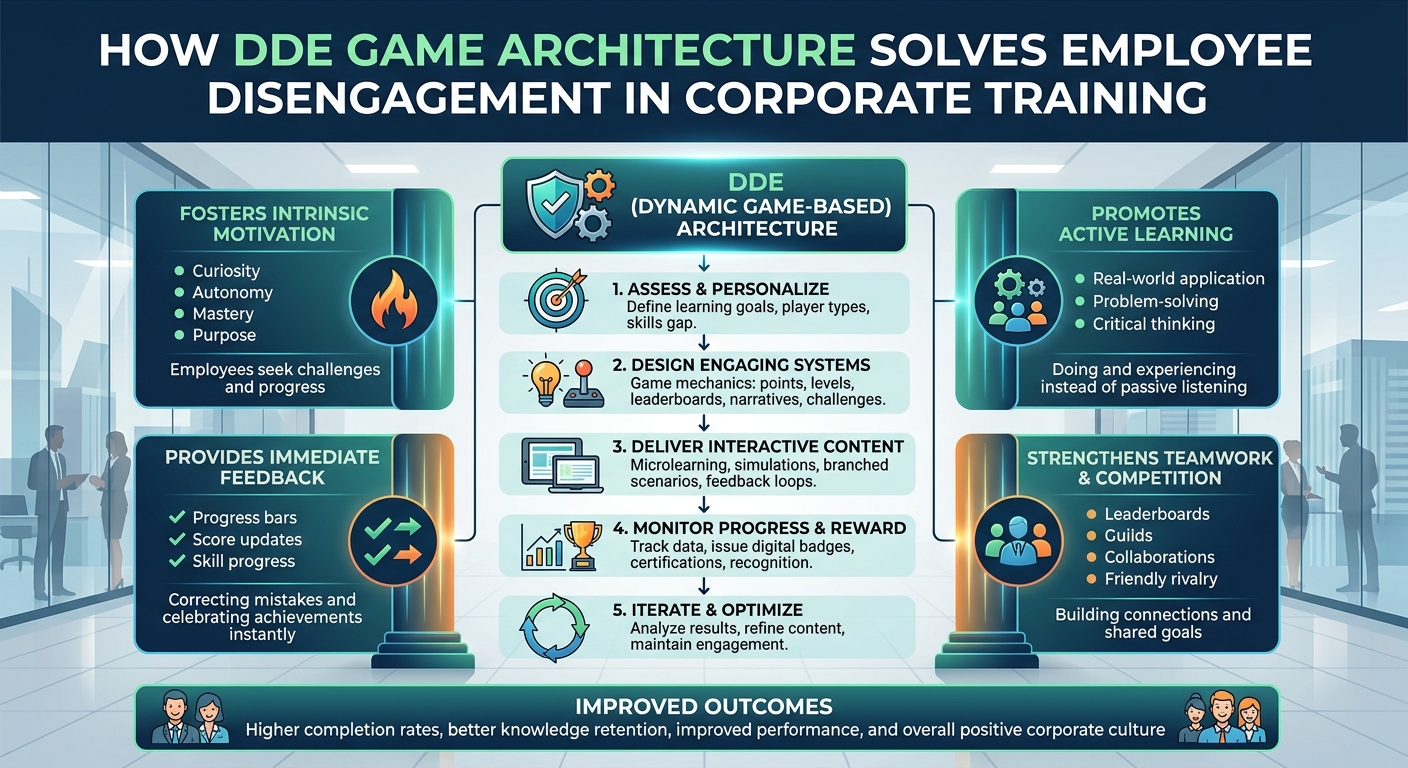
How DDE Game Architecture Solves Employee Disengagement in Corporate Training
In today’s fast-evolving corporate landscape, the efficiency and effectiveness of employee training are paramount. Yet, a persistent challenge continues to plague Learning & Development (L&D) leaders across industries like Compliance, Sales, Banking, Finance, Insurance, Retail, Pharma, Health care, Hospitality, Oil and Gas, and Mining: employee disengagement. Traditional corporate training methods often fall short, leading to low completion rates, poor knowledge retention, and minimal impact on performance. This isn't just an L&D problem; it's a strategic business issue impacting productivity, innovation, and bottom-line growth.
Enter DDE Game Architecture – an innovative framework that transcends simple gamification to fundamentally redesign how employees interact with and internalize corporate training. By focusing on Discovery, Design, and Experience, DDE offers a robust solution to reignite enthusiasm, foster deeper learning, and significantly boost the ROI of your training initiatives. This approach leverages the power of engagement principles found in successful games, not just superficial badges and leaderboards, but deep psychological drivers of motivation and achievement.
The Pervasive Problem of Employee Disengagement in Training
For too long, corporate training has been viewed as a mandatory chore rather than an opportunity for growth. The symptoms of disengagement are stark:
- Low Completion Rates: Employees abandon courses halfway, viewing them as irrelevant or tedious.
- Poor Knowledge Retention: Information is quickly forgotten post-training, failing to translate into practical skills.
- Lack of Motivation: Apathy towards learning opportunities, leading to missed skill development and stagnation.
- Limited Behavioral Change: Even if knowledge is gained, applying it on the job remains a significant hurdle.
These issues directly impact critical business areas, from regulatory adherence in Banking and Pharma to customer service excellence in Retail and Hospitality, or safety protocols in Oil and Gas and Mining. An ineffective learning management system (LMS) or a poorly designed learning content management system can exacerbate these problems, failing to deliver the dynamic learning experiences employees now expect.
Understanding DDE Game Architecture: Beyond Gamification
DDE Game Architecture isn't just about adding game elements; it's about fundamentally restructuring the learning journey based on principles that make games inherently engaging. It stands for:
Discovery: Unearthing Learner Needs and Context
This initial phase focuses on understanding the learner, their existing knowledge, skill gaps, motivations, and the specific context of their role and industry. Instead of a one-size-fits-all approach, DDE emphasizes personalization. What are the specific challenges faced by a sales team in the field, or compliance officers navigating complex financial regulations? This phase often involves in-depth analysis and can be greatly enhanced by an AI Powered Authoring Tool to rapidly assess and tailor content. The goal is to make the learning immediately relevant and meaningful, moving beyond generic modules to targeted, impactful interventions.
Design: Crafting Engaging Learning Experiences
With a clear understanding from the Discovery phase, the Design phase focuses on building a compelling learning narrative and structure. This involves integrating meaningful challenges, progression systems, immediate feedback loops, and opportunities for choice and autonomy. It moves beyond simple quizzes to simulations, branching scenarios, and collaborative problem-solving. A robust Gamified LMS is crucial here, providing the tools to implement complex game mechanics, track progress, and foster a sense of achievement. The design phase ensures that learning is not passive consumption but active participation.
Experience: Delivering Immersive and Continuous Learning
The Experience phase is where the carefully designed training comes to life. It's about creating an immersive environment where learners feel agency, receive timely feedback, and see the direct impact of their learning. This might involve virtual realities for Risk-focused Training in high-stakes environments, or interactive scenarios for customer service teams. Continuous learning, often delivered through a Microlearning LMS, ensures that engagement doesn't stop after a single module. The experience is designed to be ongoing, adaptive, and deeply integrated into the employee's work life, ensuring long-term skill development and application.
The Impact of DDE Architecture on Employee Engagement
By implementing DDE Game Architecture, L&D leaders can transform their corporate training programs:
- Increased Motivation and Ownership: Learners are intrinsically motivated when training feels personally relevant and challenging, giving them a sense of ownership over their development journey.
- Enhanced Knowledge Retention: Active engagement through problem-solving and immediate feedback leads to deeper understanding and better recall.
- Improved Skill Application: The experiential nature of DDE ensures that learned skills are practiced in relevant contexts, making their application in real-world scenarios more seamless.
- Higher Completion Rates: A compelling narrative and clear progression paths encourage learners to complete modules and programs.
- Measurable ROI: Engaged learners translate to a more skilled workforce, reduced errors, increased productivity, and direct business impact.
Integrating this approach with an advanced LMS or a comprehensive learning management software becomes effortless. Modern platforms, often cloud based learning management system solutions, are built to support the dynamic requirements of such architectures, offering features like robust reporting and analytics that measure engagement and learning outcomes.
DDE in Practice: Powering Modern eLearning
A sophisticated enterprise learning management system, such as a MaxLearn LMS, is ideally suited to host DDE-driven training. These platforms can seamlessly integrate various elements:
- Adaptive Learning Paths: The Discovery phase feeds directly into Adaptive Learning capabilities, ensuring content adjusts to individual learner needs and progress.
- Interactive Content Development: An AI Powered Authoring Tool can expedite the creation of rich, scenario-based content, critical for the Design phase.
- Engagement Analytics: A robust learning management system (LMS) provides insights into learner behavior, identifying engagement hotspots and areas for improvement in the Experience phase.
Whether you're looking for an LMS to manage your programs, or a powerful learning management solutions suite for complex enterprise needs, the underlying technology must support this level of dynamic, engaging interaction. Modern LCMS platforms are designed to handle the complexity and rich media required by DDE.
Frequently Asked Questions for L&D Leaders
As you consider transforming your corporate training with DDE Game Architecture, some common questions arise:
Q: How can advanced computational intelligence enhance the DDE architecture for corporate learning?
A: Advanced computational intelligence, particularly machine learning, can revolutionize the Discovery phase by analyzing vast amounts of data on learner performance, preferences, and job roles to recommend highly personalized learning paths. During the Design phase, it can assist in generating dynamic content, creating adaptive scenarios, and even suggesting optimal game mechanics based on desired learning outcomes. In the Experience phase, it powers real-time feedback, intelligent tutoring, and predictive analytics to identify learners at risk of disengagement, allowing for proactive intervention and truly Adaptive Learning experiences.
Q: Is this dynamic training approach equally effective across diverse global teams or specific industry segments like finance or healthcare?
A: Absolutely. While the core principles of DDE Game Architecture are universal for human engagement, its strength lies in its adaptability. The Discovery phase is specifically designed to deeply understand the unique cultural nuances, regulatory requirements, and operational contexts of different global teams and industries. For instance, Risk-focused Training in finance or compliance will be designed with scenarios specific to those sectors, whereas a healthcare setting might prioritize patient safety simulations. The architecture allows for tailoring the narrative, challenges, and feedback mechanisms to resonate profoundly with each specific audience, making it highly effective regardless of geographic location or industry vertical.
Q: What tangible results can L&D departments expect by implementing a DDE-driven training strategy?
A: L&D departments can anticipate a significant uplift in several key metrics. Expect higher course completion rates, often exceeding 80-90% for well-designed programs. Knowledge retention will see a marked improvement, with learners demonstrating a deeper understanding and recall of crucial information. Critically, there will be a noticeable increase in the application of learned skills on the job, leading to enhanced employee performance and productivity. Beyond these, you can expect improved employee satisfaction with training, a stronger learning culture, and a clear, measurable return on investment (ROI) for your training expenditures, thanks to more effective skill development and reduced errors.
Conclusion: Empowering a Highly Engaged Workforce
Employee disengagement in corporate training is an expensive, solvable problem. By embracing DDE Game Architecture, L&D leaders can move beyond outdated methodologies and create truly impactful, engaging learning experiences. This isn't merely about making training fun; it's about fundamentally understanding how people learn and creating environments that foster intrinsic motivation, deep learning, and practical application.
Investing in a modern MaxLearn LMS that supports DDE principles, alongside tools like an AI Powered Authoring Tool, will position your organization at the forefront of talent development. It’s time to transform mandatory training into an anticipated journey of growth, empowering your workforce across all industries with the skills and knowledge they need to thrive.


Comments
Post a Comment