How Can L&D Teams Use Howard Gardner’s Framework in Bite-Sized Learning?
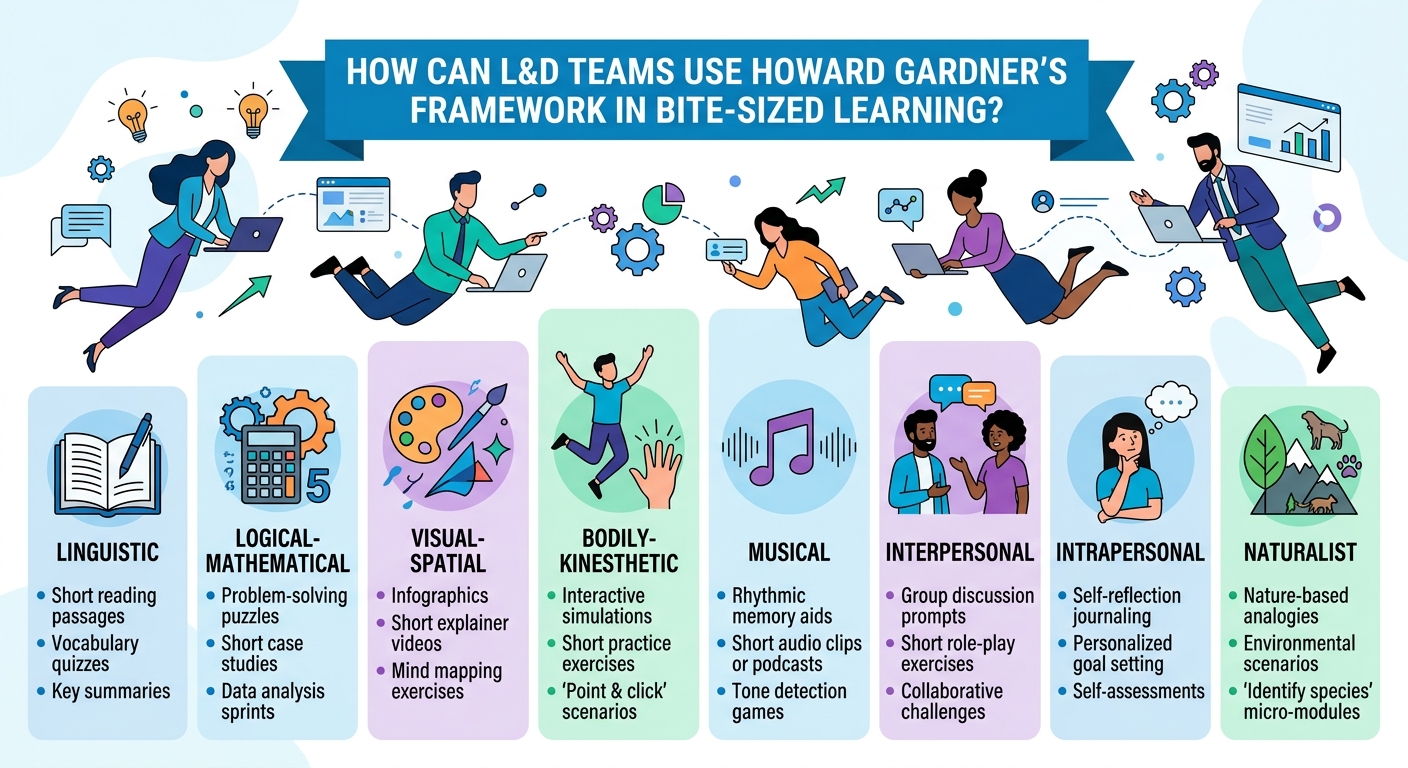
Unlock Potential: How L&D Teams Can Master Bite-Sized Learning with Howard Gardner’s Framework
As L&D leaders, the perpetual challenge lies in crafting training that not only informs but truly transforms. In an era demanding agility and personalized growth, traditional lengthy courses often fall short, struggling to capture attention and accommodate diverse learning styles. This is where the synergy of bite-sized learning and Howard Gardner's theory of Multiple Intelligences offers a groundbreaking approach. Imagine delivering targeted, impactful learning nuggets that resonate deeply with every individual's unique cognitive strengths. This article explores how Vice Presidents, Directors, and Senior Managers in L&D across industries like Compliance, Sales, Banking, Finance, Insurance, Retail, Pharma, Healthcare, Hospitality, Oil and Gas, and Mining can leverage Gardner's framework to elevate their bite-sized learning strategies and enhance organizational development.
Understanding Howard Gardner’s Theory of Multiple Intelligences
In 1983, Dr. Howard Gardner introduced his theory of Multiple Intelligences, challenging the conventional view of intelligence as a single, measurable entity. Instead, he proposed that individuals possess distinct intellectual strengths, or 'intelligences,' which influence how they learn and interact with the world. While initially identifying seven, Gardner later expanded the list. For L&D purposes, focusing on the core intelligences provides a robust foundation:
- Linguistic Intelligence: The ability to use language effectively, both orally and in writing.
- Logical-Mathematical Intelligence: Skill in logical reasoning, problem-solving, and numerical patterns.
- Spatial Intelligence: The capacity to think in three dimensions, visualize, and mentally manipulate objects.
- Bodily-Kinesthetic Intelligence: Expertise in using one's body to express ideas and feelings, and the ability to manipulate objects.
- Musical Intelligence: Sensitivity to rhythm, pitch, melody, and tone.
- Interpersonal Intelligence: The ability to understand and interact effectively with others.
- Intrapersonal Intelligence: Self-awareness, understanding one's own emotions, motivations, and goals.
- Naturalistic Intelligence: The ability to recognize, categorize, and appreciate the natural world.
Recognizing these diverse intelligences is the first step toward creating truly inclusive and effective learning experiences.
The Power of Bite-Sized Learning in Modern L&D
Bite-sized learning, often synonymous with microlearning, delivers content in short, focused bursts – typically 2 to 10 minutes long. This approach aligns perfectly with today’s fast-paced corporate environment, offering numerous advantages:
- Improved Engagement: Shorter modules combat attention decay and learner fatigue.
- Better Retention: Focusing on one concept per module enhances comprehension and recall.
- Flexibility and Accessibility: Learners can access content anytime, anywhere, fitting learning into their workflow.
- Faster Skill Acquisition: Targeted modules allow for quick upskilling or reskilling.
- Cost-Effectiveness: Easier to update and produce, leading to efficient content management.
When combined with an understanding of individual intelligences, bite-sized learning becomes an incredibly potent tool for any modern learning content management system.
Integrating Gardner’s Framework with Bite-Sized Learning Strategies
The true innovation lies in designing bite-sized modules that cater specifically to each intelligence. This multi-modal approach ensures every learner finds content tailored to their natural strengths, maximizing engagement and effectiveness within your enterprise learning management system.
Designing for Each Intelligence: Practical Applications
- Linguistic Intelligence:
- Bite-sized Formats: Short articles, executive summaries, quick-read policy updates (e.g., for Compliance), audio snippets summarizing key points, flashcards for vocabulary (e.g., banking product terms), interactive quizzes with text-based scenarios.
- Example: A 3-minute read on a new financial regulation, followed by a quick quiz.
- Logical-Mathematical Intelligence:
- Bite-sized Formats: Infographics displaying statistics, short data analysis exercises, interactive problem-solving simulations, flowcharts for processes (e.g., supply chain logistics in Retail or Oil & Gas), decision-tree scenarios.
- Example: A 5-minute interactive exercise on calculating profit margins for a new product line in Retail.
- Spatial Intelligence:
- Bite-sized Formats: Animated explainers, interactive diagrams, 3D simulations of equipment (e.g., in Mining or Pharma), virtual tours of facilities (e.g., Hospitality), visual process maps, short video demonstrations.
- Example: A 2-minute animation explaining the layout of a new healthcare facility or a complex machine part.
- Bodily-Kinesthetic Intelligence:
- Bite-sized Formats: Mini-simulations (e.g., operating a sales CRM), interactive role-playing scenarios (e.g., customer service in Banking or Insurance), clickable exercises, step-by-step video guides for physical tasks (e.g., equipment maintenance).
- Example: A 7-minute interactive module simulating a customer complaint resolution process.
- Musical Intelligence:
- Bite-sized Formats: Jingle-based memory aids for complex procedures, short podcasts with background music, rhythmic prompts for recall, mnemonic songs for key facts (e.g., safety protocols).
- Example: A 2-minute audio clip using a catchy jingle to help remember compliance steps.
- Interpersonal Intelligence:
- Bite-sized Formats: Collaborative mini-projects, short discussion prompts for peer learning, quick group activities, empathy-building scenarios, case studies with team-based solutions.
- Example: A 5-minute scenario presenting an ethical dilemma, followed by a quick team discussion prompt.
- Intrapersonal Intelligence:
- Bite-sized Formats: Reflection prompts, journaling exercises, short self-assessment quizzes, goal-setting micro-activities, personal growth prompts.
- Example: A 3-minute reflective exercise on personal leadership style after a virtual meeting.
- Naturalistic Intelligence:
- Bite-sized Formats: Case studies linking business challenges to natural phenomena or ecological principles, short videos on sustainable practices, modules on environmental impact in industries like Oil & Gas.
- Example: A 4-minute case study illustrating lean manufacturing principles through observations of natural ecosystems.
Leveraging Technology for Multi-Intelligent Bite-Sized Learning
Implementing such a diverse range of bite-sized content requires robust technological infrastructure. A cutting-edge Microlearning LMS is essential, serving as a comprehensive learning management system designed to support this multi-modal delivery. Modern learning management software goes beyond basic content delivery; it facilitates a dynamic and engaging learning ecosystem.
- Personalization and Adaptive Learning: An advanced LMS can track learner progress and preferences, suggesting content tailored to their identified intelligences and knowledge gaps. This ensures a personalized learning journey for every employee, making learning management solutions truly effective.
- Gamified LMS Features: Incorporating elements like points, badges, leaderboards, and interactive challenges can appeal to various intelligences, particularly kinesthetic and logical learners, driving engagement and motivation. This is crucial for industries like Sales or Retail where motivation is key.
- Content Creation with AI Powered Authoring Tool: Modern LCMS platforms increasingly integrate AI tools to expedite the creation of diverse bite-sized modules – from automatically generating quiz questions from text to suggesting visual aids. This significantly reduces the burden on L&D teams.
- Risk-focused Training: For sectors like Finance, Banking, and Healthcare, delivering complex compliance and risk management training in bite-sized, intelligence-specific formats improves comprehension and reduces human error. Imagine a spatial learner visualizing a risk matrix or a linguistic learner quickly absorbing regulatory updates via audio.
A cloud based learning management system like MaxLearn LMS provides the scalability and flexibility needed for diverse organizations to implement these strategies effectively, acting as a powerful lms learning management system.
Optimizing Learning Delivery: Common Inquiries
How can technology help personalize learning experiences for diverse learners?
Sophisticated learning platforms utilize data analytics and machine learning to understand individual learning patterns, preferences, and progress. By tracking which types of bite-sized content (videos, interactive simulations, text, audio) a learner engages with most effectively, the system can dynamically recommend subsequent modules that align with their dominant intelligences. This intelligent curation ensures that each learner receives a pathway optimized for their unique cognitive strengths, maximizing knowledge retention and skill development. For example, a learner who excels with visual content will be presented with more spatial-intelligence focused micro-modules, while a linguistic learner will receive more text-based or audio summaries.
What are the key considerations for implementing these varied learning formats across different organizational locations?
When deploying multi-modal bite-sized learning globally, key considerations include language localization, cultural relevance of content, and ensuring equitable access to technology. Content must be easily translatable and adaptable to local contexts, avoiding idioms or examples that might not resonate universally. Additionally, bandwidth limitations and device availability in different regions should inform the format choices; for instance, offering text-heavy options where internet access is inconsistent. A robust cloud based learning management system with multilingual support and responsive design capabilities is crucial for seamless deployment across diverse geographical footprints, ensuring consistent, high-quality learning experiences for all employees.
How can we ensure our learning content truly resonates with individual employee needs and preferences?
Beyond initial intelligence assessments, continuous feedback loops are vital. Incorporate short surveys or quick reaction buttons within bite-sized modules to gather immediate insights on content effectiveness and preferred formats. Encourage learners to provide input on what types of activities they find most engaging and helpful. Analyzing this qualitative and quantitative feedback, coupled with data from the learning platform on completion rates and assessment scores, allows L&D teams to continuously refine and adapt their content strategy. This iterative approach ensures that the learning offerings evolve alongside employee needs, fostering a sense of ownership and relevance among learners.
Conclusion
The fusion of Howard Gardner’s Multiple Intelligences theory with bite-sized learning offers a powerful paradigm shift for L&D teams aiming for true impact. By consciously designing learning experiences that cater to the diverse cognitive strengths within your workforce, you move beyond mere training to foster genuine understanding, engagement, and skill mastery. This approach is not just innovative; it’s a strategic imperative for organizations striving for agility and continuous growth in any sector. Embrace this methodology within your chosen learning management software and watch your workforce thrive.


Comments
Post a Comment