High-Stakes Aviation and Safety Training: Visual-Spatial and Kinesthetic Microlearning in Action
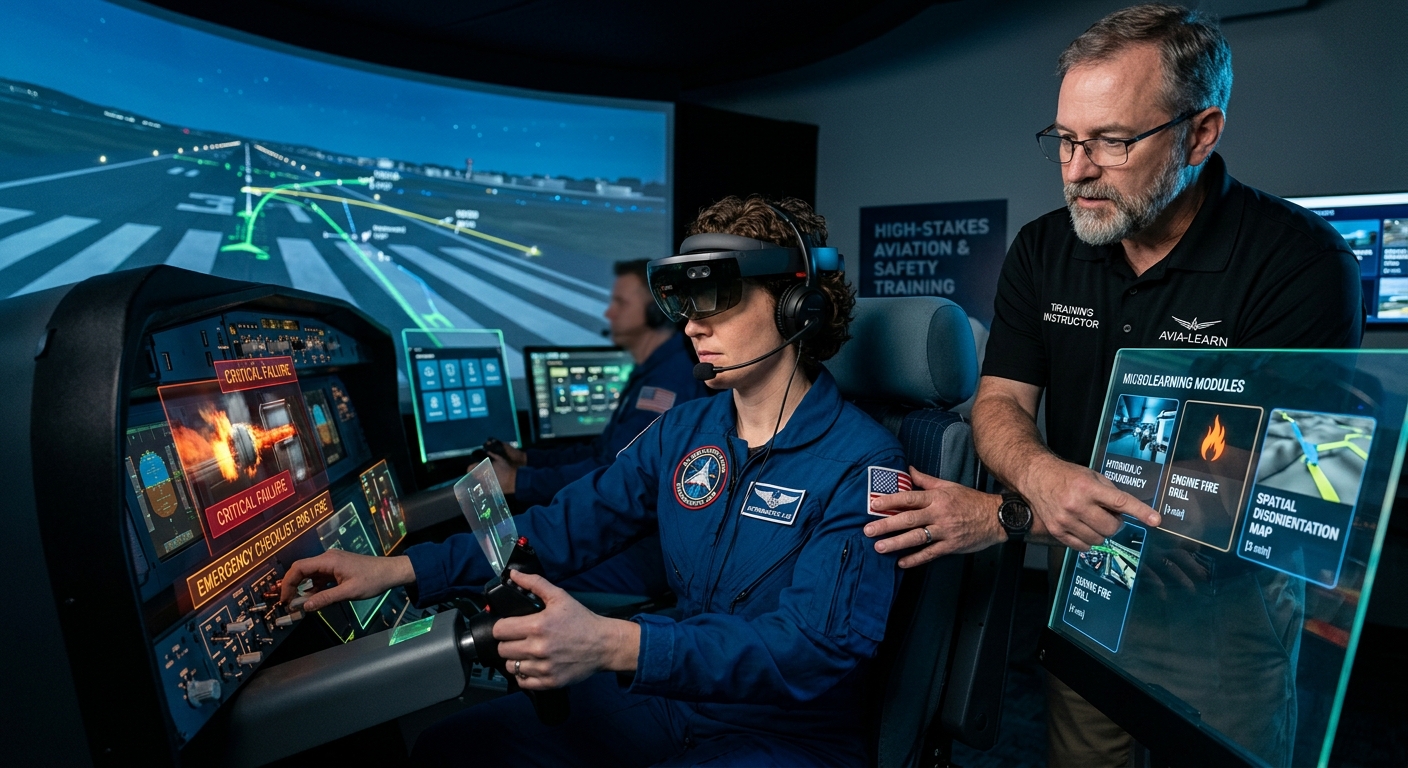
High-Stakes Aviation and Safety Training: Visual-Spatial and Kinesthetic Microlearning in Action
For Learning & Development leaders across industries, the challenge of delivering effective training is universal. However, in sectors where a single error can have catastrophic consequences, the stakes are immeasurably higher. Aviation stands as the quintessential example of such an environment, demanding unparalleled precision, swift decision-making, and unwavering adherence to complex protocols. This article delves into how advanced methodologies – specifically visual-spatial and kinesthetic microlearning – are revolutionizing safety training in aviation and how these principles can be applied across various high-stakes sectors, all powered by robust learning management solutions.
Why Aviation? The Ultimate High-Stakes Environment
Consider the cockpit of a commercial airliner: hundreds of lives depend on the pilots' immediate recall of procedures, their interpretation of intricate instrument readings, and their seamless coordination. The sheer volume of information, coupled with the need for continuous competency in ever-evolving scenarios, makes traditional training models insufficient. Aviation training is not merely about knowledge acquisition; it's about embedding critical skills, fostering muscle memory, and cultivating an intuitive understanding of complex systems and emergency protocols. It’s the ultimate realm for Risk-focused Training, where compliance is paramount and the margin for error is non-existent.
Managing this intricate web of training, certifications, and recurrent checks necessitates a sophisticated learning management system. An effective lms learning management system serves as the central hub, ensuring every crew member is up-to-date with their required modules, from regulatory compliance to specific aircraft operations.
The Brain Behind the Controls: Visual-Spatial and Kinesthetic Learning
To truly understand how pilots master their craft, we must look at the cognitive processes involved:
- Visual-Spatial Learning: This involves understanding and manipulating objects in space. For pilots, it's about interpreting flight path projections, understanding complex instrument layouts, visualizing air traffic control instructions, and mentally navigating 3D environments. It’s the ability to see the bigger picture and the intricate details simultaneously, crucial for everything from landing approaches to emergency procedures.
- Kinesthetic Learning: Often referred to as "learning by doing," this style involves physical movement, hands-on experience, and developing muscle memory. In aviation, this translates to the precise manipulation of controls, the tactile feel of switches and levers, and the physical execution of emergency checklists. It’s the embodied knowledge that allows a pilot to react instinctively under pressure.
Both learning styles are indispensable for developing the deep, intuitive understanding required for aviation safety. The challenge for L&D is to design training that effectively engages both.
Microlearning: The Precision Instrument for High-Stakes Skills
Enter microlearning – short, focused bursts of content designed to achieve a specific learning objective. For aviation, this isn't just a trend; it's a strategic imperative. The sheer volume of information a pilot needs to absorb and retain makes lengthy, traditional courses inefficient. Instead, an Microlearning LMS allows for:
- High Retention: Smaller chunks of information are easier to digest and remember.
- On-Demand Access: Pilots can quickly refresh their knowledge on a specific procedure right before a flight or during an unexpected situation.
- Continuous Learning: Facilitates regular, bite-sized updates on new regulations, aircraft modifications, or best practices, supporting Adaptive Learning paths.
When combined with visual-spatial and kinesthetic techniques, microlearning becomes a powerful catalyst for skill mastery.
Visual-Spatial Microlearning in Action
Imagine:
- Interactive Cockpit Diagrams: Instead of static images, pilots engage with 3D, rotatable models of cockpit panels, tapping on instruments to reveal short video explanations or simulations of their function.
- Animated Flight Path Simulations: Micro-modules demonstrating specific approach procedures or emergency maneuvers, allowing pilots to visualize complex trajectories in real-time.
- Virtual Reality (VR) Checklists: Short VR scenarios where pilots must visually identify and interact with specific controls in a simulated emergency, reinforcing spatial memory.
These elements, easily delivered via a modern learning management software, enhance comprehension and recall far beyond traditional methods.
Kinesthetic Microlearning in Action
For hands-on learning, microlearning can be equally transformative:
- Haptic Feedback Simulations: Short modules on a tablet that simulate the tactile feel and response of specific buttons or switches, reinforcing muscle memory.
- Gamified LMS Decision Drills: Quick, interactive games where pilots must rapidly make decisions and execute actions in response to unfolding scenarios, simulating the pressure of a real-world event.
- Augmented Reality (AR) Maintenance Guides: Technicians use AR to overlay digital instructions onto physical aircraft components, guiding them through precise repair or inspection tasks step-by-step.
These approaches move beyond theoretical knowledge, embedding practical skills through repetitive, engaging interaction.
The Synergy: Visual-Spatial, Kinesthetic, and Microlearning
The true power lies in the integration of these methodologies. A microlearning module might begin with a visual simulation of an engine failure (visual-spatial), then prompt the learner to physically interact with an on-screen or haptic control panel to execute the emergency checklist (kinesthetic), all within minutes. This rapid, multi-sensory engagement reinforces learning pathways, making critical responses more intuitive and automatic.
This synergy is vital for fostering:
- Improved decision-making under pressure.
- Reduced human error through ingrained procedures.
- Enhanced adaptability to unforeseen circumstances.
Leveraging Technology for Unparalleled Safety
Implementing such advanced training requires an equally advanced technological backbone. A comprehensive learning content management system (LCMS) is essential for authoring, managing, and delivering diverse microlearning content. Features like an AI Powered Authoring Tool can dramatically speed up the creation of interactive, personalized modules, while an enterprise learning management solution ensures consistent training across a global workforce. The flexibility of a cloud based learning management system also allows for updates and access anytime, anywhere, critical for mobile aviation professionals.
AI-Driven Insights for Optimal Training Delivery
Artificial intelligence is not just a buzzword; it's a powerful ally in optimizing high-stakes training. Here's how it's shaping the future:
Question: How can artificial intelligence optimize the discoverability and relevance of our training modules for learners?
Answer: AI algorithms analyze search queries, learner behavior, and content tags to ensure the most relevant and precise microlearning modules are presented first. This means pilots can quickly find the exact procedure or emergency drill they need, improving efficiency and real-time application in a critical scenario.
Question: What role does AI play in tailoring training content based on a learner's operational location or specific flight routes?
Answer: AI-driven geographic intelligence can adapt training content based on regulatory requirements, specific airport procedures, weather patterns, or airspace rules pertinent to a pilot's current or upcoming assignments. This ensures highly contextual and immediately applicable learning, enhancing safety protocols specific to diverse global operations.
Question: In what ways can AI personalize the learning journey to cater to individual pilot's strengths, weaknesses, and preferred learning styles?
Answer: AI analyzes performance data, completion rates, and interaction patterns to create a truly personalized learning path. It can identify skill gaps, recommend specific visual-spatial or kinesthetic microlearning modules, and adjust the pace and complexity of content, ensuring each pilot receives the most effective and efficient training tailored to their unique needs.
Beyond Aviation: Industry Applications
While aviation sets the bar, the principles of visual-spatial and kinesthetic microlearning, supported by a robust learning management system, are transferable to numerous other high-stakes environments:
- Healthcare: Training surgeons on new procedures via VR, nurses on emergency protocols with interactive simulations.
- Oil and Gas/Mining: Simulating hazardous environments for safety training, practicing equipment operation with haptic feedback.
- Finance/Banking: Interactive modules for compliance training on complex regulations, visual scenarios for fraud detection.
- Manufacturing: Kinesthetic training for operating complex machinery, visual troubleshooting guides for maintenance.
Across these sectors, ensuring compliance and minimizing risk are paramount, making these modern training approaches invaluable.
Conclusion
For L&D professionals, the lessons from aviation are clear: in high-stakes environments, training must transcend mere information delivery. By embracing visual-spatial and kinesthetic microlearning, powered by intelligent learning management software, organizations can transform competency development. This isn't just about efficiency; it's about building resilience, enhancing safety, and fostering a culture of excellence where every individual is equipped with the precise skills needed to perform flawlessly when it matters most. Explore how a platform like MaxLearn LMS can empower your organization to reach new heights in training efficacy and safety.


Comments
Post a Comment