Gardner’s 9 Intelligences in L&D: The Complete Definitive Guide for Instructional Designers
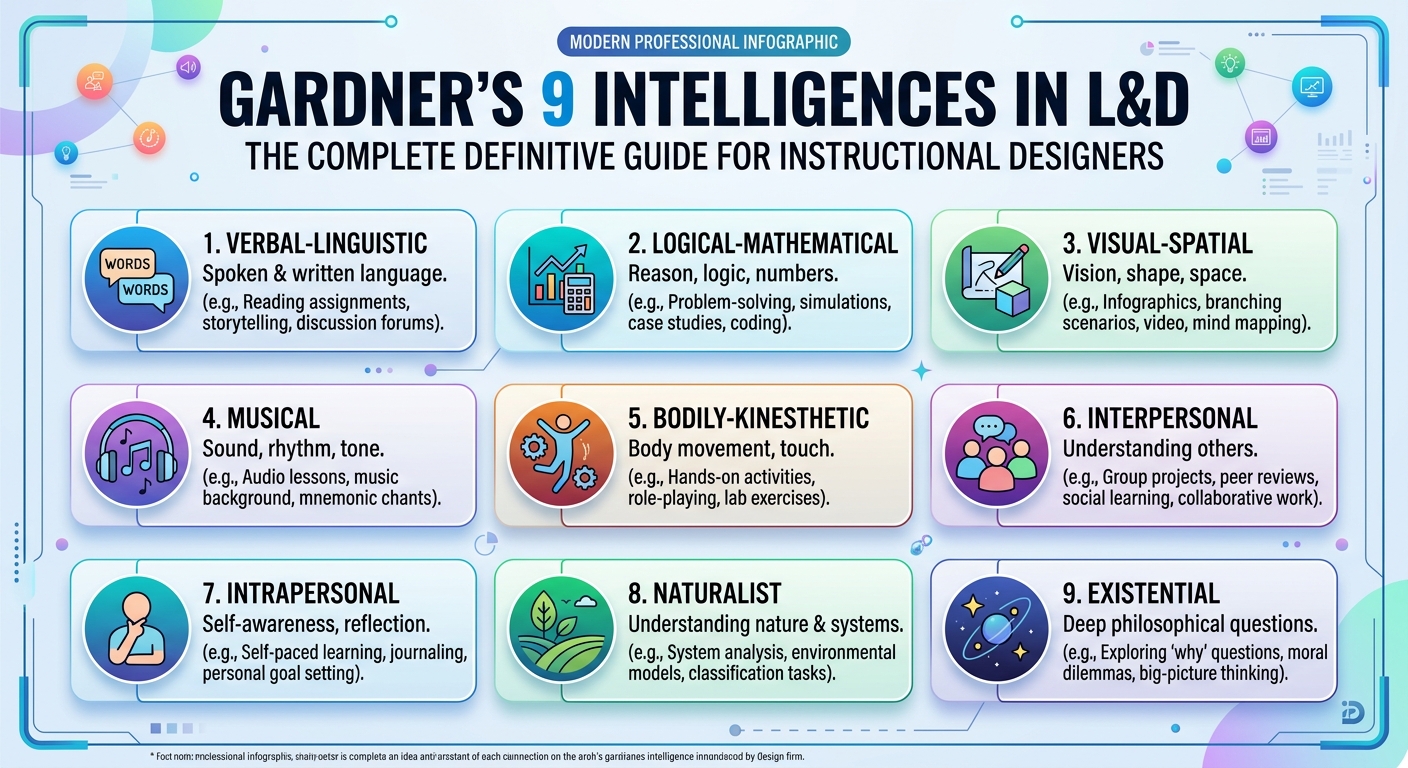
Gardner’s 9 Intelligences in L&D: The Complete Definitive Guide for Instructional Designers
In today's dynamic corporate landscape, effective learning and development (L&D) is not just a perk; it's a strategic imperative. As L&D leaders, Vice Presidents, Directors, and Senior Managers, your primary goal is to foster a highly skilled, adaptable, and engaged workforce across industries like Compliance, Sales, Banking, Finance, Insurance, Retail, Pharma, Health care, Hospitality, Oil and Gas, and Mining. But how do you design training that truly resonates with every individual, maximizing knowledge retention and performance? The answer lies in understanding and applying Howard Gardner's groundbreaking theory of Multiple Intelligences.
For too long, L&D has operated under a 'one-size-fits-all' assumption, inadvertently leaving many learners behind. This approach overlooks the diverse ways individuals perceive, process, and apply information. This definitive guide will empower instructional designers and L&D leaders to revolutionize their strategies by integrating Gardner’s 9 Intelligences, creating more personalized, engaging, and impactful learning experiences through a robust learning management system.
Understanding Gardner's Theory of Multiple Intelligences
What is Howard Gardner's theory of Multiple Intelligences? Developed by Harvard psychologist Howard Gardner in 1983, the theory challenges the traditional view of intelligence as a single, measurable entity (like an IQ score). Instead, Gardner proposed that humans possess at least nine distinct intelligences, each representing a different way of interacting with the world. Recognizing these intelligences allows instructional designers to move beyond conventional pedagogical methods and craft content that speaks to the innate strengths of diverse learners.
By tailoring learning content management system approaches to these varied intelligences, organizations can unlock previously untapped potential, boost engagement, and significantly improve learning outcomes. This is particularly crucial when dealing with complex or critical training, such as risk mitigation in finance or compliance protocols in healthcare.
The 9 Intelligences and Their L&D Applications
Let's delve into each intelligence and explore how instructional designers can strategically integrate them into their L&D programs, often facilitated by an advanced Microlearning LMS or an efficient AI Powered Authoring Tool.
1. Linguistic-Verbal Intelligence
Definition: The ability to think in words and use language to express and appreciate complex meanings. In L&D: These learners thrive with written materials, lectures, debates, storytelling, and discussions. They excel at writing reports, crafting persuasive arguments, and understanding nuanced instructions.
- Provide comprehensive written manuals and detailed microlearning LMS modules with text-based explanations.
- Incorporate case studies, scenario-based learning, and role-playing scripts.
- Encourage peer discussions, written reflections, and presentation assignments.
- Utilize narratives and storytelling to convey complex information, especially in compliance or ethics training.
2. Logical-Mathematical Intelligence
Definition: The ability to carry out mathematical operations and critically analyze problems. In L&D: These individuals are drawn to logic, patterns, cause-and-effect, and data. They need to understand the 'why' behind processes.
- Present data-driven insights, statistics, and logical frameworks.
- Integrate problem-solving exercises, simulations, and financial models.
- Design modules with clear objectives, step-by-step processes, and quantitative assessments.
- Crucial for Risk-focused Training in banking, finance, and oil & gas, requiring analytical skill development.
3. Spatial Intelligence
Definition: The ability to think in three dimensions, mentally manipulate objects, and visualize effectively. In L&D: Visual learners benefit from charts, graphs, diagrams, videos, and simulations. They excel at understanding blueprints, maps, and visual presentations.
- Employ rich multimedia content, infographics, and interactive diagrams within the learning management software.
- Utilize virtual reality (VR) or augmented reality (AR) for practical training in healthcare or manufacturing.
- Offer flowcharts for processes and visual metaphors to explain abstract concepts.
- An AI Powered Authoring Tool can help generate visual content more efficiently.
4. Bodily-Kinesthetic Intelligence
Definition: The capacity to manipulate objects and use one's body skillfully to achieve goals. In L&D: These learners need hands-on experiences, movement, and physical interaction. They learn by doing.
- Incorporate simulations, role-playing, practical exercises, and lab work.
- For retail or hospitality, provide opportunities for hands-on product demonstrations or customer service simulations.
- Encourage ergonomic breaks or active learning strategies within longer online modules.
- Field training and practical application are essential for industries like Mining and Oil & Gas.
5. Musical Intelligence
Definition: The capacity to discern pitch, rhythm, timbre, and tone, and to appreciate musical forms of expressiveness. In L&D: While less overtly common in corporate training, it can be leveraged through rhythm, pattern recognition, and sound. They might use mnemonics with rhythm.
- Use background music strategically in training videos or during reflection periods.
- Employ mnemonic devices that rely on rhythm or jingles for memorization (e.g., safety protocols).
- Some learners might create musical summaries or jingles to internalize information.
6. Interpersonal Intelligence
Definition: The ability to understand and interact effectively with others. In L&D: These individuals thrive in collaborative environments, group projects, and peer-to-peer learning. They are often strong leaders and facilitators.
- Design collaborative projects, group discussions, and team-based problem-solving.
- Facilitate peer coaching, mentoring programs, and social learning features within the Gamified LMS.
- Encourage feedback sessions and cross-departmental training initiatives.
- Highly beneficial for sales training and team leadership development across all segments.
7. Intrapersonal Intelligence
Definition: The capacity to understand oneself—one's own feelings, motivations, and goals. In L&D: These learners benefit from self-reflection, independent study, and goal-setting activities. They understand their own learning styles and preferences.
- Provide opportunities for self-assessment, journaling, and reflective exercises.
- Offer personalized learning paths through Adaptive Learning technologies, allowing learners to control their pace.
- Encourage setting personal development goals and tracking progress within the enterprise learning management system.
8. Naturalist Intelligence
Definition: The ability to recognize and categorize elements of the natural world, and to understand their interrelationships. In L&D: While traditionally linked to nature, in a corporate context, this intelligence translates to recognizing patterns, classifying information, and understanding systems and environments. They excel at identifying trends and making connections.
- Use real-world examples, case studies, and analogies from relevant environments (e.g., supply chain ecosystems for retail, natural resource management for Oil & Gas).
- Incorporate training on environmental compliance or sustainability practices.
- Encourage understanding of systemic relationships within a business or industry.
9. Existential Intelligence
Definition: The capacity to ponder deep questions about life, death, and human existence. In L&D: These individuals seek purpose, meaning, and a broader context for their work. They are driven by values and ethical considerations.
- Connect training topics to the organization's mission, values, and larger societal impact.
- Incorporate ethical dilemmas, corporate social responsibility discussions, and leadership philosophy modules.
- Highly relevant for Compliance, Banking, Finance, and Healthcare, where understanding the impact of actions is paramount.
- Link training to individual career purpose and professional growth.
Leveraging Technology for Multi-Intelligent Learning
How can modern L&D technology support diverse learning styles? The key to effectively implementing Gardner's theory at scale lies in adopting advanced learning management solutions. A modern cloud based learning management system acts as the central hub for delivering diverse content formats tailored to each intelligence.
- Microlearning LMS platforms are ideal for catering to varied attention spans and preferences, offering bite-sized content adaptable to different intelligences.
- Gamified LMS features can engage Bodily-Kinesthetic, Logical-Mathematical, and Interpersonal learners through challenges, leaderboards, and team activities.
- Adaptive Learning pathways, driven by machine learning, automatically tailor content and pace to individual learner needs, profoundly impacting Intrapersonal and Logical-Mathematical learners.
- An AI Powered Authoring Tool can significantly reduce the burden on instructional designers by generating diverse content (visuals, quizzes, scenarios) for various intelligences, and even suggesting optimal delivery methods. This helps create robust LCMS content quickly.
- For Risk-focused Training, utilizing interactive simulations (Spatial, Bodily-Kinesthetic) combined with logical problem-solving (Logical-Mathematical) and ethical discussions (Existential) ensures comprehensive understanding and application.
Implementing a comprehensive MaxLearn LMS can provide the infrastructure needed to deploy these multi-intelligent strategies effectively, ensuring that every learner finds their optimal path to proficiency.
Implementing a Multi-Intelligent L&D Strategy
For L&D leaders, the journey to a multi-intelligent training strategy involves several steps:
- Assess Your Workforce: Understand the dominant intelligences within your teams and individual roles. While direct assessment isn't always feasible, observing how employees learn and contribute provides valuable insights.
- Map Content to Intelligences: For each learning objective, identify which intelligences it naturally appeals to and which additional intelligences could be engaged through alternative content formats or activities.
- Leverage Technology: Invest in a modern learning management system, like a MaxLearn LMS, that supports diverse content types, adaptive pathways, and social learning features.
- Train Your Instructional Designers: Equip your team with the knowledge and tools to design for multiple intelligences, moving beyond traditional text-and-quiz formats.
- Iterate and Optimize: Continuously gather feedback and analyze learning data to refine your approach. What specific elements boost engagement for your sales team? How does risk-focused training resonate with your finance professionals?
Conclusion
Moving beyond a singular view of intelligence is no longer an academic exercise; it's a strategic imperative for L&D. By embracing Gardner's 9 Intelligences, instructional designers can create learning experiences that are not only more engaging and inclusive but also profoundly more effective. This approach ensures that every employee, regardless of their innate strengths, has the opportunity to excel, driving organizational growth and resilience across all sectors.
Embrace the power of personalized learning. Leverage advanced learning management software and MaxLearn LMS solutions to craft a truly definitive L&D strategy that speaks to the brilliance within every learner, transforming potential into performance.


Comments
Post a Comment