Frontline Workforce Enablement: Adapting 9 Intelligences for Deskless Microlearning
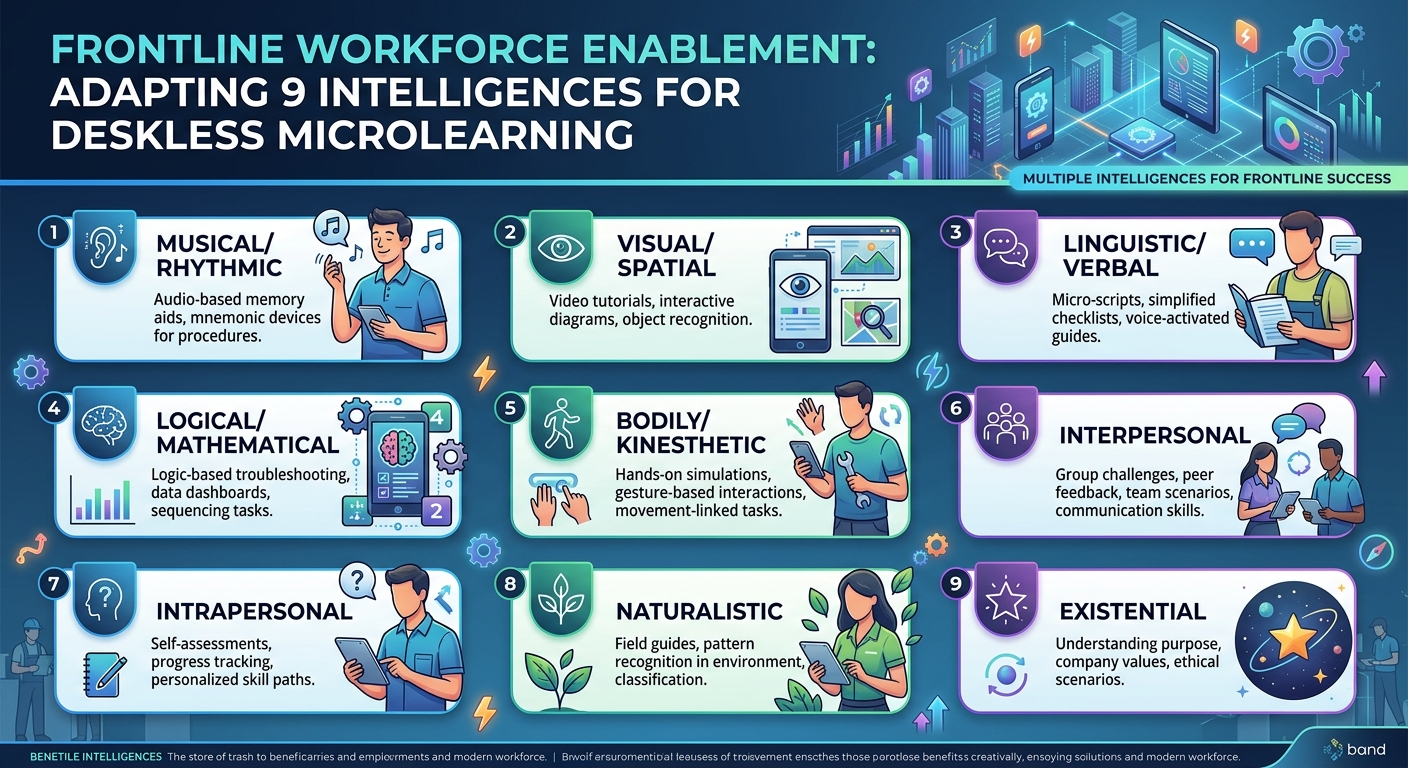
Frontline Workforce Enablement: Adapting 9 Intelligences for Deskless Microlearning
In today's dynamic business landscape, the frontline workforce stands as the backbone of operational success. From retail associates and healthcare providers to manufacturing technicians and field service engineers, these deskless professionals are the direct interface with customers, products, and critical processes. Yet, enabling their continuous learning and development presents unique challenges. Traditional long-form training often fails to resonate with their fast-paced, on-the-go roles. The solution? A strategic blend of Microlearning LMS and an understanding of human intelligence diversity.
For L&D Vice Presidents, Directors, and Senior Managers, the imperative is clear: optimize training delivery to boost performance, ensure compliance, and drive engagement among your most vital asset. This article explores how adapting Howard Gardner's theory of multiple intelligences to deskless microlearning can revolutionize frontline enablement, fostering a workforce that is not just trained, but truly intelligent and adaptable.
The Unique Learning Landscape of the Deskless Workforce
Deskless workers operate in environments characterized by constant movement, limited access to traditional workstations, and immediate demands. Their learning needs are often contextual, urgent, and best delivered at the point of need. Compliance updates, new product features, safety protocols, or customer service best practices – all require efficient and effective knowledge transfer. However, common hurdles include:
- Time constraints and unpredictable schedules.
- Lack of dedicated learning spaces.
- Reliance on mobile devices for information access.
- Diverse educational backgrounds and learning preferences.
- High turnover rates in some sectors, demanding rapid onboarding.
These factors underscore the need for an agile, accessible, and personalized approach to learning.
Microlearning: The Agile Solution for On-the-Go Professionals
Microlearning, characterized by short, focused bursts of content (typically 3-7 minutes), is perfectly suited for the deskless environment. It minimizes disruption to workflow, is easily consumable on mobile devices, and targets specific learning objectives. When powered by a robust Microlearning LMS, it becomes a scalable and trackable solution for industries ranging from compliance to sales, banking, finance, insurance, retail, pharma, healthcare, hospitality, oil and gas, and mining.
However, simply breaking down content isn't enough. To truly engage and empower a diverse workforce, microlearning must speak to the various ways individuals perceive and process information. This is where the concept of multiple intelligences becomes a game-changer.
Harnessing Multiple Intelligences for Enhanced Learning
Howard Gardner's theory of multiple intelligences suggests that intelligence is not a single, monolithic entity, but rather a spectrum of distinct abilities. By designing microlearning experiences that appeal to these different intelligences, L&D professionals can create more engaging, effective, and inclusive training programs. For frontline workers, this means going beyond text-based modules to incorporate a rich tapestry of learning modalities.
Adapting the 9 Intelligences for Deskless Microlearning
Let's explore how each intelligence can be leveraged:
- Linguistic-Verbal Intelligence: Individuals strong in this area excel with words, both written and spoken. Microlearning content can include concise text summaries, brief audio instructions, quick quizzes with clear explanations, and compelling storytelling scenarios.
- Logical-Mathematical Intelligence: Learners with this intelligence thrive on reasoning, patterns, and problem-solving. Offer quick problem-solving challenges, "if-then" scenarios, data interpretation exercises, and interactive simulations that require logical deduction.
- Spatial-Visual Intelligence: These learners prefer images, diagrams, and visual representations. Utilize infographics, short instructional videos, animated explainers, interactive maps, and visual checklists for tasks.
- Bodily-Kinesthetic Intelligence: Hands-on learners benefit from physical activity and direct experience. Integrate short demonstration videos, augmented reality (AR) overlays for equipment, interactive simulations, and brief "try-it-now" prompts for practical application.
- Musical Intelligence: While less direct for corporate training, this intelligence relates to rhythm and sound. Creative use could involve mnemonic jingles for recalling procedures, rhythmic cues for process steps, or even background audio that aids focus.
- Interpersonal Intelligence: Social learners thrive in group settings and through interaction. Design microlearning with peer-to-peer discussion prompts, short collaborative tasks, role-playing scenarios that can be recorded and reviewed, and team-based Gamified LMS challenges.
- Intrapersonal Intelligence: These individuals are self-aware and reflective. Provide opportunities for self-assessment, reflective journal prompts, personalized goal setting within modules, and confidential feedback loops.
- Naturalistic Intelligence: Learners with a strong connection to the natural world appreciate context and real-world relevance. Present training scenarios rooted in real-environment challenges, case studies from their specific operational context, and content that highlights environmental impact or sustainability practices.
- Existential Intelligence: This involves pondering deeper questions about purpose and meaning. For frontline roles, connect training to the broader organizational mission, ethical considerations, and the impact of their work on customers and society. Focus on the "why" behind their tasks.
Leveraging Technology for Intelligent Enablement
Implementing this multi-intelligence approach requires sophisticated tools. A modern LMS is crucial for delivering, tracking, and managing diverse microlearning content. An effective learning management system acts as a central hub, ensuring content accessibility and learner engagement. Look for a cloud based learning management system that offers robust mobile capabilities, supporting deskless workers on their preferred devices.
Key features to consider include a comprehensive learning content management system that allows for easy creation and organization of varied media types, and Adaptive Learning paths that can dynamically adjust based on a learner's performance and identified intelligence strengths. An AI Powered Authoring Tool can further streamline content creation, helping L&D teams rapidly develop engaging modules tailored to different intelligences.
AI-Driven Insights for Optimal Learning
The convergence of microlearning, multiple intelligences, and advanced technology opens new avenues for intelligent enablement:
How can learning platforms deliver highly personalized training experiences?
Modern learning management software leverages artificial intelligence to analyze individual performance data, engagement levels, and learning preferences. By understanding how a frontline worker best absorbs information—be it through visual aids, interactive simulations, or short textual summaries—the platform can dynamically recommend and deliver content tailored to their unique cognitive strengths. This granular personalization ensures each learner receives the most effective microlearning modules, optimizing knowledge retention and skill development. It's about moving from a one-size-fits-all approach to highly individualized learning journeys that adapt to the learner.
What strategies ensure training content is relevant and accessible to diverse global teams?
For globally dispersed frontline workforces across banking, retail, or oil and gas, ensuring relevance and accessibility is paramount. Intelligent enterprise learning management solutions employ machine learning for content localization, automatically translating and culturally adapting microlearning modules for different regions. They also prioritize mobile-first design, ensuring seamless access across various devices and network conditions. Furthermore, by analyzing geographic-specific performance trends and regulatory requirements, these systems can push highly targeted and timely updates, ensuring compliance and operational excellence no matter the location.
How can organizations anticipate and proactively address skill gaps in real-time?
Proactive skill development is crucial in fast-evolving sectors like healthcare or finance. AI-powered analytics within a comprehensive learning management system continuously monitor workforce performance against evolving industry standards and company objectives. By identifying emerging trends in operational challenges or compliance requirements, these systems can predict potential skill gaps before they become critical. This enables L&D leaders to rapidly deploy Risk-focused Training microlearning modules, created efficiently with an AI Powered Authoring Tool, directly to the affected segments of the frontline workforce. This anticipatory approach ensures continuous readiness and mitigates operational risks, distinguishing a proactive MaxLearn LMS from a reactive one.
The Path Forward for L&D Leaders
For L&D VPs, Directors, and Managers, embracing this intelligent approach to frontline enablement is not just an option, but a strategic imperative. It's about recognizing the inherent diversity in how people learn and leveraging technology to meet those diverse needs at scale. By investing in an enterprise learning management solution that supports microlearning, adaptive paths, and intelligent content creation, you empower your deskless workforce to learn effectively, perform optimally, and drive business success.
Conclusion
The future of frontline workforce training lies in intelligent, adaptable, and engaging microlearning. By thoughtfully designing content that appeals to the full spectrum of human intelligences, delivered through a powerful learning management system like MaxLearn LMS, organizations can unlock the full potential of their deskless teams. This strategic shift not only enhances individual capabilities but also fortifies the entire operational framework, ensuring agility, compliance, and sustained growth across all industries.


Comments
Post a Comment