From Cognitive Theory to Enterprise Impact: Operationalizing Howard Gardner’s Framework
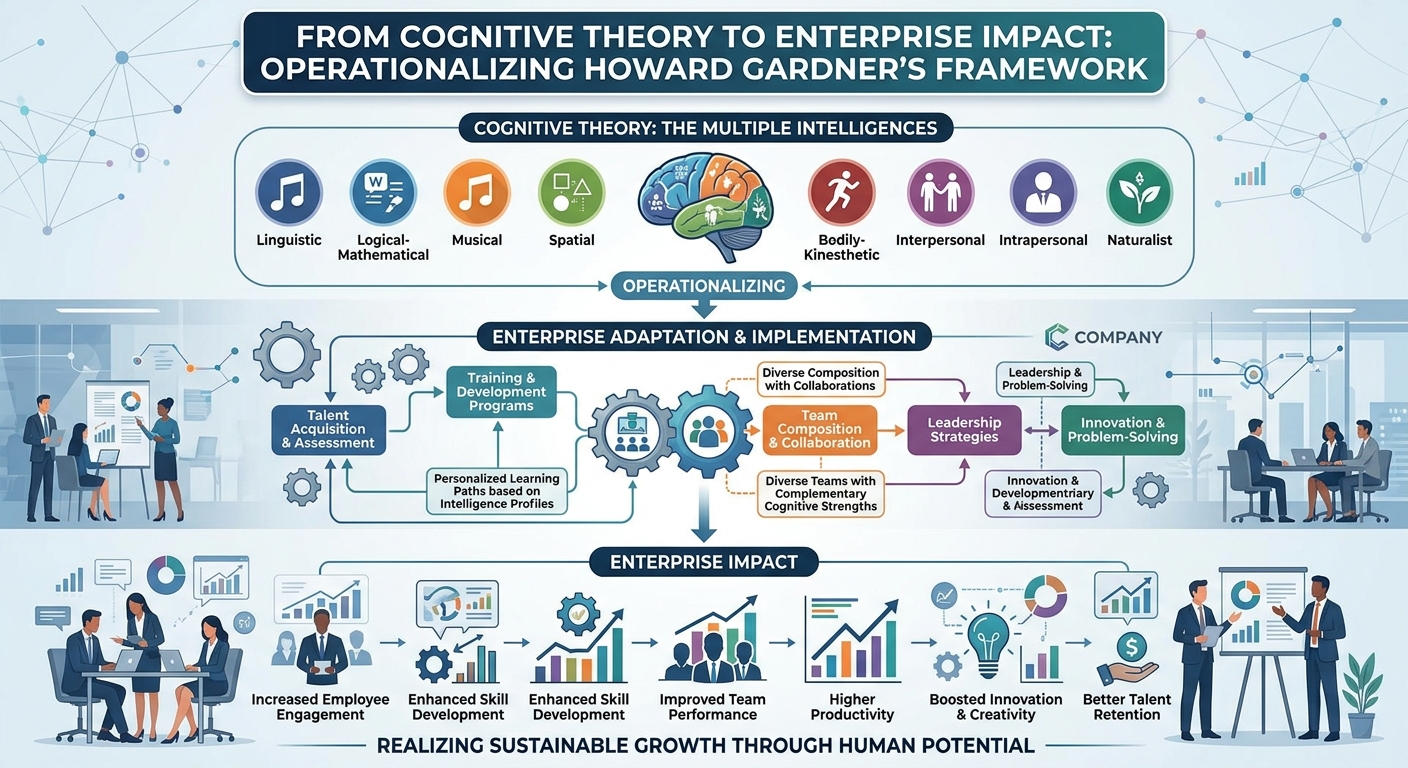
From Cognitive Theory to Enterprise Impact: Operationalizing Howard Gardner’s Framework
In the dynamic landscape of modern enterprise, L&D leaders are constantly seeking innovative strategies to maximize learning effectiveness and drive tangible business outcomes. While advanced technologies like artificial intelligence and sophisticated learning management systems dominate strategic discussions, the foundational insights from cognitive psychology remain indispensable. Howard Gardner’s theory of Multiple Intelligences, though developed decades ago, offers a powerful lens through which to re-evaluate and optimize corporate training programs, transforming theoretical understanding into significant enterprise impact.
For Vice Presidents, Directors, and Managers of L&D across industries like Compliance, Sales, Banking, Finance, Insurance, Retail, Pharma, Health care, Hospitality, Oil and Gas, and Mining, understanding and operationalizing Gardner’s framework can be a game-changer. It moves us beyond a one-size-fits-all approach to learning, embracing the rich diversity of cognitive strengths within an organization.
Understanding Gardner's Framework in an Enterprise Context
The Core of Multiple Intelligences
Howard Gardner proposed that intelligence is not a single, monolithic entity, but rather a spectrum of distinct intellectual strengths. Initially identifying seven, and later adding an eighth, these intelligences describe different ways individuals interact with the world, process information, and demonstrate competence.
- Linguistic Intelligence: Proficient with words, language, and communication.
- Logical-Mathematical Intelligence: Skilled in reasoning, patterns, and logical thinking.
- Spatial Intelligence: Strong in visual and spatial judgment, understanding physical space.
- Bodily-Kinesthetic Intelligence: Aptitude for physical movement, coordination, and hands-on activities.
- Musical Intelligence: Sensitivity to rhythm, pitch, and tone.
- Interpersonal Intelligence: Adept at understanding and interacting with others.
- Intrapersonal Intelligence: Strong self-awareness, understanding one's own emotions and motivations.
- Naturalistic Intelligence: Capacity to recognize and classify elements of the natural world.
In an enterprise setting, this theory challenges the conventional wisdom that all employees learn best through traditional text-based modules or lectures. Instead, it advocates for a multifaceted approach that caters to these diverse strengths.
Bridging Theory to Practice: Why it Matters for L&D
Enhanced Engagement and Retention
When training aligns with an individual's natural intelligence, engagement skyrockets. Employees feel understood, valued, and find the learning process more enjoyable and less arduous. This personalized connection to content significantly boosts knowledge retention and application, crucial for complex topics like compliance regulations or intricate sales strategies.
Personalized Learning Paths
The true power of Gardner's framework lies in its potential for personalization. Instead of a linear training path, L&D can design modular learning experiences that allow individuals to choose or be guided towards content formats that resonate with their dominant intelligences. This is where a robust learning management system becomes an invaluable asset.
Operationalizing Gardner with Modern eLearning Solutions
Leveraging an LMS for Diverse Intelligences
A modern LMS is no longer just a repository for courses; it’s a dynamic platform for delivering diverse learning experiences. An advanced learning content management system allows for a wide array of content types to cater to different intelligences:
- Linguistic: Ebooks, articles, written case studies, discussion forums.
- Logical-Mathematical: Simulations, problem-solving challenges, data analysis exercises.
- Spatial: Infographics, interactive diagrams, virtual reality tours (e.g., for oil rigs or hospital layouts).
- Bodily-Kinesthetic: Gamified scenarios, interactive simulations, role-playing exercises (supported by video recordings).
- Musical: Explanatory videos with background music, mnemonic jingles, audio courses.
- Interpersonal: Group projects, collaborative learning modules, peer-to-peer coaching.
- Intrapersonal: Reflective journals, self-assessment quizzes, personalized feedback loops.
Implementing a cloud based learning management system ensures accessibility and flexibility, enabling employees across various global offices and diverse roles to engage with content that suits their individual needs.
The Role of Gamified LMS and Adaptive Learning
A Gamified LMS taps into bodily-kinesthetic and logical-mathematical intelligences through challenges, points, badges, and leaderboards, making learning feel less like a chore and more like an achievement. Meanwhile, Adaptive Learning technologies, often powered by an intelligent learning management software, automatically adjust the learning path based on a learner's performance and preferences, creating truly personalized experiences that cater to their unique blend of intelligences.
AI Powered Authoring Tool for Tailored Content
Creating diverse content for various intelligences can be resource-intensive. This is where an AI Powered Authoring Tool becomes invaluable. It can assist L&D teams in rapidly generating multiple versions of content—text, video scripts, interactive quizzes, simulation scenarios—from a single source, dramatically reducing development time and ensuring a richer, more varied MaxLearn LMS content library.
AI-Driven Insights for Optimal L&D Strategies
Practical Applications for Enterprise Training
Harnessing AI within your learning management solutions can provide unprecedented insights into how employees learn, enabling L&D leaders to refine their strategies continuously.
Question: How can AI help identify diverse learning needs within a large enterprise?
Answer: AI algorithms embedded in an enterprise learning management system can analyze vast amounts of learner data—course completion rates, quiz scores, content interaction patterns, preferred media types, and even sentiment analysis from discussion forums. By identifying correlations and trends, AI can infer individual and group learning preferences, suggesting whether an employee is more inclined towards visual aids (spatial), hands-on practice (bodily-kinesthetic), or logical problem-solving. This predictive analytics capability helps L&D teams tailor recommendations and course assignments more effectively.
Question: What benefits does a modern learning management software offer for individual learning styles?
Answer: A sophisticated learning management solution allows for dynamic content delivery. For a linguistically intelligent learner, it might prioritize in-depth articles; for a spatial learner, it could suggest interactive infographics or video explanations; for a logical-mathematical learner, complex simulations. The benefit is increased engagement, better comprehension, and higher completion rates because learners are consuming information in a way that aligns with their natural cognitive strengths. Furthermore, a modern lms learning management system often includes features like Microlearning LMS, which delivers information in bite-sized, focused chunks that can be easily customized for different intelligence types.
Question: How does integrating Risk-focused Training align with diverse intelligences?
Answer: Risk-focused Training, particularly in sectors like finance, healthcare, or oil and gas, can be designed to appeal to multiple intelligences. For example, a spatial learner might benefit from interactive diagrams showing accident probabilities, while a logical-mathematical learner would engage with data-driven case studies. Bodily-kinesthetic learners can benefit from simulations of safety protocols, and interpersonal learners can engage in group discussions about ethical dilemmas. By varying the delivery methods for critical risk information, organizations ensure that every employee, regardless of their dominant intelligence, can grasp and apply essential safety and compliance knowledge.
Industry-Specific Impact: Tailoring Training for Diverse Sectors
Compliance and Regulatory Training
In highly regulated industries, from Finance to Pharma, compliance training is critical. Instead of tedious text, an LMS can deliver compliance content through interactive scenarios (logical), animated case studies (spatial), or role-playing modules (interpersonal/bodily-kinesthetic), ensuring a deeper understanding of regulations like GDPR, HIPAA, or industry-specific safety standards.
Sales and Product Knowledge
For Sales and Retail, product knowledge and sales skills are paramount. Training can involve interactive product demos (spatial), competitive analysis simulations (logical-mathematical), customer role-plays (interpersonal), or sales script drills (linguistic). An effective LCMS allows for rapid updates and deployment of such varied content.
Finance and Banking Acumen
In Banking and Finance, complex financial concepts need clear articulation. This could involve interactive dashboards for data visualization (spatial/logical-mathematical), case studies on market trends (linguistic), or simulations of trading floors (bodily-kinesthetic/interpersonal) to develop robust financial acumen.
Conclusion: The Future of Enterprise Learning Management
Operationalizing Howard Gardner’s framework is not merely an academic exercise; it’s a strategic imperative for modern L&D. By embracing the full spectrum of human intelligence and leveraging advanced eLearning technologies, including a comprehensive MaxLearn LMS, organizations can move beyond generic training to create truly engaging, effective, and impactful learning experiences. This holistic approach fosters a culture of continuous learning, enhances employee development, and ultimately drives superior business performance across every industry sector.


Comments
Post a Comment