Enterprise Gamification Strategy: Leveraging the DDE Framework
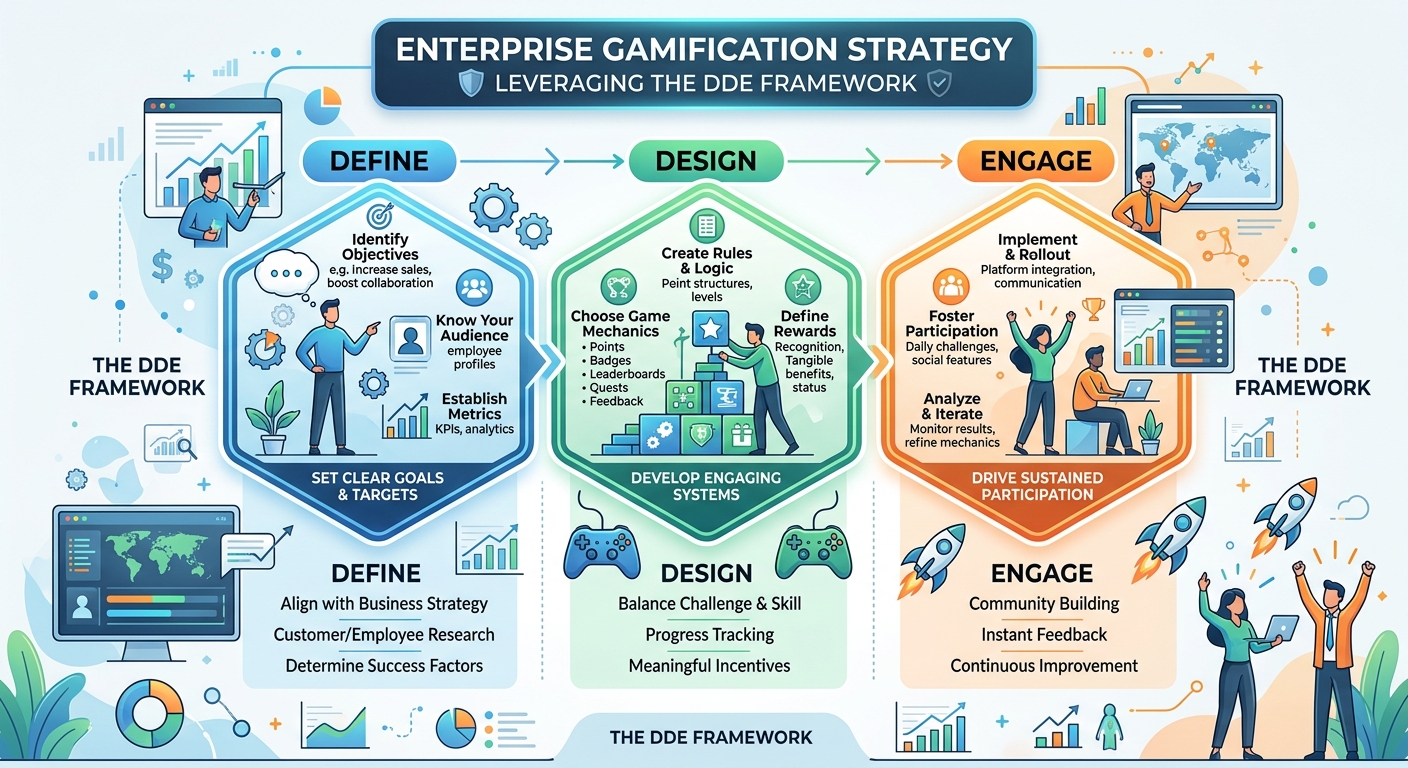
Enterprise Gamification Strategy: Leveraging the DDE Framework for Unprecedented Engagement
In today’s rapidly evolving corporate landscape, the traditional approach to employee training and development often falls short. Vice Presidents, Directors, and Senior Managers in L&D grapple with common challenges: declining learner engagement, poor knowledge retention, and the struggle to demonstrate a clear return on investment for training initiatives. From ensuring compliance in banking and finance to boosting sales performance in retail or enhancing patient care in healthcare, the need for effective, impactful learning is universal.
Enter enterprise gamification – a powerful strategy that transforms mundane training into an engaging, motivational experience. By applying game design elements and principles in non-game contexts, organizations can significantly improve learning outcomes. But how do you implement gamification effectively across a large enterprise? The answer lies in a structured approach: the Discovery, Design, Engagement (DDE) Framework. This blog will explore how this framework can revolutionize your enterprise learning strategy, driving measurable success and fostering a culture of continuous development.
What is Enterprise Gamification?
Enterprise gamification isn't just about adding points and badges to a course; it's about strategically leveraging motivational psychology to achieve specific business objectives. It involves integrating game mechanics, narratives, and social interactions into various aspects of an organization, particularly learning and development. The goal is to make learning more interactive, enjoyable, and sticky, thereby increasing participation, improving skill acquisition, and driving desired behaviors.
For L&D leaders, the benefits are compelling:
- Increased learner participation and course completion rates.
- Enhanced knowledge retention and application.
- Improved skill development and mastery.
- Better adherence to regulatory compliance training, critical in industries like banking, insurance, and pharma.
- Stronger team collaboration and communication.
- A more positive and proactive learning culture.
The DDE Framework Explained
The DDE Framework provides a robust blueprint for developing and implementing successful enterprise gamification strategies. It breaks down the complex process into three manageable and interconnected phases:
Discovery
This initial phase is all about understanding the "why" and "what." Before any game elements are considered, it's crucial to conduct thorough research and analysis. Key activities include:
- Defining Business Objectives: What specific outcomes are you trying to achieve? Is it to reduce compliance violations, increase sales figures, or improve product knowledge? For instance, in the oil and gas sector, it might be reducing safety incidents.
- Audience Analysis: Who are your learners? What are their demographics, technological proficiency, motivations, and existing skill gaps? Understanding your audience is paramount for designing relevant and appealing experiences.
- Current State Assessment: Evaluate existing training programs, technology infrastructure (like your current LMS or MaxLearn LMS), and organizational culture. This helps identify pain points and opportunities.
- Resource Allocation: Determine the budget, timeline, and personnel required for the project.
Design
Once the discovery phase has laid a solid foundation, the design phase focuses on crafting the actual gamified experience. This is where creativity meets strategy.
- Game Mechanics & Dynamics: Select appropriate game mechanics such as points, badges, leaderboards, levels, challenges, quests, virtual rewards, and progress bars. Consider the underlying game dynamics like competition, collaboration, achievement, and mastery that will motivate learners.
- Narrative & Theme: Develop an engaging storyline or theme that contextualizes the learning and makes it more immersive. For sales teams, this could be a "sales championship"; for healthcare, a "patient care journey."
- Feedback Loops & Progression: Design clear and immediate feedback mechanisms, allowing learners to understand their progress and performance. Structure the learning path to provide a sense of accomplishment and continuous advancement.
- Technology Integration: Choose the right technology to support your gamification. A Gamified LMS is often essential, providing the platform to host content, track progress, and manage game elements. A robust learning content management system (LCMS) is also crucial for organizing and deploying learning assets.
Engagement
The final phase focuses on implementing, maintaining, and iterating the gamified solution to ensure sustained engagement and measurable impact.
- Launch & Rollout: Execute a well-planned launch, communicating the benefits and rules to participants. Consider pilot programs for fine-tuning.
- Monitoring & Analytics: Continuously track user engagement, completion rates, performance metrics, and feedback. Utilize the robust analytics often available in modern learning management software to gather insights.
- Iteration & Optimization: Gamification isn't a "set it and forget it" solution. Regularly review data, solicit user feedback, and make iterative improvements to the game design, content, and mechanics. This adaptive approach ensures the solution remains relevant and engaging over time.
- Recognition & Rewards: Ensure that achievements are celebrated and meaningful rewards are provided, whether intrinsic (e.g., skill mastery) or extrinsic (e.g., recognition, small incentives).
Why the DDE Framework is Critical for L&D
For L&D professionals, adopting the DDE Framework means moving beyond superficial gamification to a deeply strategic approach that aligns with organizational goals. This structured methodology offers several key advantages:
- Improved Learner Retention: By making learning fun and interactive, information sticks better. This is especially vital for complex topics in finance or intricate procedures in pharma.
- Enhanced Skill Development: Gamified scenarios allow for safe practice and immediate feedback, accelerating skill acquisition in areas like sales techniques or customer service in hospitality.
- Better Compliance Adherence: In industries like banking, insurance, and healthcare, compliance training can be tedious. Gamification transforms it into an interactive challenge, significantly boosting completion rates and understanding of Risk-focused Training.
- Increased Employee Motivation and Productivity: A sense of achievement and progression fuels motivation, translating into higher productivity and job satisfaction across all segments, including manufacturing and mining.
- Data-Driven Insights: The "Engagement" phase, particularly with a sophisticated lms learning management system, provides rich data on learner behavior and performance, enabling L&D to demonstrate clear ROI.
Gamification in Action: Industry-Specific Applications
The versatility of the DDE framework allows for tailored gamification strategies across diverse sectors:
- Compliance: Interactive quizzes and scenarios to reinforce policies and procedures, tracking completion and understanding.
- Sales: Leaderboards, sales challenges, and virtual rewards for achieving targets and mastering product knowledge. An AI Powered Authoring Tool can quickly create engaging sales scenarios.
- Banking & Finance: Simulated market trading games, fraud detection challenges, and ethical dilemma scenarios.
- Healthcare & Pharma: Patient journey simulations, diagnostic puzzles, and medication adherence games.
- Retail: Customer service role-playing, product knowledge quests, and inventory management challenges.
- Hospitality: Guest experience simulations, language learning games, and operational efficiency challenges.
- Oil and Gas & Mining: Safety procedure simulations, equipment operation challenges, and environmental compliance quests.
Integrating Gamification with Modern Learning Systems
Implementing a successful gamification strategy often hinges on the right technological infrastructure. A robust learning management system (LMS) is the backbone. Modern cloud based learning management system solutions offer integrated features that make enterprise gamification seamless.
Look for an enterprise learning management system that natively supports gamification elements. A dedicated Gamified LMS goes beyond basic features, offering advanced options for leaderboards, points, badges, virtual currencies, and more complex narrative structures. Many modern platforms also incorporate Adaptive Learning capabilities, personalizing the gamified experience based on individual learner performance and needs.
Additionally, tools like an AI Powered Authoring Tool can significantly accelerate the creation of engaging, interactive content, while a Microlearning LMS can deliver bite-sized, gamified modules perfect for quick knowledge reinforcement and continuous engagement.
Addressing Common Questions about Enterprise Gamification
How can technology help us tailor gamified experiences to individual employee needs?
Advanced learning management solutions leverage sophisticated algorithms and machine intelligence to analyze individual learning patterns, preferences, and performance data. This allows for dynamic adjustments to game difficulty, personalized content recommendations, and adaptive learning paths within the gamified environment. Imagine a system that recognizes a learner is struggling with a particular concept and automatically presents a more focused challenge or a different instructional approach, all within the game's narrative. This ensures that the gamified experience is always relevant and appropriately challenging for each employee.
What innovative methods exist to measure the real-world impact of gamification on business outcomes?
Beyond traditional metrics like completion rates and quiz scores, organizations are now utilizing comprehensive data analytics and predictive modeling to assess impact. Modern learning management software collects vast amounts of behavioral data – how often employees engage, which challenges they complete, their improvement over time, and even their emotional responses to certain game elements. This data can then be correlated with key business performance indicators, such as reduced error rates, increased sales figures, faster project completion, or improved employee retention. Intelligent systems can even predict potential skill gaps or compliance risks, allowing L&D to intervene proactively with targeted gamified interventions.
Can these strategies be effectively scaled across a large, geographically dispersed workforce?
Absolutely. The advent of cloud-based learning management solutions and robust learning management systems has made enterprise-wide gamification scalable and accessible. These platforms enable consistent content delivery and experience across diverse locations and devices. Intelligent content delivery systems ensure that local regulations or cultural nuances can be incorporated, even within a global gamified framework. Furthermore, automated progress tracking, reward distribution, and real-time leaderboard updates mean that L&D teams can manage vast numbers of participants without significant manual overhead, ensuring that every employee, regardless of their location, can participate equally in and benefit from the gamified learning journey.
Measuring Success and Iteration
The DDE framework emphasizes that gamification is an ongoing process. Success metrics go beyond mere participation; they include tangible improvements in performance, retention, and business KPIs. Regularly review these metrics and gather qualitative feedback to refine the gamified experience. An effective MaxLearn LMS or any advanced learning management software will provide the analytical tools needed for this continuous improvement cycle.
The Future of Learning with Gamification
As organizations continue to seek innovative ways to develop their talent, enterprise gamification, guided by the DDE Framework, will become an indispensable tool. It transforms learning from a mandatory task into an enjoyable and rewarding journey, fostering a proactive, engaged workforce ready to tackle future challenges. The strategic integration of a comprehensive learning management system with robust gamification capabilities is no longer a luxury but a necessity for competitive advantage.
Conclusion
Leveraging the DDE Framework for your enterprise gamification strategy provides a structured, strategic, and highly effective path to transforming corporate learning. By methodically discovering needs, designing engaging experiences, and continuously optimizing engagement, L&D leaders can unlock unprecedented levels of learner motivation and achieve significant business outcomes. Embrace gamification not just as a trend, but as a fundamental shift in how your organization learns, grows, and innovates, powered by intelligent learning management solutions.


Comments
Post a Comment