Cognitive Load Theory in Corporate L&D: Why 3-Minute Modules Outperform 60-Minute Courses
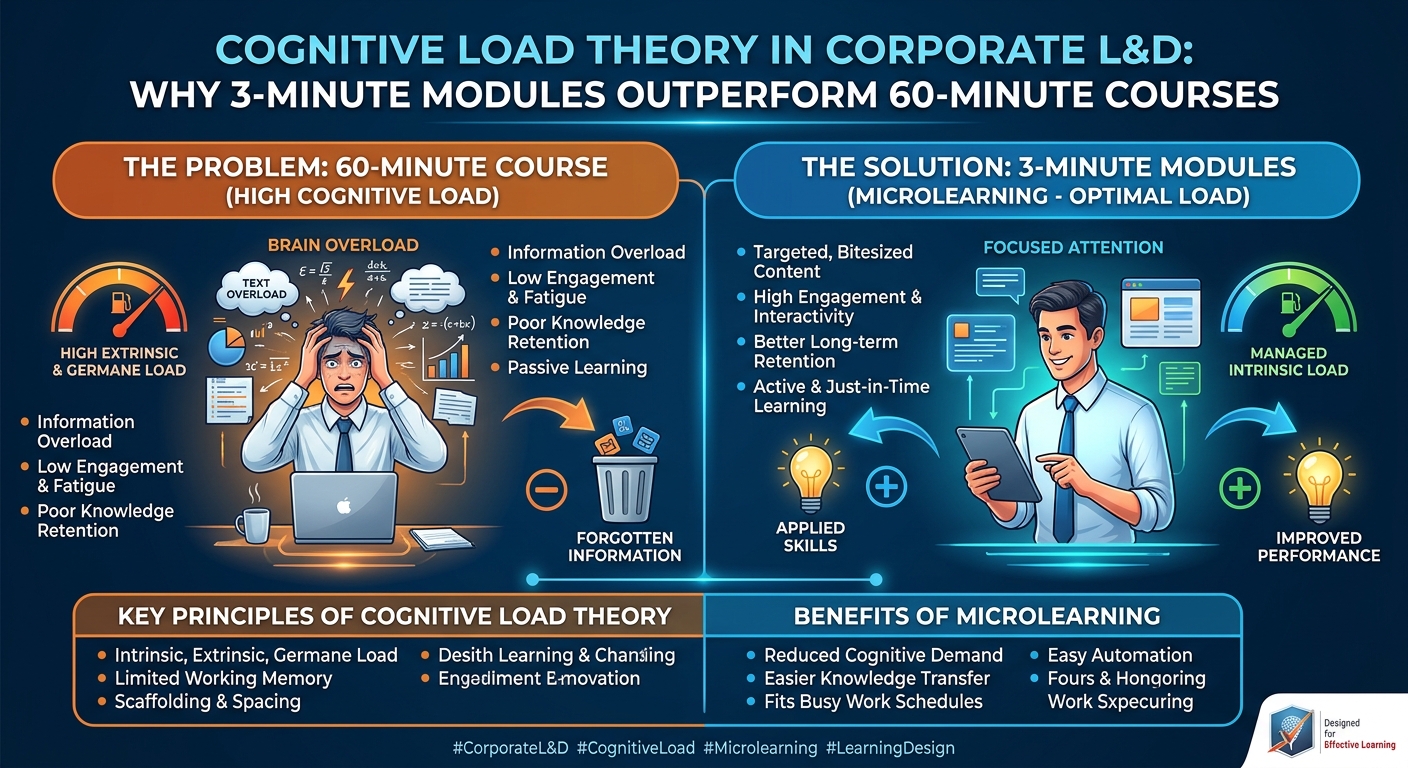
Cognitive Load Theory in Corporate L&D: Why 3-Minute Modules Outperform 60-Minute Courses
In the fast-paced corporate world, effective Learning & Development (L&D) is not merely a nice-to-have; it's a critical driver of performance, compliance, and competitive advantage. Yet, many organizations still rely on traditional, lengthy training modules that often leave employees overwhelmed, disengaged, and with limited knowledge retention. Imagine sitting through a 60-minute course on a complex compliance regulation in banking or a new sales process in retail. How much of that information truly sticks? The answer, according to cognitive science, might be less than you think.
Enter Cognitive Load Theory (CLT), a powerful framework that explains how our working memory processes information. Understanding and applying CLT principles can revolutionize how corporate L&D designs and delivers training, leading to a compelling argument for why concise, 3-minute modules are often far more effective than their hour-long counterparts. For L&D Vice Presidents, Directors, and Managers across industries like Pharma, Healthcare, Oil and Gas, and Finance, grasping this concept is key to optimizing your training investment.
Understanding Cognitive Load Theory
Developed by educational psychologist John Sweller, Cognitive Load Theory posits that our working memory has a limited capacity. When we're learning, this capacity is subjected to three types of cognitive load:
- Intrinsic Load: This is the inherent difficulty of the material itself. A complex concept like quantum physics will naturally have a higher intrinsic load than learning simple arithmetic. L&D professionals can't change the intrinsic complexity of a topic, but they can simplify how it's presented.
- Extraneous Load: This refers to the mental effort imposed by the way information is presented, rather than the information itself. Poorly designed slides, confusing navigation, irrelevant graphics, or an excessive amount of text all contribute to extraneous load, distracting learners from the core content. This is where L&D has significant control.
- Germane Load: This is the "good" cognitive load. It's the mental effort required to process information deeply, form schemas (mental models), and integrate new knowledge with existing knowledge. Effective training aims to maximize germane load while minimizing extraneous load.
The goal of effective instructional design, especially within an enterprise learning management system context, is to manage the total cognitive load so that it doesn't exceed the learner's working memory capacity. When total load is too high, learning becomes inefficient, frustrating, and often ineffective.
The Pitfalls of Traditional Long-Form Training
Sixty-minute courses, while seemingly comprehensive, often fall prey to several cognitive load traps:
- Information Overload: Packing too many concepts into a single, extended session skyrockets both intrinsic and extraneous load, making it difficult for the learner's working memory to process and retain everything. This is particularly problematic for dense topics like compliance or risk management in Banking or Insurance.
- Decreased Engagement & Attention Spans: Human attention spans are notoriously short. Expecting employees, especially those with demanding roles in Sales or Hospitality, to maintain focus for an hour is unrealistic. Disengagement leads to passive learning, where information washes over them without deep processing.
- Poor Retention: When working memory is overloaded, information rarely makes it into long-term memory. Learners may complete the course, but the knowledge is quickly forgotten, rendering the training effort largely futile.
- Practical Time Constraints: Pulling employees away from their core duties for extended periods is costly and disruptive, especially in industries like Retail or Pharma where every minute counts. This often leads to rushed, unmotivated participation.
The Power of the 3-Minute Module: A Cognitive Load Solution
Microlearning, characterized by its short, focused bursts of content, directly addresses the challenges posed by high cognitive load. A 3-minute module is not just a shorter course; it's a strategically designed learning experience that:
- Minimizes Extraneous Load: By focusing on a single learning objective, these modules eliminate unnecessary information, cluttered interfaces, and lengthy explanations. This allows the learner to concentrate solely on the core concept.
- Manages Intrinsic Load: Complex topics are broken down into digestible, manageable chunks. Instead of trying to grasp an entire policy change, an employee learns one key aspect at a time, reducing the inherent difficulty presented in any learning management system.
- Maximizes Germane Load: With less clutter and more focus, learners have the mental capacity to actively process the new information, make connections, and build robust mental models. This leads to deeper understanding and better recall.
- Enhances Flexibility & Just-in-Time Learning: Short modules can be accessed precisely when needed – before a client call, while handling a tricky customer query, or reviewing a new safety protocol in Mining. This just-in-time approach reinforces learning at the point of application.
- Boosts Engagement: The brevity of these modules makes them less daunting and more achievable, encouraging consistent participation and completion rates. This is especially true when delivered through a Gamified LMS.
This approach aligns perfectly with modern learning content management system philosophies, advocating for bite-sized, accessible, and impactful content.
Microlearning in Action Across Industries
The benefits of 3-minute modules translate directly into tangible improvements across various sectors:
- Compliance: In Banking, Healthcare, or Oil and Gas, mandatory compliance training can be tedious. Short modules on specific regulations, ethical guidelines, or safety protocols increase understanding and reduce the likelihood of costly errors and penalties. This enables more effective Risk-focused Training.
- Sales: Sales teams in Retail and Pharma need to quickly master product knowledge, objection handling, and sales techniques. A Microlearning LMS allows them to refresh on a specific feature or tactic just before a client meeting, improving performance.
- Onboarding: New hires across all industries, from Hospitality to corporate offices, can quickly get up to speed on company culture, essential tools, and initial tasks without being overwhelmed, fostering faster productivity.
- Software Training: Learning new software features, common in almost any industry, becomes less daunting when broken into short, task-oriented modules, leading to faster adoption and fewer support tickets.
Leveraging Technology for Optimal Microlearning Delivery
Implementing a successful microlearning strategy heavily relies on the right technology. A modern Microlearning LMS is crucial for delivering these bite-sized experiences effectively. These platforms, often considered the best learning management software available today, offer features such as:
- Intuitive Content Delivery: Ensuring easy access to modules on any device.
- Analytics & Reporting: Tracking completion rates, engagement, and knowledge retention to identify areas for improvement.
- Content Curation: Allowing L&D teams to quickly update and manage their learning content management system.
Beyond basic delivery, advanced learning management solutions enhance the experience significantly. A Gamified LMS can incorporate points, badges, and leaderboards to further boost engagement for short modules. Adaptive Learning capabilities personalize the learning path, ensuring learners receive content tailored to their individual needs and pace. Furthermore, an AI Powered Authoring Tool can dramatically accelerate the creation of these focused 3-minute modules, making the transition to microlearning highly efficient for any lms learning management system.
Organizations seeking a robust, cloud based learning management system to support this shift might consider a solution like MaxLearn LMS, designed to simplify enterprise learning management and content management (LCMS).
Advanced Insights for Future L&D
As L&D embraces modern methodologies, the role of advanced technologies becomes even more pronounced. Here are some insights into how these innovations are shaping the future of corporate training:
How can advanced algorithms personalize learning paths?
Intelligent systems analyze individual learner data—performance, preferences, and progress—to dynamically adjust course recommendations and content delivery. This ensures each employee receives highly relevant training, maximizing engagement and skill acquisition. Such personalization dramatically reduces wasted effort on already mastered topics and focuses on areas requiring development, offering a truly tailored experience within an LMS.
What role does predictive analytics play in identifying skill gaps?
By analyzing learning data, job performance metrics, and industry trends, predictive analytics can forecast future skill requirements and proactively identify existing gaps within the workforce. This allows L&D teams to design targeted 3-minute modules and interventions before skill deficiencies impact business operations, ensuring a proactive and strategic approach to talent development.
Can intelligent systems help optimize learning content for maximum impact?
Yes, systems can evaluate content performance, learner engagement, and comprehension rates to suggest improvements to existing modules. They can recommend optimal formats, adjust complexity, or even flag sections that learners consistently struggle with, allowing L&D professionals to continuously refine content for better outcomes.
How might machine learning enhance content creation and delivery?
Machine learning can automate the generation of quizzes, summaries, and even initial drafts of learning modules based on source material. For delivery, it can dynamically present content variations (e.g., video, text, interactive simulation) based on an individual's preferred learning style, optimizing the overall experience and reducing extraneous cognitive load.
Conclusion
The shift from lengthy 60-minute courses to agile 3-minute modules isn't just a trend; it's a strategic imperative rooted in how humans learn. By applying Cognitive Load Theory, L&D leaders can design more effective, engaging, and memorable training experiences that respect the learner's cognitive capacity. Embracing microlearning, powered by advanced learning management software and Microlearning LMS solutions, is not only about improving knowledge retention but also about boosting employee productivity, ensuring compliance, and fostering a culture of continuous learning across every industry. It’s time to rethink your L&D strategy and embrace the power of the bite-sized module for impactful corporate learning.


Comments
Post a Comment