Cognitive, Emotional, and Sensory Engagement: The DDE Experience Layer Explained
Cognitive, Emotional, and Sensory Engagement: The DDE Experience Layer Explained
In the rapidly evolving landscape of corporate learning and development, merely delivering information is no longer sufficient. L&D leaders across industries—from Compliance and Sales to Banking, Healthcare, and Oil & Gas—are tasked with fostering deep understanding, skill mastery, and sustained behavioral change. This critical objective is best achieved through a learning philosophy that prioritizes engagement on multiple fronts: cognitive, emotional, and sensory. Welcome to the DDE Experience Layer.
The DDE Experience Layer represents a paradigm shift from passive information consumption to active, immersive, and truly impactful learning. It's about designing learning environments that dynamically adapt to the learner, differentiate content delivery based on individual needs, and profoundly engage the learner's mind, heart, and senses. For L&D professionals, understanding and implementing this layer is key to unlocking higher ROI on training investments, improving talent retention, and driving organizational success.
Understanding the Pillars of the DDE Experience Layer
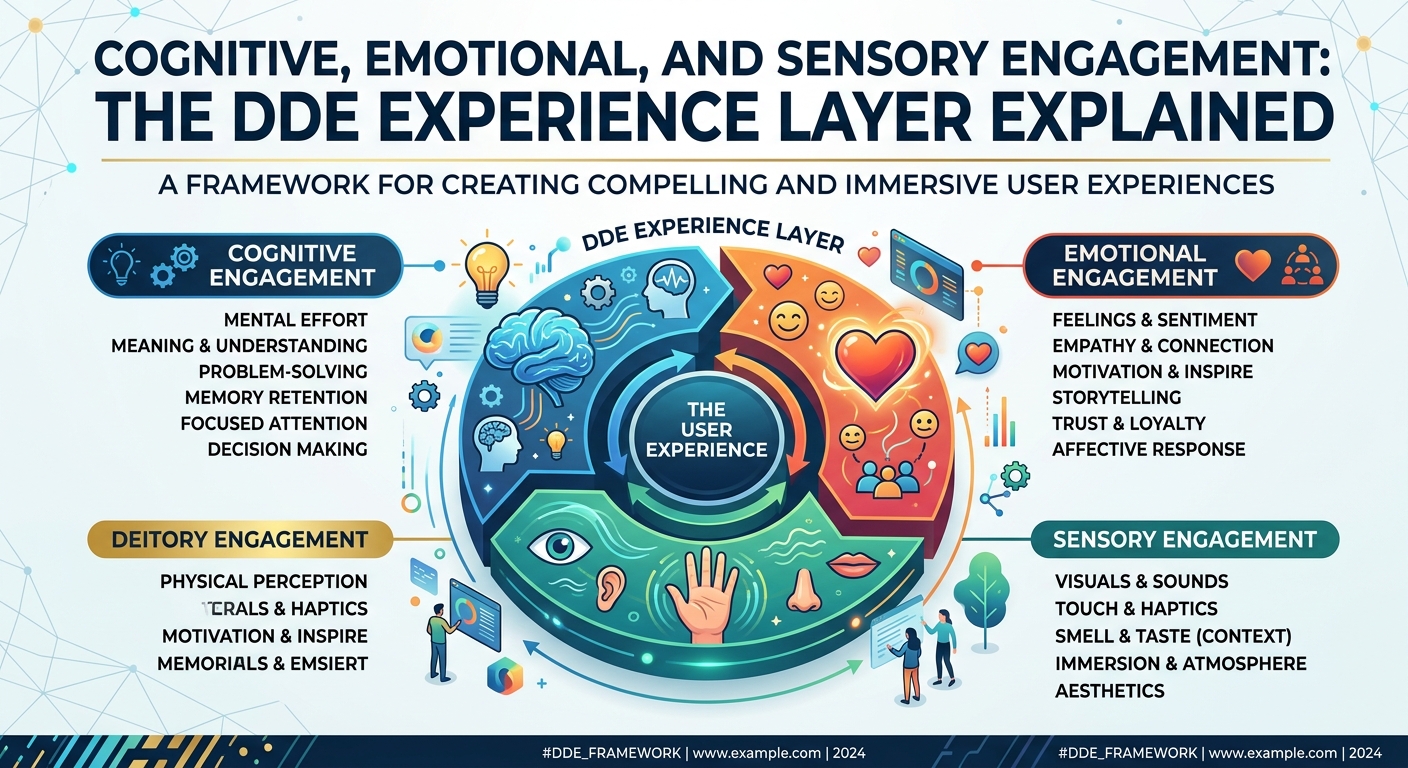
The DDE framework is built upon three interconnected pillars, each contributing uniquely to a holistic learning experience:
Cognitive Engagement: Challenging the Mind
Cognitive engagement is the intellectual glue of effective learning. It refers to the extent to which learners are mentally invested in processing information, solving problems, and constructing knowledge. It moves beyond rote memorization, encouraging critical thinking, analysis, and application.
- Stimulating Critical Thinking: Instead of simply presenting facts, cognitively engaging content prompts learners to analyze situations, evaluate alternatives, and make informed decisions. This is crucial in sectors like Finance and Healthcare where nuanced judgment is paramount.
- Problem-Solving Scenarios: Learners are presented with real-world challenges, often in a simulated environment, requiring them to apply learned concepts to find solutions. This deepens understanding and builds practical skills.
- Active Recall and Spaced Repetition: Techniques that compel learners to retrieve information from memory, rather than passively re-reading, significantly enhance retention. Platforms offering Adaptive Learning leverage algorithms to present content at optimal intervals for maximum cognitive retention.
When learners are cognitively engaged, they don't just absorb information; they wrestle with it, internalize it, and integrate it into their existing knowledge framework, leading to superior long-term retention and applicability.
Emotional Engagement: Connecting with the Heart
Learning is not solely an intellectual exercise; emotions play a profound role in memory, motivation, and decision-making. Emotional engagement in learning involves creating content that resonates with learners on a personal level, fostering empathy, and tapping into their intrinsic motivations.
- Storytelling and Relatable Narratives: Human beings are wired for stories. Presenting learning content through compelling narratives, with relatable characters and scenarios, can evoke empathy and make abstract concepts more tangible. This is particularly effective in compliance training or sales, where understanding human behavior is key.
- Real-World Consequences: Highlighting the tangible impact of actions and decisions—both positive and negative—can create a powerful emotional hook. For instance, Risk-focused Training becomes more impactful when learners emotionally grasp the stakes involved.
- Personalized Feedback and Recognition: Providing constructive, empathetic feedback that acknowledges effort and progress can significantly boost morale and motivation, creating a positive emotional connection to the learning process.
Emotionally engaged learners are more motivated, more resilient in the face of challenges, and more likely to integrate new behaviors. It transforms learning from a chore into a meaningful journey, ensuring that knowledge sticks because it truly matters to them.
Sensory Engagement: Immersing the Senses
Sensory engagement appeals to how learners perceive and interact with information through their senses. In an increasingly digital world, leveraging rich media and interactive elements can create a dynamic and memorable learning experience that caters to diverse learning preferences.
- Rich Multimedia Integration: Beyond text, incorporating high-quality videos, audio clips, animations, and infographics can capture attention and convey complex information more effectively. This is vital for complex topics in Pharma or Mining.
- Interactive Simulations and Gamification: Allowing learners to virtually interact with tools, environments, or processes (e.g., operating equipment, handling customer interactions) through simulations, VR/AR, or Gamified LMS features significantly enhances hands-on learning. Elements like points, badges, and leaderboards provide immediate feedback and foster a sense of achievement.
- Dynamic User Interfaces: A well-designed, intuitive user interface that is easy to navigate and visually appealing contributes to a positive sensory experience, reducing friction and enhancing overall engagement.
By engaging multiple senses, learning becomes more immersive, vibrant, and memorable. It helps to break the monotony of text-heavy modules and makes learning more accessible and enjoyable for a wider range of learners.
The Synergy of DDE: More Than the Sum of Its Parts
While each pillar of cognitive, emotional, and sensory engagement is powerful on its own, their true strength lies in their synergy. A learning experience that thoughtfully integrates all three creates a profound and lasting impact. For example, a simulation (sensory) about handling a difficult customer (emotional) that requires strategic decision-making (cognitive) offers a complete and deeply effective learning opportunity. This integrated approach ensures that knowledge is not just acquired, but deeply understood, personally valued, and practically applied.
Implementing DDE with Modern Learning Solutions
For L&D leaders looking to embrace the DDE Experience Layer, the right technology infrastructure is paramount. A robust LMS is the backbone for delivering such rich and engaging content.
- Content Authoring: Tools like an AI Powered Authoring Tool enable L&D teams to create diverse, interactive, and multimedia-rich learning modules quickly, supporting all three DDE pillars.
- Personalization and Adaptation: A sophisticated Microlearning LMS can deliver content in bite-sized, digestible chunks, tailored to individual learner progress and preferences. This allows for dynamic adjustments to learning paths, enhancing both cognitive and emotional relevance.
- Analytics and Feedback: Advanced analytics within an LMS learning management system provide insights into learner engagement levels, performance, and emotional responses to content, allowing for continuous optimization of the DDE experience.
- Scalability and Accessibility: A cloud based learning management system ensures that DDE-rich content is accessible to a global workforce, anytime, anywhere, catering to the needs of vast organizations in Retail or Hospitality. An enterprise learning management solution provides the necessary tools for large-scale deployment and tracking.
Moreover, the integration of intelligent systems within an LCMS or learning content management system can further elevate the DDE experience:
Intelligent System Insights for Elevated Learning
Question: How can advanced algorithms enhance individual learning paths for professionals?
Answer: Advanced algorithms analyze learner performance, preferences, and progress, dynamically adjusting content delivery, difficulty, and recommendations. This ensures that each professional receives highly relevant and challenging material, optimizing their learning journey, boosting cognitive engagement, and reducing frustration.
Question: How do intelligent systems assist in tailoring training materials for diverse regional workforces?
Answer: Intelligent systems can facilitate the localization of training content by automating translation, adapting cultural nuances, and ensuring regulatory compliance across different geographic regions. This allows organizations to deliver effective learning experiences that resonate locally, enhancing emotional connection and relevance for every learner.
Question: What insights do predictive analytical tools offer for improving organizational skill development?
Answer: Predictive analytical tools provide valuable insights into potential skill gaps, forecast future training needs, and identify areas where learning interventions are most impactful. By leveraging these predictions, organizations can proactively shape their talent development strategies for greater success, ensuring resources are directed where they will have the most cognitive and practical benefit.
Choosing the right learning management software and learning management solutions, such as MaxLearn LMS, means investing in a platform that inherently supports these dynamic and engaging methodologies.
Why the DDE Experience Layer Matters for L&D Leaders
For VPs, Directors, and Managers of L&D, adopting the DDE Experience Layer isn't just about modernizing training; it's about driving tangible business outcomes:
- Higher Engagement & Completion Rates: Learners are more likely to start, complete, and retain knowledge from courses that capture their full attention.
- Improved Skill Transfer: Deeply engaged learning translates directly into improved on-the-job performance and productivity across all segments, from Compliance to Sales.
- Enhanced Retention & Reduced Churn: A positive and effective learning experience contributes to employee satisfaction and loyalty.
- Measurable ROI: By fostering genuine understanding and skill application, the DDE approach maximizes the return on every training dollar spent.
- Future-Proofing Your Workforce: Developing critical thinking, adaptability, and emotional intelligence prepares employees for future challenges and innovations.
Conclusion
The DDE Experience Layer—Cognitive, Emotional, and Sensory Engagement—is more than a theoretical concept; it's a strategic imperative for L&D leaders aiming to create impactful and sustainable learning programs. By consciously designing learning experiences that stimulate the mind, connect with the heart, and immerse the senses, organizations can transcend traditional training limitations. Embrace a comprehensive LMS that empowers you to build this layered engagement, and watch your workforce transform from passive recipients into active, motivated, and highly capable contributors.


Comments
Post a Comment