Can Microlearning Replace Traditional New-Hire Onboarding Programs?
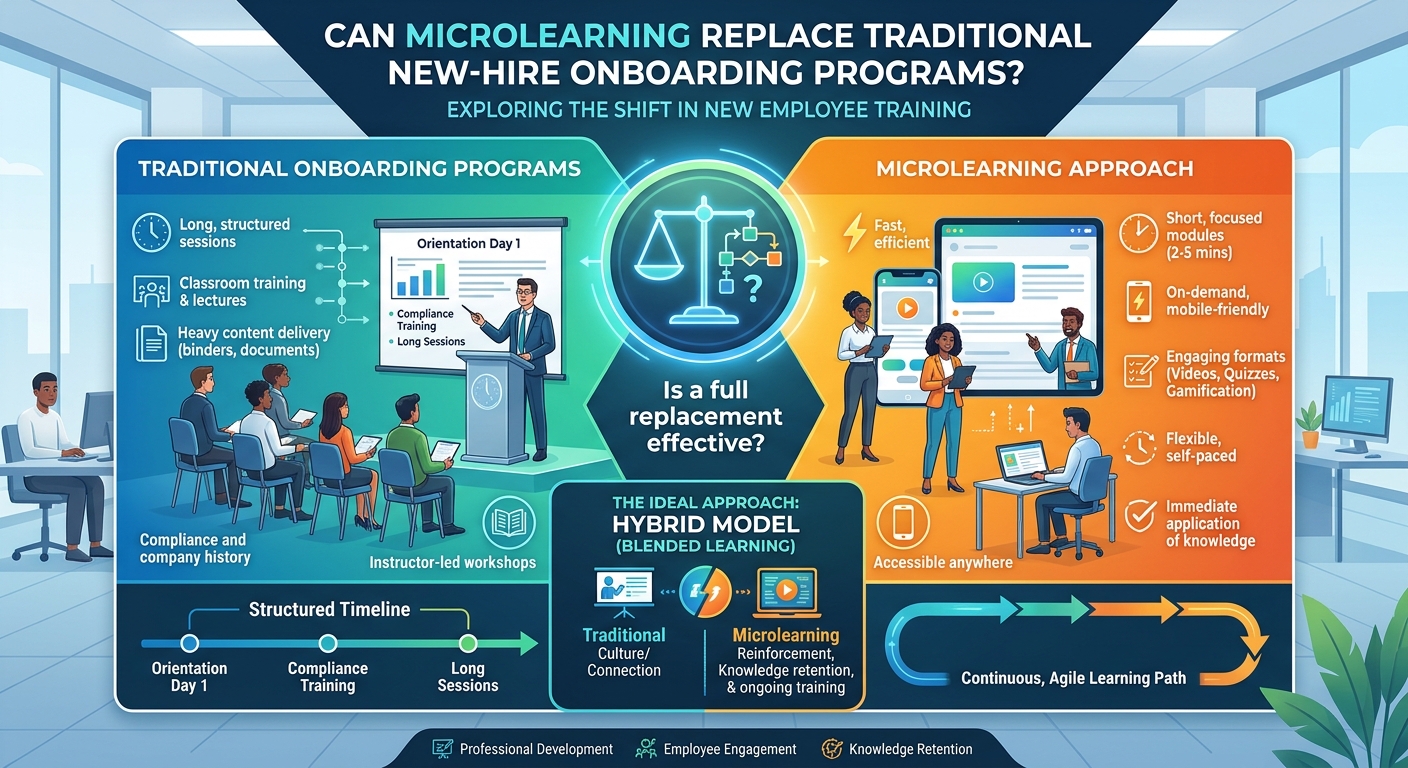
Can Microlearning Replace Traditional New-Hire Onboarding Programs? A Strategic L&D Perspective
In today's rapidly evolving corporate landscape, the efficiency and effectiveness of new-hire onboarding are paramount. Traditional onboarding programs, often characterized by lengthy classroom sessions, overwhelming information dumps, and stacks of paperwork, struggle to keep pace with the modern workforce's demands for flexibility, engagement, and immediate applicability. Learning and Development (L&D) leaders are constantly seeking innovative approaches to accelerate time-to-competence, reduce attrition, and ensure compliance from day one. Enter microlearning – a methodology delivering bite-sized, focused content. The critical question on many L&D professionals’ minds is: can microlearning truly replace these established, often extensive, traditional new-hire onboarding programs, or does its value lie in augmentation?
The Evolution of Onboarding: Shifting Paradigms
For decades, onboarding has been a rite of passage, typically involving days or even weeks of intensive, instructor-led training. While foundational, this approach frequently leads to information overload, disengagement, and a significant 'forgetting curve.' New hires, particularly in fast-paced industries like sales, banking, finance, retail, and healthcare, need to be productive quickly. The challenge for L&D departments, whether in pharma, hospitality, or oil and gas, is to distill vast amounts of crucial information – from compliance regulations to company culture – into an digestible format that sticks. The limitations of traditional classroom settings and heavy manuals are prompting a re-evaluation of how we bring new talent up to speed within an enterprise learning management framework.
What Exactly is Microlearning?
Microlearning is an approach to learning that delivers information in small, focused bursts, typically ranging from 2-10 minutes in duration. These bite-sized modules can take various forms: short videos, interactive quizzes, infographics, quick simulations, or brief text lessons. The core principle is to present one learning objective per module, making content highly digestible, accessible, and easily consumable on demand. It represents a fundamental shift in learning content management system design, emphasizing immediate utility and learner control.
Microlearning's Compelling Advantages for Onboarding
Integrating microlearning into onboarding strategies offers a multitude of benefits for organizations aiming for an optimized learning management system:
- Enhanced Engagement and Retention: Shorter modules prevent cognitive overload, keeping learners engaged and improving knowledge retention. This is crucial for complex topics in compliance or risk management, where forgetting critical details can have severe consequences.
- Flexibility and Accessibility: New hires can access microlearning content anytime, anywhere, on any device. This flexibility is invaluable for remote workers or those with varying schedules, common across industries from manufacturing to mining. A robust Microlearning LMS facilitates this seamless delivery, providing a true cloud based learning management system experience.
- Faster Time-to-Competence: By delivering just-in-time information, microlearning accelerates the learning process, allowing new employees to apply knowledge almost immediately. This is particularly beneficial for roles in sales where product knowledge is key, or in healthcare where procedural steps are vital.
- Personalization and Relevance: Microlearning modules can be curated and sequenced to address individual learning needs and job roles. This personalized approach is a hallmark of effective Adaptive Learning, ensuring that a new finance analyst isn't sifting through irrelevant retail training.
- Cost-Effectiveness and Scalability: Developing and updating microlearning content is often less resource-intensive than overhauling entire traditional programs. This makes it a scalable solution for organizations with high turnover or rapid growth, offering a cost-efficient learning management system.
- Continuous Learning Support: Onboarding doesn't end after the first few weeks. Microlearning provides ongoing support, acting as a performance support tool for new hires to revisit critical information as needed, leveraging the full power of a modern LMS.
Addressing the "Replacement" Question: Integration Over Eradication
While the benefits of microlearning are compelling, the answer to whether it can fully replace traditional onboarding is nuanced. For many L&D professionals, especially those managing vast learning content management system architectures, a complete overhaul might seem daunting or even risky. Traditional onboarding often serves critical functions that microlearning, on its own, struggles to replicate entirely:
- Culture Immersion: The shared experience of in-person orientation sessions, team introductions, and face-to-face discussions plays a vital role in integrating new hires into the company culture. This is especially true for sectors like hospitality or corporate environments where interpersonal dynamics are key.
- Complex Skill Development: Some skills, particularly those requiring hands-on practice, complex simulations, or in-depth strategic understanding, may still necessitate longer, more immersive training formats.
- Networking and Relationship Building: Initial opportunities to connect with peers, mentors, and leadership are invaluable for a new employee's long-term success and sense of belonging.
Therefore, a more pragmatic and effective approach isn't replacement, but rather strategic integration. Microlearning thrives as a powerful component within a blended or hybrid onboarding program, enhancing traditional methods rather than eradicating them. Imagine a comprehensive learning management software that combines the best of both worlds.
Designing a Blended Onboarding Experience
A truly modern new-hire onboarding program, utilizing sophisticated learning management solutions like MaxLearn LMS, intelligently combines structured traditional elements with agile microlearning:
- Pre-boarding Micro-doses: Deliver essential compliance documents, company overview videos, and welcome messages in bite-sized modules even before the first day. This lightens the load for initial in-person sessions.
- Core Knowledge & Skills: Utilize microlearning for factual information, system navigation tutorials, product features, and policy summaries. This can be delivered via a dedicated Microlearning LMS.
- Interactive Reinforcement: Incorporate Gamified LMS elements like quizzes, challenges, and leaderboards to reinforce learning and maintain engagement, especially for compliance or sales training.
- Face-to-Face for Culture and Complexities: Reserve in-person time for critical discussions, team-building exercises, executive introductions, and training on highly nuanced or sensitive topics that benefit from direct interaction.
- Ongoing Support and Reference: Create a library of searchable microlearning modules that new hires can access on-demand as they encounter new tasks or need to refresh their memory on specific procedures. This acts as an invaluable learning management software repository.
The Role of Advanced Technology in Modern Onboarding Efficiency
The evolution of learning management solutions is intrinsically linked with technological advancements, particularly in artificial intelligence. This is not just a buzzword; it's a game-changer for how organizations onboard new talent across all segments, from manufacturing to oil and gas.
Consider this challenge: How can technology ensure new hires receive the most relevant onboarding content for their specific role and background?
Artificial intelligence addresses this head-on. Through sophisticated algorithms, a modern learning management system can analyze a new hire's job description, prior experience, and even their learning style to recommend a truly personalized learning path. An AI Powered Authoring Tool, for instance, can rapidly generate tailored content modules, ensuring that a new banking associate gets precisely the compliance training relevant to their branch, not generic industry overviews. This level of customization dramatically boosts engagement and efficiency, moving beyond a one-size-fits-all enterprise learning management approach.
Next, think about the immense effort involved in keeping onboarding materials current. What technological advancements are streamlining the creation and delivery of dynamic onboarding modules?
AI-driven content creation tools and intelligent automation within a cloud based learning management system are revolutionizing this. Artificial intelligence can assist in drafting, updating, and even localizing microlearning modules, ensuring content remains fresh and relevant to evolving industry standards or company policies. Furthermore, automation can handle the scheduling and delivery of these modules, freeing up L&D teams to focus on strategic initiatives rather than administrative tasks. This capability is critical for industries like pharma and healthcare, where regulatory changes are constant.
Finally, how can platforms proactively identify knowledge gaps in new employees to address potential performance or compliance risks?
Predictive analytics, powered by artificial intelligence within a sophisticated lms learning management system, monitors learner progress and performance. By identifying patterns and flagging areas where new hires struggle, the system can automatically suggest additional Risk-focused Training modules or recommend intervention from a manager or mentor. This proactive identification of potential weaknesses is invaluable, particularly in high-stakes environments like finance or mining, where errors can have significant consequences. MaxLearn LMS excels in this area, offering robust analytics for precise intervention.
Industry-Specific Applications of Microlearning
The versatility of microlearning, especially when powered by an advanced LCMS, makes it universally applicable. In compliance-heavy sectors, it ensures consistent understanding of regulations. For sales teams, it provides quick access to product updates and objection handling techniques. In healthcare, it reinforces critical patient care protocols. Retail benefits from rapid seasonal training updates. Pharma and manufacturing leverage it for procedural training and safety protocols. Across every industry, microlearning elevates the standard of new hire integration.
Conclusion: The Future is Blended
Ultimately, microlearning is not a complete replacement for traditional new-hire onboarding programs, but rather an indispensable partner. By strategically integrating microlearning into a blended approach, L&D professionals can create more engaging, effective, personalized, and efficient onboarding experiences. This hybrid model leverages the strengths of both methodologies, ensuring new employees are not only well-informed but also deeply integrated into the company culture and equipped to succeed faster. Embracing this evolution is not just about keeping pace; it's about setting a new standard for talent development in the modern enterprise. Explore how a powerful learning management system can transform your onboarding today.


Comments
Post a Comment