Beyond One-Size-Fits-All: Maximizing Training ROI with Multiple Intelligences Microlearning
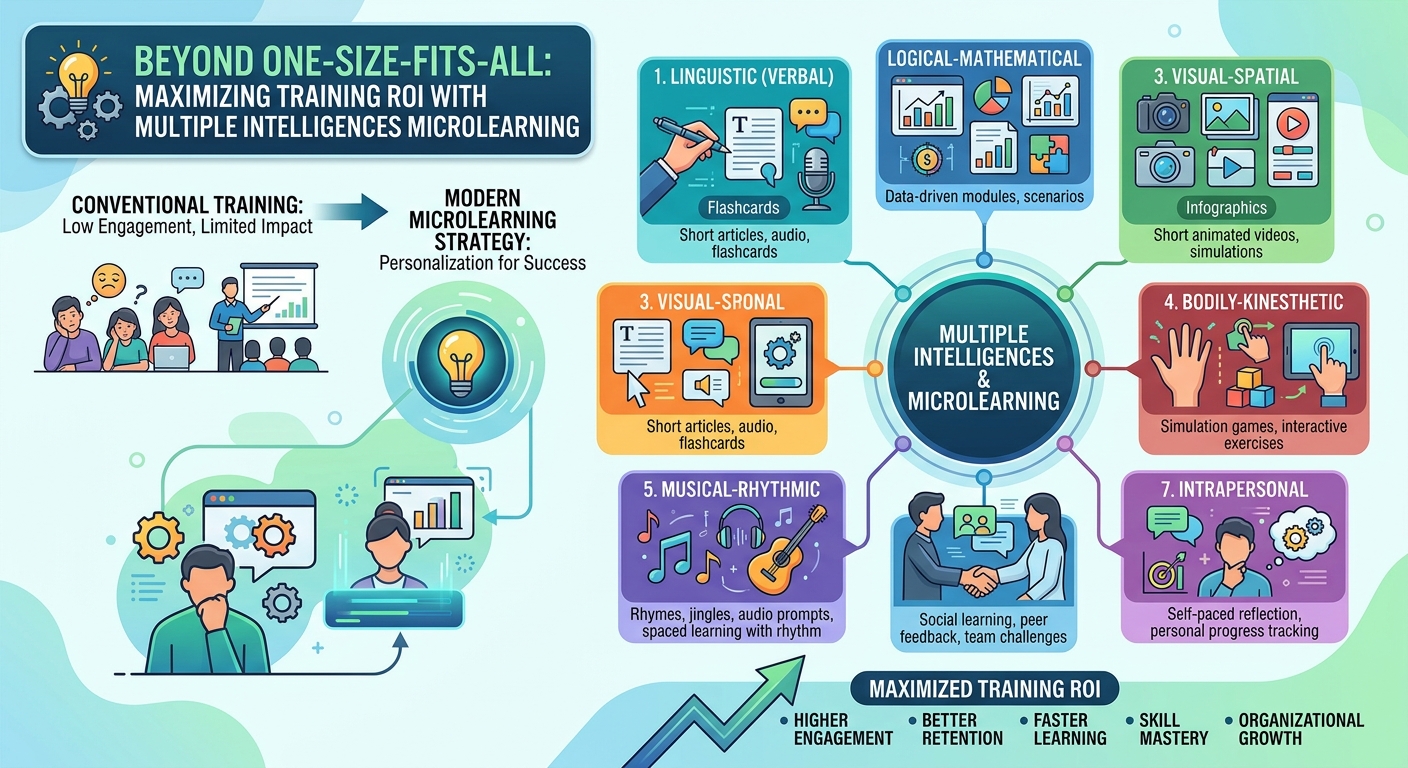
Beyond One-Size-Fits-All: Maximizing Training ROI with Multiple Intelligences Microlearning
In today’s dynamic corporate landscape, the adage “one-size-fits-all” for employee training is not just outdated; it’s a direct drain on resources and a barrier to true organizational growth. Vice Presidents, Directors, and Senior Managers in Learning & Development know all too well the challenges of engaging a diverse workforce with generic content. From ensuring critical compliance in banking to boosting sales performance in retail, or updating complex procedures in healthcare and oil & gas, the need for effective, impactful learning management software has never been more pressing. This article explores how combining the power of Multiple Intelligences (MI) with Microlearning LMS can revolutionize your enterprise learning management strategy, delivering unprecedented return on investment.
The Flaw in Uniformity: Why One-Size-Fits-All Fails
Traditional training methodologies, often characterized by lengthy modules, dense presentations, and infrequent sessions, assume a uniform learning style across all employees. This approach, while seemingly efficient from a content creation standpoint, consistently falls short. Employees in various sectors—be it finance, insurance, pharma, or hospitality—possess unique cognitive strengths and preferred methods of absorbing information. When training fails to acknowledge these differences, it leads to:
- Low engagement and participation rates.
- Poor knowledge retention and application.
- Wasted training budgets on ineffective programs.
- Increased time away from productive work.
- Inconsistent skill development across teams.
The result is a significant negative impact on an organization’s competitive edge and an undeniable drag on potential ROI. A robust learning content management system must address this fundamental mismatch.
Understanding Multiple Intelligences in the Workplace
Howard Gardner's theory of Multiple Intelligences posits that individuals possess varying strengths across several distinct intelligences, including linguistic, logical-mathematical, spatial, bodily-kinesthetic, musical, interpersonal, intrapersonal, and naturalistic. While not every intelligence is directly applicable to corporate training, acknowledging the primary ways adults learn—visually, auditorily, kinesthetically, or through logical reasoning—is crucial.
For instance, an employee with strong spatial intelligence might excel with visual aids like infographics and simulations, while another with high logical-mathematical intelligence might thrive on case studies, data analysis, and problem-solving exercises. Someone strong in bodily-kinesthetic intelligence would benefit greatly from interactive scenarios and role-playing. A forward-thinking learning management system should be designed to cater to this spectrum, moving beyond mere information delivery to genuine knowledge absorption and skill mastery.
The Power of Microlearning: Precision-Engineered Knowledge
Microlearning delivers short, focused bursts of information designed to achieve specific learning outcomes. These bite-sized modules, typically 3-7 minutes long, are highly effective because they align with the brain's natural ability to process information in manageable chunks. When integrated into a comprehensive Microlearning LMS, this approach offers numerous benefits:
- Enhanced Retention: Reduces cognitive overload, allowing learners to absorb and retain information more effectively.
- Increased Engagement: Short, relevant content prevents boredom and keeps learners motivated.
- Flexible Access: Learners can access content anytime, anywhere, fitting learning into their workflow.
- Just-in-Time Learning: Provides immediate answers to critical questions, supporting performance when it matters most.
- Reduced Training Time: Efficient delivery minimizes time spent away from core responsibilities.
Imagine a Gamified LMS leveraging microlearning principles. It transforms mundane training into engaging challenges, further boosting participation and learning outcomes across your workforce.
Synergizing MI and Microlearning for Unprecedented ROI
The true magic happens when Multiple Intelligences theory is combined with the efficiency of microlearning. This synergy creates a personalized learning experience that resonates deeply with individual learners, optimizing knowledge transfer and maximizing your training investment.
Tailoring Content for Diverse Minds
By understanding that learners engage differently, a modern learning management system can offer varied content formats for the same learning objective. For example, to explain a new compliance regulation:
- Visual Learners: Short animated videos, infographics, and interactive flowcharts.
- Auditory Learners: Concise audio summaries, podcasts, or narrated explainers.
- Logical-Mathematical Learners: Case studies with scenarios, decision trees, and interactive quizzes testing understanding.
- Bodily-Kinesthetic Learners: Simulations, role-play scenarios, or interactive exercises requiring active participation.
This multi-faceted approach ensures that regardless of an individual's primary learning preference, they receive the information in a format that maximizes their comprehension and retention. This also means that employees get the information they need in a way that truly sticks, reducing the need for repeated training sessions and improving overall productivity.
Personalized Learning Paths and Adaptive Delivery
A sophisticated Adaptive Learning system takes this a step further. By analyzing a learner's performance, preferences, and progress, it can dynamically adjust the learning path, recommending specific microlearning modules that target areas of weakness or leverage individual strengths. This ensures that every learner receives the most relevant and effective content at the optimal time. Such a system, often a cloud based learning management system, offers scalability and flexibility for global enterprises.
AI's Role in Revolutionizing Personalized Microlearning
As L&D leaders, you might wonder: "How can we efficiently scale personalized training across thousands of employees with diverse needs?" The answer lies in artificial intelligence.
Imagine a system that intelligently curates and even generates microlearning content tailored to an individual's past performance, job role, and inferred learning style. An AI Powered Authoring Tool can analyze existing knowledge gaps, propose content variations (e.g., convert text to an infographic or a short quiz), and even recommend the best delivery method. This ensures that the right content reaches the right learner, at the right moment, in the right format.
Another common concern for L&D professionals is: "What’s the most effective way to continuously optimize learning experiences for individual employee growth?" AI-driven analytics within a modern LMS learning management system can provide deep insights into learner engagement, content effectiveness, and skill proficiency. It can identify patterns, predict future training needs, and automate the creation of hyper-personalized learning journeys, pushing microlearning modules that are specifically relevant to an individual's career path or identified skill gaps. This intelligent automation not only enhances the learner experience but also dramatically reduces the manual effort for L&D teams, freeing them to focus on strategic initiatives.
Real-World Applications and Benefits Across Industries
The combination of Multiple Intelligences, microlearning, and AI offers tangible benefits across a wide range of industries:
- Compliance: In banking, finance, and healthcare, Risk-focused Training becomes more effective. Microlearning modules can break down complex regulations, and MI-based delivery ensures every employee, regardless of their preferred learning style, grasps critical information, reducing legal and operational risks.
- Sales: For retail and pharma, equipping sales teams with product knowledge, objection handling, and sales techniques through interactive micro-lessons leads to immediate improvements in performance and quota attainment.
- Healthcare: Fast adoption of new medical procedures or equipment is crucial. Microlearning videos, simulations, and interactive quizzes ensure healthcare professionals are up-to-date, enhancing patient safety and care quality.
- Hospitality: Training on customer service standards, safety protocols, or new reservation systems can be delivered in engaging, bite-sized formats, leading to consistent service excellence.
- Oil and Gas/Mining: Complex safety procedures and equipment operation can be taught through visual guides, virtual simulations, and short instructional videos, reducing accidents and improving operational efficiency.
The common thread is a direct impact on operational efficiency, reduction in errors, increased employee satisfaction, and ultimately, a healthier bottom line. MaxLearn LMS excels in delivering such targeted solutions.
Measuring Success and Optimizing ROI
To truly maximize ROI, it's essential to measure the impact of your training initiatives. A robust learning management software provides analytics to track completion rates, assessment scores, and learner progress. Beyond these, L&D leaders should look at behavioral changes in the workplace—reduced errors, improved performance metrics, higher customer satisfaction, and increased sales figures. The iterative nature of personalized microlearning, supported by a powerful LCMS, allows for continuous refinement of content and delivery methods based on real-time data, ensuring your training investment continually yields maximum returns.
Conclusion
The future of corporate training is undeniably personalized, dynamic, and intelligence-driven. Moving beyond generic, one-size-fits-all programs to embrace a strategy powered by Multiple Intelligences and microlearning, enhanced by AI, is no longer an option but a strategic imperative for L&D leaders aiming for significant ROI. By investing in a comprehensive learning management system that supports this paradigm, organizations across all segments—from compliance to sales, banking to healthcare—can cultivate a workforce that is not only highly skilled and engaged but also truly prepared for the challenges of tomorrow.


Comments
Post a Comment