AI Authoring Tools and Gardner’s Theory: Rapidly Generating Multimodal Microlearning Content
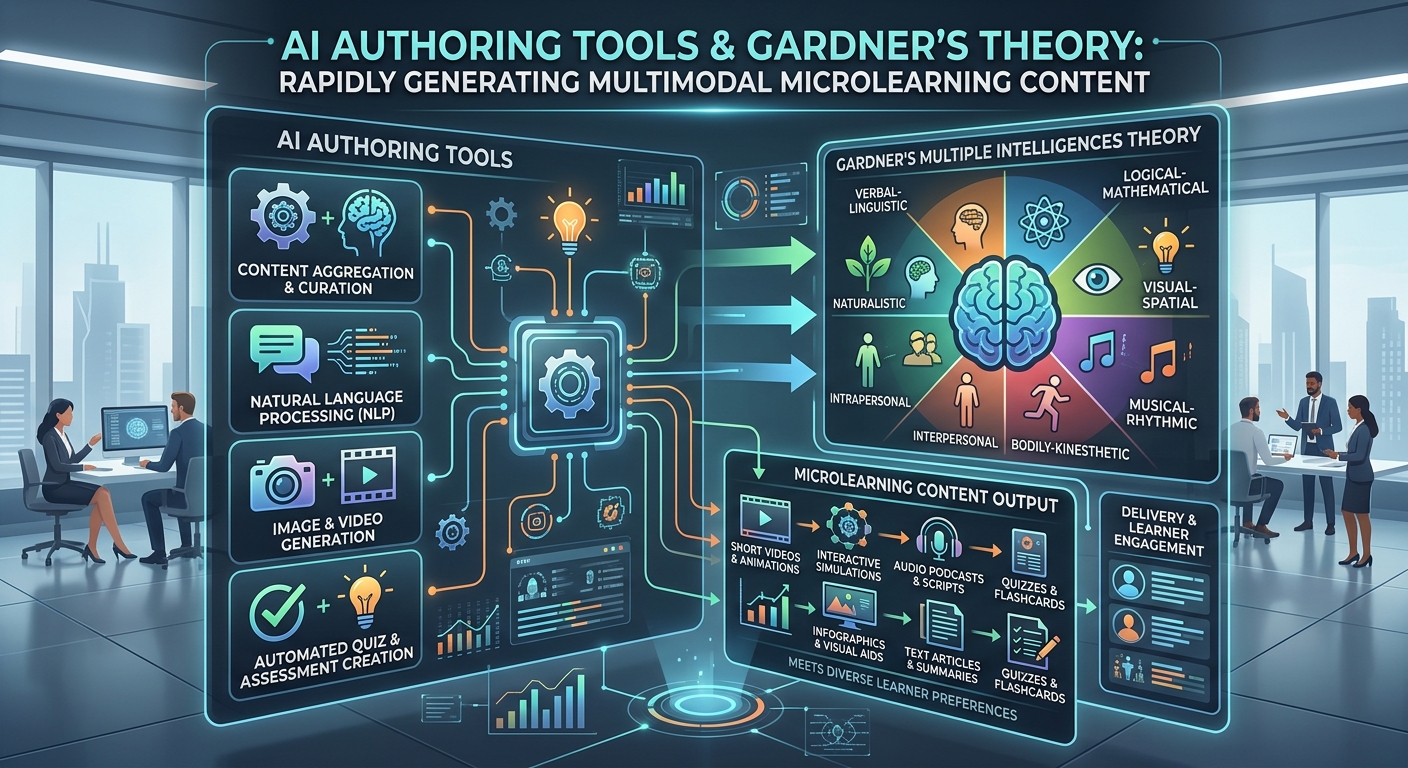
AI Authoring Tools and Gardner’s Theory: Rapidly Generating Multimodal Microlearning Content
In today's fast-paced corporate landscape, the demand for effective, engaging, and immediate learning experiences has never been higher. L&D leaders across industries – from Compliance and Banking to Pharma and Retail – are constantly challenged to equip their workforce with critical knowledge and skills at an unprecedented speed. The traditional content creation model often struggles to keep pace, leading to stale materials, disengaged learners, and ultimately, a gap in competency. But what if there was a way to rapidly generate diverse, impactful learning content tailored to every individual?
Enter the powerful synergy of AI authoring tools and the timeless wisdom of Gardner's Theory of Multiple Intelligences, culminating in a revolution for multimodal microlearning content. For Vice Presidents, Directors, and Managers of L&D, understanding this convergence is not just about staying relevant; it's about defining the future of organizational learning.
The Modern L&D Imperative: Agility and Impact
Modern enterprises operate in a state of constant flux. New regulations, product launches, technological shifts, and evolving market demands mean that employee knowledge must be continuously updated. This urgency makes agile content development a top priority. Learning content management system approaches need to be flexible enough to address these dynamic requirements across diverse segments like Sales, Health care, Oil and Gas, and even Hospitality.
Furthermore, training isn't a one-size-fits-all endeavor. An effective learning management system must cater to a spectrum of learners, ensuring that content resonates and sticks. This is particularly crucial for complex areas such as Risk-focused Training, where comprehension and retention directly impact business growth and compliance adherence. The goal is to move beyond passive consumption to active engagement, fostering true understanding and application.
Gardner's Theory and the Power of Multimodal Learning
Howard Gardner's Theory of Multiple Intelligences posits that individuals possess varying cognitive strengths, from linguistic and logical-mathematical to spatial, musical, bodily-kinesthetic, interpersonal, intrapersonal, and naturalistic. Applied to learning, this theory underscores the necessity of presenting information through multiple channels and formats to optimize comprehension and retention for the broadest audience.
For L&D, this translates into a need for multimodal content: videos for visual learners, podcasts for auditory learners, interactive simulations for kinesthetic learners, and text-based modules for linguistic learners. Manually creating such a diverse array of content is resource-intensive and time-consuming, often a bottleneck for even the most well-equipped L&D departments. This is where the power of artificial intelligence steps in, bridging the gap between theoretical understanding and practical implementation.
The AI Revolution in Content Creation
Artificial intelligence is no longer a futuristic concept; it's a transformative force reshaping how we create and consume information. For L&D, AI Powered Authoring Tool solutions are fundamentally changing the content generation lifecycle. These advanced tools leverage machine learning and natural language processing to automate previously manual, repetitive tasks, freeing up L&D professionals to focus on strategy and instructional design.
How can artificial intelligence transform learning and development content creation?
AI can revolutionize L&D content creation by automating the drafting of learning materials, generating diverse media formats from a single source, and even personalizing content paths based on learner data. This significantly reduces production time and costs while boosting content relevance and engagement. Imagine instantly converting a compliance document into an interactive quiz, a short explainer video script, and an audio summary – all in a fraction of the time it would traditionally take.
Unleashing Multimodal Microlearning with AI
The true power of AI authoring tools lies in their ability to generate a wide spectrum of multimodal content, perfectly suited for a Microlearning LMS environment. Microlearning, characterized by its bite-sized, focused content delivery, thrives on variety and immediate applicability. AI accelerates this by:
- Generating Diverse Content Formats: From converting long-form text into concise summaries, bullet points, and Q&A formats, to scripting short videos, creating audio narrations, and designing interactive scenarios, AI tools can produce a rich tapestry of learning assets.
- Ensuring Consistency and Quality: AI can maintain brand voice, terminology, and instructional design principles across all generated content, ensuring a cohesive and professional learning experience.
- Personalizing Learning Paths: Coupled with data analytics, AI can even suggest or generate content variations based on individual learner preferences, performance, or job role, embodying the principles of Adaptive Learning.
- Rapid Prototyping and Iteration: L&D teams can quickly test different content formats or approaches, gather feedback, and iterate at speed, optimizing for learner engagement and outcomes.
For industries like Banking and Finance, where regulatory changes are frequent, rapidly generating updated compliance micro-modules in various formats means employees are always up-to-date. In Pharma, complex drug information can be broken down into digestible, multimodal chunks, enhancing sales force knowledge and adherence to protocols. The ability to churn out relevant, fresh content quickly is a game-changer.
What are the key advantages of using AI for rapid learning module production?
The primary advantages include unparalleled speed in content generation, scalability to meet large-scale training needs, enhanced consistency in messaging and branding, and significant cost reductions associated with traditional content development. This allows L&D teams to be proactive rather than reactive, delivering timely learning solutions.
The Symbiosis: AI, Microlearning, and a Robust Learning Platform
Generating exceptional multimodal microlearning content with AI is only half the battle. This content needs a powerful, intuitive home where it can be organized, delivered, tracked, and optimized. This is where a sophisticated learning management system (LMS) becomes indispensable. A comprehensive learning management software or an enterprise learning management solution acts as the backbone, providing the infrastructure for AI-powered content to thrive.
Modern learning management solutions, such as the MaxLearn LMS, offer the capabilities to seamlessly integrate AI-generated content. A cloud based learning management system ensures accessibility and scalability across global workforces, a critical factor for large organizations in Mining or Health care. Features like a Gamified LMS further boost engagement, making learning an enjoyable and competitive experience that complements the varied formats produced by AI tools.
The synergy is clear: AI tools create the content, and a robust LMS learning management system delivers it effectively. This complete ecosystem empowers L&D leaders to manage an extensive library of dynamic, relevant, and engaging learning assets with an efficiency previously unattainable. An integrated LCMS (Learning Content Management System) within the broader LMS can further streamline the entire content lifecycle, from creation to delivery and archival.
Where can organizations find advanced platforms to deploy AI-created learning materials?
Organizations should seek leading enterprise learning management systems that offer robust integration capabilities for AI authoring tools, comprehensive content management features, and powerful delivery mechanisms. Platforms designed for scale and adaptability are best suited to deploy, manage, and optimize the impact of AI-generated learning experiences.
Strategic Implications for L&D Leaders
For L&D VPs, Directors, and Managers, the integration of AI authoring tools is not merely an operational upgrade; it's a strategic imperative. It allows for:
- Increased ROI on Training: By rapidly deploying highly engaging and relevant content, organizations can see faster skill acquisition and improved performance, directly impacting business outcomes.
- Scalability and Reach: Address the training needs of thousands, or even hundreds of thousands, of employees across diverse regions and roles without proportional increases in L&D headcount or budget.
- Enhanced Learner Experience: Provide truly personalized and multimodal learning journeys that cater to individual preferences, significantly improving engagement and knowledge retention.
- Competitive Advantage: Outpace competitors by ensuring your workforce is always equipped with the latest skills and knowledge, maintaining a sharp edge in dynamic markets.
The role of the L&D professional evolves from content creator to content strategist, curator, and innovator. While AI can generate, human expertise remains vital for instructional design, quality assurance, ethical considerations, and ensuring the content truly aligns with organizational goals and culture.
The convergence of AI authoring tools with Gardner's theory offers a revolutionary pathway to rapidly generate multimodal microlearning content. This approach not only addresses the critical need for agility and engagement in corporate training but also empowers L&D leaders to deliver transformative learning experiences. By leveraging a powerful LMS and embracing AI-driven content creation, organizations can unlock unprecedented levels of learning effectiveness and prepare their workforce for future challenges with confidence.


Comments
Post a Comment