5 Critical Shifts L&D Leaders Must Make to Embrace Gardner’s Cognitive Theory
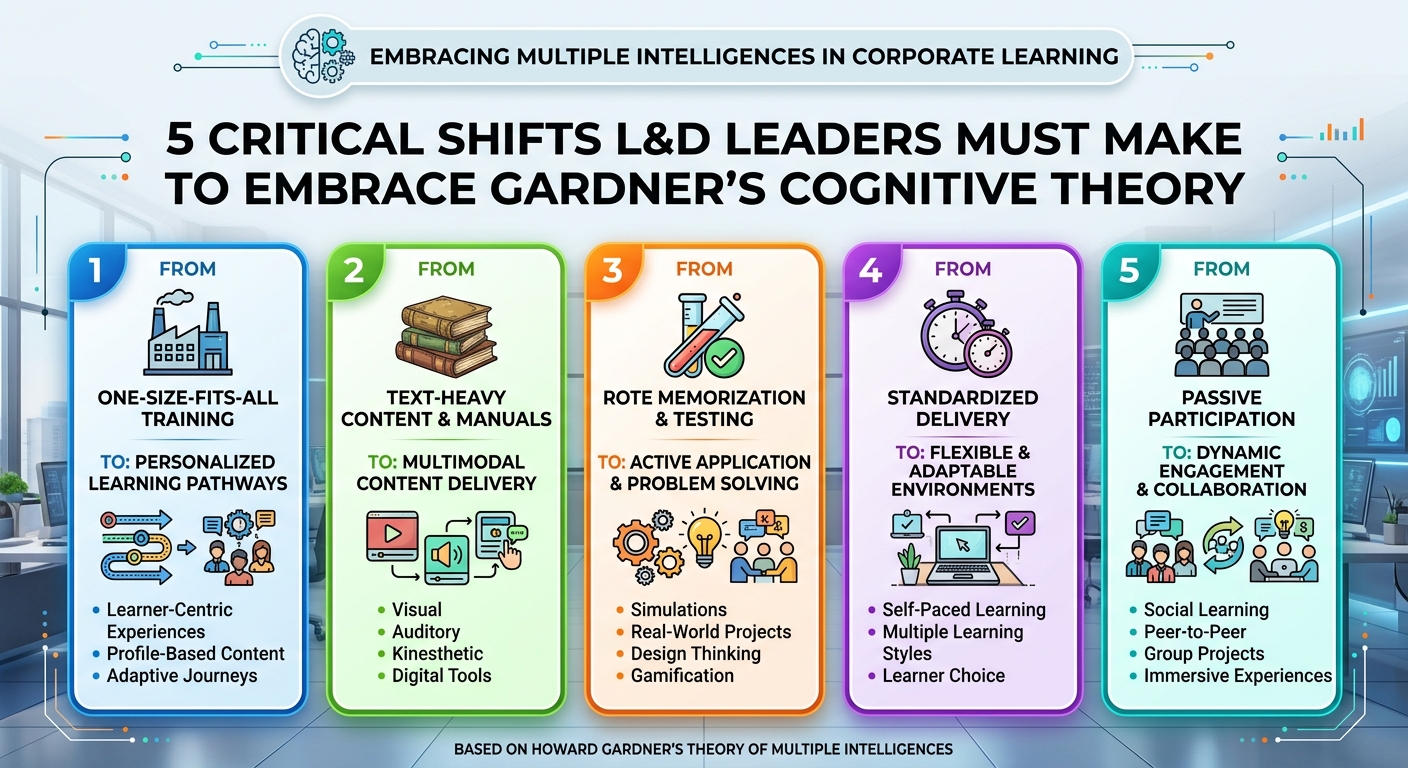
5 Critical Shifts L&D Leaders Must Make to Embrace Gardner’s Cognitive Theory
In today's rapidly evolving corporate landscape, the role of Learning & Development (L&D) is more crucial than ever. As L&D leaders, you're tasked not just with training, but with fostering continuous growth, adaptability, and high performance across diverse workforces. Traditional one-size-fits-all training models are becoming obsolete, especially when confronted with the complexities of modern business in sectors like Compliance, Sales, Banking, Finance, Insurance, Retail, Pharma, Health care, Hospitality, Oil and Gas, and Mining.
Enter Howard Gardner's Theory of Multiple Intelligences, a revolutionary concept that challenges the conventional view of intelligence as a singular, quantifiable entity. Instead, Gardner proposed that individuals possess distinct intelligences – linguistic, logical-mathematical, spatial, bodily-kinesthetic, musical, interpersonal, intrapersonal, and naturalistic – each representing a different way of learning, processing information, and demonstrating mastery. For L&D professionals, this isn't just an academic theory; it's a blueprint for transforming corporate training into a truly effective, engaging, and personalized experience.
Embracing Gardner's cognitive theory means moving beyond generic eLearning modules and towards a more nuanced, inclusive, and impactful approach to talent development. This requires L&D leaders to make five critical shifts in strategy, technology, and mindset. Let's explore these pivotal transformations.
Shift 1: From Standardized Content to Personalized Learning Paths
Tailoring Learning to Individual Strengths
The first and most fundamental shift is to move away from the assumption that all learners grasp information in the same way. A standardized corporate training module, while efficient to deploy, often fails to resonate with individuals whose dominant intelligences are not catered to by the content delivery method. Imagine a finance professional who excels in logical-mathematical reasoning being subjected to purely linguistic, text-heavy manuals, or a retail associate with strong interpersonal intelligence receiving no opportunities for collaborative role-playing.
L&D leaders must champion the creation of personalized learning paths. This involves assessing learner preferences and strengths to offer varied content formats and engagement opportunities. A robust LMS with advanced analytics can identify learning patterns and recommend content that aligns with an individual's specific intelligence profile. This approach ensures that a sales team, for instance, receives not just product knowledge, but also training tailored to their communication styles and problem-solving abilities.
- Utilize pre-assessments to identify dominant intelligences.
- Offer choice in learning materials: videos for spatial learners, case studies for logical-mathematical learners, group discussions for interpersonal learners.
- Leverage an Adaptive Learning system that dynamically adjusts content based on learner performance and style.
Shift 2: From Passive Consumption to Active Engagement & Experiential Learning
Engaging the Whole Learner
Traditional eLearning often defaults to passive content consumption – reading, watching, listening. Gardner's theory emphasizes that true learning occurs when individuals actively engage with the material in ways that align with their strengths. This means a significant pivot towards experiential and interactive learning methodologies.
For industries like healthcare, where hands-on application is critical, or for compliance training where understanding context is paramount, this shift is vital. Incorporating elements that appeal to bodily-kinesthetic intelligence (simulations, role-playing), interpersonal intelligence (group projects, peer coaching), and logical-mathematical intelligence (interactive problem-solving scenarios) can dramatically boost engagement and retention. A modern Gamified LMS can transform mundane training into exciting challenges, appealing to competitive spirits and making learning stickier.
- Implement simulations and virtual reality for practical skill development.
- Foster collaborative learning environments for group problem-solving.
- Integrate Microlearning LMS modules that encourage immediate application of knowledge.
Shift 3: From Text-Heavy to Multimedia-Rich & Visual Design
Catering to Diverse Sensory Preferences
While linguistic intelligence is highly valued in academic and corporate settings, it's not the only way people learn. Many individuals, especially those strong in spatial intelligence, process information best through visual aids, diagrams, and interactive media. Relying solely on text-heavy documents or lengthy presentations alienates a significant portion of your workforce.
L&D leaders must advocate for and invest in diverse multimedia content. This includes high-quality videos, infographics, interactive quizzes, animations, and virtual tours. An AI Powered Authoring Tool can significantly streamline the creation of such diverse content, enabling L&D teams to produce engaging materials rapidly and efficiently. This is particularly relevant for complex topics in pharma or oil and gas, where visual representations of processes or mechanisms can simplify understanding.
- Prioritize visual storytelling and interactive elements over dense text.
- Use audio narration and podcasts for auditory learners.
- Ensure all content is accessible and engaging across multiple intelligence types.
Shift 4: From Isolated Learning to Collaborative & Contextual Application
Learning in the Real World, Together
Gardner's theory underscores the importance of interpersonal intelligence (understanding and interacting effectively with others) and intrapersonal intelligence (self-awareness). Learning in isolation, without opportunities for collaboration or reflection, misses out on these critical dimensions. The modern workplace thrives on teamwork and the ability to apply knowledge in real-world contexts.
L&D must shift towards fostering communities of practice, peer-to-peer learning, and project-based assignments. This encourages learners to apply their knowledge collectively, receive feedback, and deepen their understanding through social interaction. For instance, in banking and finance, case studies involving team-based problem-solving of complex financial scenarios can be immensely effective. Furthermore, providing opportunities for self-reflection allows intrapersonal learners to connect new information with their personal experiences and goals, solidifying their learning. An effective learning management system should facilitate these interactions.
- Implement social learning features within your learning management software.
- Design group projects and team-based simulations, especially for complex compliance or risk scenarios.
- Encourage journaling or reflective exercises as part of the learning process.
Shift 5: From General Assessment to Diverse, Authentic Evaluation
Measuring What Truly Matters
If training is personalized and diverse, so too must be its evaluation. Traditional multiple-choice tests often primarily assess linguistic or logical-mathematical intelligence, failing to capture mastery demonstrated through other intelligences. This can lead to an incomplete picture of a learner's capabilities and the true effectiveness of the training.
The final critical shift is towards implementing diverse and authentic assessment methods. For example, a bodily-kinesthetic learner might demonstrate mastery through a simulated task, while an interpersonal learner might excel in a team presentation. For Risk-focused Training in industries like oil and gas or insurance, practical demonstrations of safety protocols or risk mitigation strategies are far more effective than written tests. An advanced learning content management system (LCMS) should offer tools for varied assessment types.
- Utilize project-based assessments, presentations, and portfolios.
- Implement performance-based evaluations and simulations.
- Incorporate peer reviews and self-assessments to reflect a broader range of skills.
Addressing Your Key L&D Questions
As L&D leaders navigate these shifts, common questions arise:
What is the most effective way to individualize employee training in large organizations?
The most effective way is to leverage an enterprise learning management system that supports adaptive learning paths and a rich library of diverse content. This allows learners to choose modalities that align with their cognitive strengths and learn at their own pace, moving beyond generic modules. A modern lms learning management system can track individual progress and recommend future learning. MaxLearn LMS provides tools for such customization.
How can L&D departments globally ensure consistent high-quality training across different regions and cultures?
For global consistency, implementing a robust cloud based learning management system is crucial. This ensures centralized content management, easy updates, and consistent delivery worldwide. Localization features, where content can be easily translated and culturally adapted within the same learning management solutions platform, are also key. This ensures that a common understanding of critical procedures, like compliance in pharmaceuticals, is maintained everywhere.
Why is investing in advanced learning technologies now essential for future-proofing our workforce skills?
Investing in advanced learning technologies, such as an intelligent learning management system, is no longer optional but essential. These technologies enable personalized, engaging, and data-driven training that can quickly adapt to new skill requirements. They provide the agility to upskill and reskill employees efficiently, ensuring your workforce remains competitive and innovative in rapidly changing industries like retail or technology, directly impacting business growth and resilience. A powerful learning management software offers this strategic advantage.
Conclusion: The Future of L&D is Cognitively Informed
Embracing Gardner's cognitive theory isn't just about adopting a new framework; it's about fundamentally rethinking how L&D serves its purpose. By making these five critical shifts – personalizing paths, fostering active engagement, diversifying media, encouraging collaboration, and authenticating assessment – L&D leaders can unlock the full potential of their workforce.
The journey involves strategic investment in advanced LMS platforms, innovative content creation, and a commitment to understanding the unique learning profiles of every employee. The payoff is a highly skilled, adaptable, and engaged workforce, ready to drive success in any industry. Begin your transformation today and build an L&D ecosystem that truly champions individual growth and organizational excellence.


Comments
Post a Comment