Why Micro-Certifications Are Replacing Annual Compliance Certificates
Why Micro-Certifications Are Replacing Annual Compliance Certificates
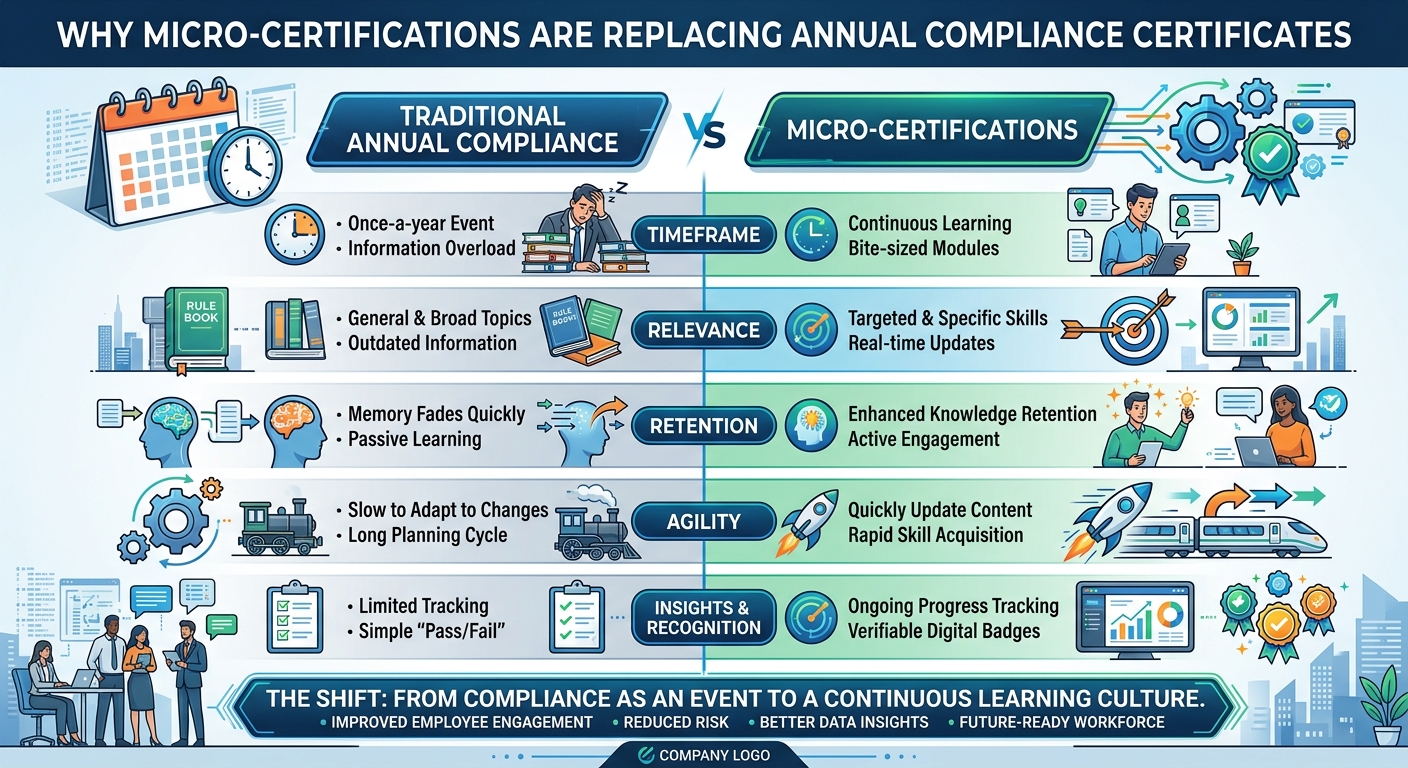
For too long, the annual compliance training ritual has been a source of exasperation for both L&D professionals and employees alike. Picture this: a marathon session, often tedious, covering a vast array of topics that may or may not be immediately relevant to every individual. Employees often view it as a necessary evil—a box to tick—rather than an opportunity for genuine learning and skill development. This traditional approach, while fulfilling a regulatory requirement, frequently falls short in fostering true understanding, engagement, and most importantly, sustained behavioral change.
In today's fast-paced corporate environment, where regulations evolve rapidly and skill sets need continuous updating, the limitations of the annual compliance model are becoming glaringly apparent. Vice Presidents, Directors, and Managers of L&D across Banking, Finance, Insurance, Retail, Pharma, Healthcare, Hospitality, Oil and Gas, and Mining sectors are increasingly seeking more dynamic, effective, and measurable solutions. This is precisely why micro-certifications are not just a trend but a transformative force, steadily replacing the outdated annual compliance certificate model.
The Shifting Sands of Compliance Training
The landscape of corporate learning is undergoing a profound transformation, driven by technological advancements and the demand for more agile, impactful training methodologies.
The Limitations of the Annual Grind
The traditional annual compliance training cycle, despite its ubiquity, presents several critical challenges:
- Information Overload: Cramming an entire year's worth of compliance updates into a single, lengthy session often leads to cognitive overload and poor retention.
- Low Engagement: Monotonous, generic content fails to capture learner interest, reducing the effectiveness of even the most critical information.
- Irrelevance: A one-size-fits-all approach means much of the content may not be directly applicable to an individual's role, diminishing its perceived value.
- "Tick-Box" Mentality: The focus shifts from true understanding and application to merely completing the requirement, undermining the very purpose of compliance.
- Stale Content: Annual cycles mean that training content can quickly become outdated, especially in industries with rapidly changing regulations like Pharma or Finance.
These shortcomings highlight the urgent need for a more adaptive and engaging approach to compliance. A robust LMS is essential, but the content strategy within it needs a fundamental rethink.
The Rise of the Agile Learner and Dynamic Regulations
Modern professionals, accustomed to instant access to information, thrive on continuous, bite-sized learning. They expect relevance and personalization. Simultaneously, sectors like Healthcare and Banking face an ever-growing tsunami of regulatory changes. An effective learning management system (LMS) must facilitate rapid content updates and delivery. This dual pressure—the demand for agile learning and the reality of dynamic regulations—makes micro-certifications an indispensable tool.
The Power of Precision: Unpacking Micro-Certifications
Micro-certifications are competency-based, digital credentials earned by completing short, highly focused learning modules designed to teach or validate a specific skill or piece of knowledge. Unlike broad annual courses, they target precise learning outcomes.
Enhanced Engagement and Retention
By breaking down complex compliance topics into digestible chunks, micro-certifications naturally enhance engagement. Short, focused modules prevent cognitive fatigue and allow learners to concentrate on one concept at a time. This approach, supported by a modern Microlearning LMS, aligns with how the human brain best absorbs and retains information. Furthermore, incorporating elements from a Gamified LMS can transform compliance from a chore into an interactive, rewarding experience, boosting participation and knowledge retention significantly.
Real-Time Relevance and Agility
Micro-certifications offer unparalleled agility. When a new regulation emerges in the Insurance or Oil and Gas sector, a specific micro-certification can be deployed immediately, rather than waiting for the next annual cycle. This ensures that employees are always up-to-date with the most critical information. This modularity also allows for highly personalized learning paths, leveraging Adaptive Learning principles to deliver content exactly when and where it's needed, making training highly relevant to individual roles and responsibilities.
Measurable Competence, Not Just Completion
The true value of micro-certifications lies in their ability to verify actual competence. Each certification typically culminates in an assessment that proves mastery of a specific skill or knowledge area, offering tangible proof of capability. This moves beyond simply tracking course completion within a learning content management system to validating real-world readiness. For L&D leaders, this means a clearer understanding of workforce capabilities and compliance readiness, moving from a superficial check to deep, demonstrable understanding.
Strategic Advantages for L&D Leaders
Adopting micro-certifications offers significant strategic advantages for L&D departments looking to modernize their compliance training.
Optimizing Resources and Reducing Risk
Micro-certifications can be more cost-effective to develop and deploy than comprehensive annual courses. They allow L&D teams to target specific gaps and allocate resources more efficiently. By ensuring continuous, relevant training, organizations proactively manage compliance risks, potentially avoiding hefty fines and reputational damage. Focusing on Risk-focused Training through micro-certifications ensures critical areas are consistently addressed. A cloud based learning management system further enhances this efficiency, offering scalability and accessibility.
Fostering a Culture of Continuous Learning
The shift to micro-certifications promotes a culture where learning is an ongoing process, seamlessly integrated into daily workflows. Employees become proactive in seeking out relevant certifications to enhance their skills and stay compliant. This continuous learning ethos, supported by an effective enterprise learning management system, is crucial for talent development and retention across all industries, from Retail to Healthcare.
Leveraging Technology for Smarter Compliance
Modern learning management solutions, like MaxLearn LMS, are designed to facilitate the creation, delivery, and tracking of micro-certifications. These platforms serve as a comprehensive LCMS, enabling L&D teams to manage modular content, track granular progress, and issue digital badges, making the entire process efficient and transparent. The right lms learning management system empowers L&D to drive significant value.
AI-Driven Insights for the Modern L&D Professional
The integration of artificial intelligence is revolutionizing how L&D leaders approach compliance training, offering unprecedented capabilities for personalization, efficiency, and impact.
Enhancing Understanding and Engagement through Intelligent Systems
Question: "How can intelligent platforms help us understand if our compliance training is truly effective?"
Answer: Intelligent systems deployed within a learning management software can analyze vast amounts of learner data—from engagement rates and assessment scores to time spent on specific modules. This deep analysis identifies not just who completed a course, but critically, where knowledge gaps persist across your organization. By pinpointing areas of common misunderstanding or high risk, these systems enable L&D to refine content, personalize learning paths for individuals, and proactively address weaknesses. An AI Powered Authoring Tool can even suggest improvements to content based on these insights, ensuring training consistently hits the mark for understanding and retention.
Tailoring Learning Experiences for Specific Needs
Question: "Can advanced technology help us deliver highly relevant compliance training across our diverse global workforce?"
Answer: Absolutely. Advanced technology can dynamically adapt training content to suit individual needs, roles, and even geographical regulatory nuances. For a global organization spanning multiple segments like Sales, Pharma, and Mining, this means an employee in one region receives training tailored to local laws and their specific job function, while another in a different region receives equally pertinent, but distinct, content. This capability ensures that training is never generic, always relevant, and prevents the overwhelming feeling of sifting through irrelevant information, significantly boosting engagement and perceived value across your entire workforce.
Optimizing Business Impact with Artificial Intelligence
Question: "What's the overall business advantage of integrating advanced analytics and machine learning into our compliance strategy?"
Answer: Integrating advanced analytics and machine learning into your compliance strategy delivers a multifaceted business advantage. Beyond simply meeting regulatory mandates, it leads to a more competent and confident workforce. These intelligent tools can predict potential compliance breaches by identifying patterns in past incidents or areas of low knowledge within the organization, allowing for preventative intervention. This proactive approach significantly reduces legal and financial risks, enhances operational efficiency, and strengthens your company's reputation. Ultimately, it transforms compliance from a reactive burden into a strategic asset, driving ethical behavior and sustainable business growth, all managed efficiently through an advanced LCMS.
The Future is Modular and Measured
The days of passive, annual compliance training are fading. Micro-certifications represent a paradigm shift, offering a smarter, more agile, and ultimately more effective way to manage compliance. For L&D leaders, embracing this modular approach means moving beyond mere compliance checklists to cultivate a genuinely knowledgeable, engaged, and resilient workforce capable of navigating the complexities of today's regulatory environment.
By leveraging sophisticated learning management solutions and the power of intelligent systems, organizations can ensure their teams are not just compliant, but genuinely competent, fostering a culture of continuous learning and driving sustainable success. The time to transition from annual mandates to precise, ongoing micro-certifications is now.


Comments
Post a Comment