How Does the Player-Subject Concept Work in Gamified Learning?
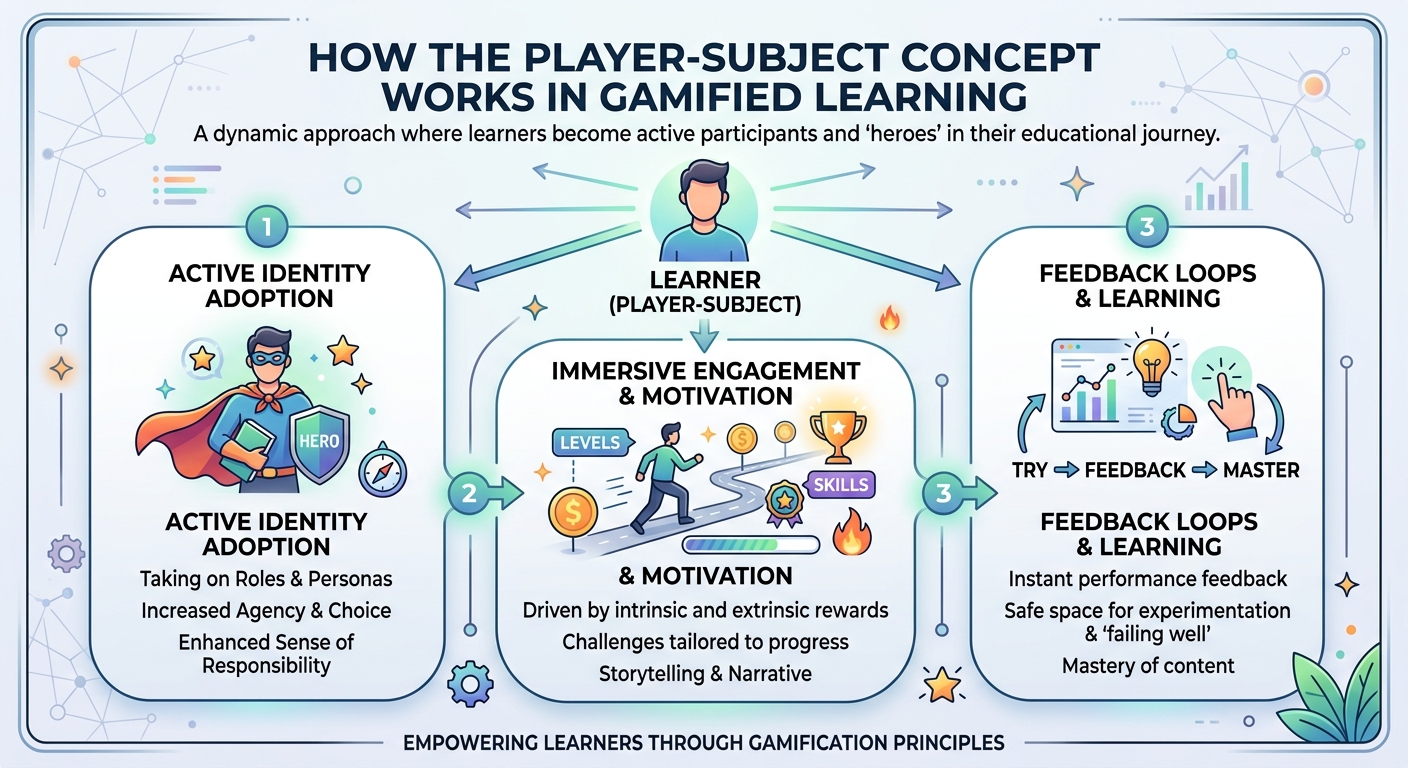
How Does the Player-Subject Concept Work in Gamified Learning?
In the dynamic landscape of corporate learning and development, the traditional model of passive information consumption is rapidly becoming obsolete. Today's L&D leaders, across sectors like Compliance, Sales, Banking, Finance, and Healthcare, are seeking innovative strategies to foster deeper engagement, skill retention, and measurable performance improvements. This quest often leads to gamified learning – a powerful methodology that transforms mundane training into immersive, motivating experiences. Central to its effectiveness is the 'player-subject' concept, a paradigm shift that moves learners from mere recipients of knowledge to active, empowered participants in their educational journey.
This article delves into the core mechanics of the player-subject concept, exploring how it reshapes the learning experience and drives superior outcomes for your organization. We will also examine how cutting-edge AI integration further amplifies its potential.
Understanding the Player-Subject Concept
At its heart, the player-subject concept redefines the learner's role. Instead of being a passive 'subject' upon whom information is acted, they become an active 'player' within a structured learning environment. This transformation mirrors the engagement found in well-designed games, where individuals are intrinsically motivated to achieve goals, overcome challenges, and progress through a narrative. It's about giving learners agency, purpose, and a sense of ownership over their development.
Why is this shift so crucial for engagement? When individuals perceive themselves as players, they are more likely to invest cognitive effort, persist through difficulties, and derive satisfaction from their achievements. This intrinsic motivation is far more potent than external pressures, leading to improved knowledge acquisition, application, and retention – critical for any enterprise learning management strategy.
Key Elements of the Player-Subject Experience
The successful implementation of the player-subject concept relies on integrating several fundamental elements:
Autonomy and Agency
Players thrive on choice. In a gamified learning environment, this translates to giving learners control over their path, pace, and even the content they engage with. Whether it's choosing which module to tackle next, selecting different approaches to a problem, or deciding when to revisit challenging topics, autonomy fosters a sense of personal responsibility and investment. Modern Microlearning LMS platforms are expertly designed to support this, breaking down complex subjects into digestible, self-paced units that learners can navigate at their discretion, fitting seamlessly into busy professional schedules.
Meaningful Challenges and Objectives
Just as games present escalating challenges, gamified learning must offer objectives that are clear, relevant, and progressively more complex. These aren't just quizzes; they are scenarios, simulations, and problem-solving tasks that directly relate to real-world job functions. For instance, in Compliance training, a player might navigate a complex regulatory scenario, making decisions with simulated consequences, rather than simply memorizing rules. This approach is vital for ensuring that skills learned are directly applicable.
Immediate Feedback and Progression
Nothing deflates a player more than uncertainty about their performance. Instant, constructive feedback is paramount. A robust Gamified LMS provides real-time insights into progress, points earned, badges achieved, and areas needing improvement. This constant feedback loop allows players to adjust their strategies, reinforce correct behaviors, and see a clear path of progression, keeping motivation high. It transforms mistakes into learning opportunities rather than failures.
Social Interaction and Collaboration
Many of the most engaging games involve interaction with others. In professional learning, this translates to features like leaderboards, team challenges, peer-to-peer feedback, and collaborative problem-solving. Such elements foster healthy competition, community building, and shared learning experiences. For industries like Sales or Banking, where teamwork and communication are key, this social dimension reinforces critical workplace skills.
Storytelling and Immersion
A compelling narrative can transport a player into the learning content, making it more memorable and emotionally resonant. Whether it's a simulated customer interaction for Retail staff or a complex financial fraud investigation for Finance professionals, a well-crafted story provides context and purpose. This immersive experience is often enhanced through Adaptive Learning techniques, which can adjust the narrative and challenges based on the player's choices and performance, creating a truly personalized adventure.
Integrating AI for an Enhanced Player-Subject Journey
Artificial Intelligence (AI) is rapidly transforming the capabilities of an LMS, elevating the player-subject experience to unprecedented levels.
How can intelligent systems tailor learning paths to individual needs? AI-powered personalization is perhaps the most significant contribution. By analyzing a player's performance, learning style, and even emotional responses, AI can dynamically adapt content, recommend specific modules, or even modify the difficulty of challenges in real-time. This ensures that each player receives the most relevant and effective training, maximizing engagement and efficiency. An AI Powered Authoring Tool makes it easier for L&D teams to create such dynamic content.
What insights can advanced analytics provide about learner behavior? AI-driven predictive analytics can identify patterns in player engagement and performance, flagging individuals who might be struggling or disengaging before they fall behind. For an enterprise learning management system, this proactive insight allows L&D managers to intervene with targeted support, ensuring no player is left behind. This intelligence enhances the overall efficacy of any learning management software.
Can artificial intelligence create realistic training simulations? Absolutely. AI excels at generating complex, branching scenarios and dynamic virtual environments, crucial for Risk-focused Training in sectors like Oil and Gas, Mining, or Pharma. These simulations allow players to practice critical decision-making in a safe, yet highly realistic, setting, preparing them for high-stakes situations without real-world consequences. This level of immersion fosters deeper learning and skill transfer.
Real-World Impact Across Industries
The player-subject concept, amplified by AI, delivers tangible benefits across diverse industries:
- Compliance: Rather than dry policy reviews, players might navigate a virtual audit, identifying violations and implementing corrective actions. This active participation dramatically improves adherence and reduces corporate risk, utilizing a robust learning content management system.
- Sales: Sales professionals engage in AI-driven role-play simulations with virtual customers, honing negotiation and objection-handling skills in a low-pressure environment.
- Healthcare: Medical staff can practice complex diagnostic procedures or patient interactions in immersive simulations, improving critical decision-making and empathy.
- Retail: Employees master customer service scenarios, inventory management, or new product launches through interactive quests and challenges.
- Banking & Finance: Players learn about market dynamics, risk assessment, and regulatory changes by managing virtual portfolios or responding to simulated economic events. This is where a specialized LCMS becomes invaluable.
By empowering employees as players, organizations using a sophisticated lms learning management system or a cloud based learning management system can achieve higher training completion rates, improved skill application, and ultimately, better business outcomes. The shift from passive learning to active play cultivates a workforce that is not only knowledgeable but also highly capable and motivated.
Challenges and Best Practices
While powerful, implementing the player-subject concept requires thoughtful design. Avoid superficial gamification (points for points' sake). Instead, focus on:
- **Alignment:** Ensure game mechanics directly support learning objectives.
- **Relevance:** Content must be meaningful and applicable to the player's role.
- **Balance:** Challenges should be neither too easy nor too frustratingly difficult.
- **Continual Improvement:** Gather feedback and iterate on your learning experiences.
Choosing the right learning management solutions is also crucial. A platform like MaxLearn LMS is designed to facilitate these engaging, player-centric experiences, offering the tools and flexibility needed to bring this concept to life effectively.
Conclusion
The player-subject concept is more than just a trend in eLearning; it's a fundamental shift towards a more effective, engaging, and human-centered approach to corporate training. By transforming learners into active players, equipped with autonomy, facing meaningful challenges, receiving immediate feedback, and leveraging the power of AI-driven personalization and simulation, organizations can unlock unprecedented levels of engagement and skill development. For L&D leaders looking to drive impactful learning outcomes and foster a highly skilled, motivated workforce, embracing the player-subject paradigm within a robust learning management system is not just an option—it's an imperative for future success.


Comments
Post a Comment