How Does DDE Game Design Drive Workplace Behavioral Change?
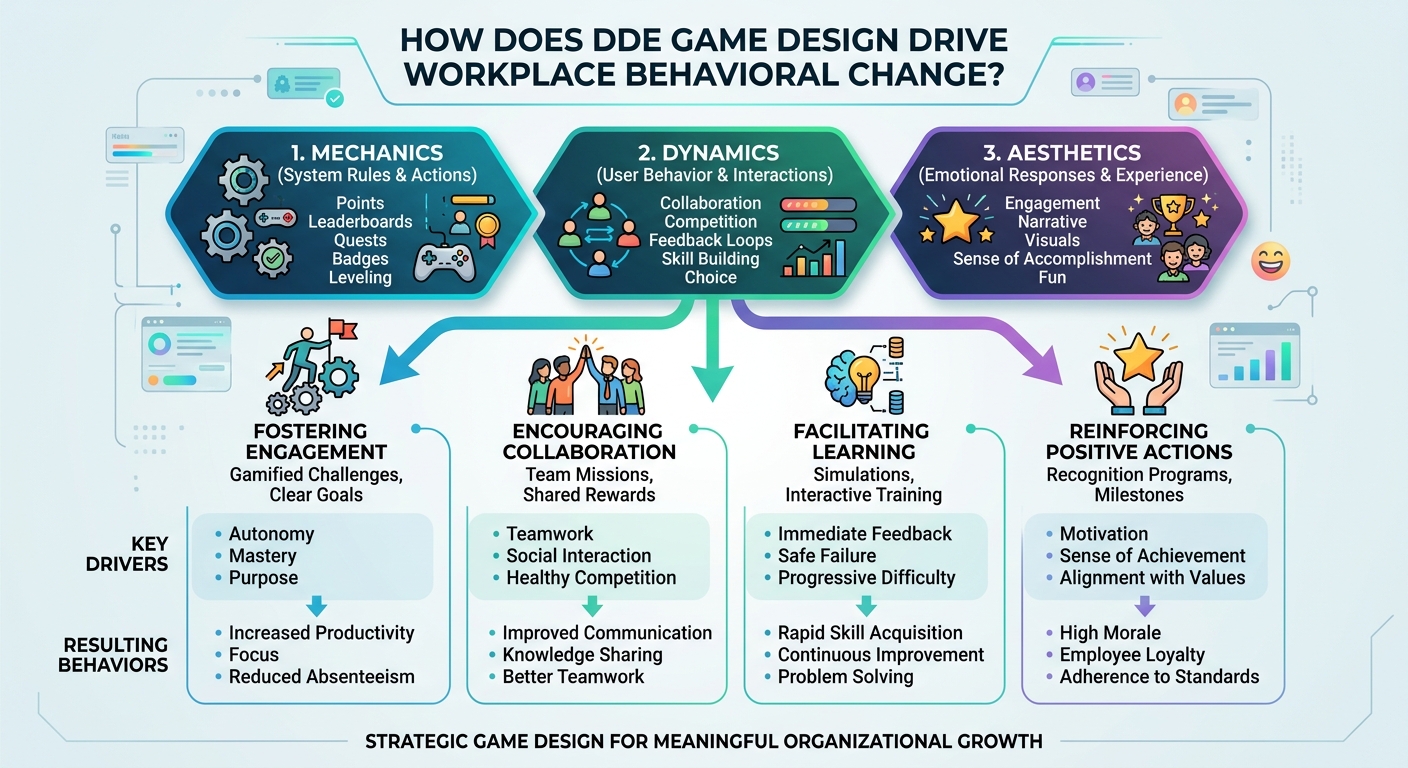
How Does DDE Game Design Drive Workplace Behavioral Change?
In today's dynamic corporate landscape, the quest for effective workplace behavioral change is a constant challenge for L&D leaders. Traditional training methods often fall short, struggling to capture attention, sustain engagement, and translate knowledge into lasting habits. This is where DDE (Discovery, Design, and Engagement) game design emerges as a transformative methodology. For Vice Presidents, Directors, Senior Managers, and Managers of L&D across industries like Compliance, Sales, Banking, Finance, Insurance, Retail, Pharma, Healthcare, Hospitality, Oil and Gas, and Mining, understanding DDE is no longer an option but a strategic imperative to foster a culture of continuous improvement and measurable impact.
DDE game design goes beyond mere gamification, embedding profound psychological principles within a structured approach to learning. It's about crafting immersive experiences that not only educate but intrinsically motivate employees to adopt new behaviors, master complex skills, and internalize crucial company values. By focusing on deep understanding, thoughtful construction, and sustained interaction, DDE offers a potent antidote to passive learning, paving the way for profound shifts in performance and organizational culture.
Understanding DDE Game Design: A Deeper Dive
DDE stands for Discovery, Design, and Engagement – three interconnected phases that form the backbone of this powerful approach to learning:
- Discovery: This initial phase is all about deep understanding. It involves a thorough analysis of the target audience, their existing behaviors, motivations, pain points, and the specific behavioral changes desired. L&D professionals work closely with stakeholders to identify learning objectives, performance gaps, and the environmental factors that influence behavior. This isn't just about what needs to be learned, but how and why.
- Design: Armed with insights from the discovery phase, the design phase focuses on creating the game's mechanics, narrative, challenges, and reward systems. This includes crafting engaging scenarios, decision points, feedback loops, and progression paths that directly address the identified behavioral objectives. It's about building a compelling world where learners can safely experiment, make mistakes, and experience the consequences of their actions, all within a structured learning environment.
- Engagement: The final, and arguably most crucial, phase ensures sustained interaction and continued behavioral reinforcement. This involves strategies to keep learners motivated over time, such as progressive challenges, social learning elements, leaderboards, recognition systems, and real-world application prompts. A well-designed engagement strategy ensures that the learning doesn't stop when the "game" ends, but rather translates into ongoing behavioral practice and habit formation.
Unlike superficial gamification that might simply add points or badges to existing content, DDE embeds gameful mechanics and principles from the ground up, creating truly immersive and effective learning experiences that resonate deeply with adult learners.
The Psychological Power of Play: Why DDE Works
The effectiveness of DDE game design in driving behavioral change is rooted in robust psychological and neurological principles:
- Intrinsic Motivation: DDE taps into our natural desire for mastery, autonomy, and purpose. When learning feels like a self-directed challenge rather than an imposed task, motivation soars.
- Immediate Feedback Loops: Games provide instant, non-judgmental feedback, allowing learners to understand the impact of their choices and adjust their approach in real-time. This accelerates the learning curve.
- Safe Experimentation: The virtual environment of a game offers a safe space to practice new behaviors, make mistakes without real-world consequences, and build confidence before applying skills in actual work situations.
- Narrative and Immersion: Engaging storylines and immersive scenarios create an emotional connection, making complex information more memorable and relatable.
- Social Learning: Many DDE implementations incorporate collaborative elements, fostering peer-to-peer learning, healthy competition, and a sense of community.
By leveraging these mechanisms, DDE transforms passive recipients of information into active participants in their own development, fostering deeper learning retention and a greater propensity for sustained behavioral change.
DDE in Action: Driving Change Across Industries
The versatility of DDE game design makes it invaluable across a multitude of industries:
Compliance Training: From Drab to Dynamic
In sectors like Banking, Finance, Healthcare, and Oil and Gas, compliance training is often perceived as a necessary evil. DDE can revolutionize this. Imagine a game where employees navigate complex regulatory scenarios, make ethical decisions under pressure, and experience the virtual consequences of non-compliance. This approach significantly boosts engagement and understanding, leading to improved adherence and reduced organizational risk. This becomes particularly powerful when coupled with Risk-focused Training, directly addressing high-impact areas.
Sales Training: Building Skills, Boosting Revenue
For Sales teams, DDE offers unparalleled opportunities for skill development. Sales professionals can practice objection handling, negotiation techniques, and product knowledge in realistic simulated customer interactions. The immediate feedback helps refine their approach, while competitive elements can drive performance. Utilizing an AI Powered Authoring Tool can further enhance these simulations, making them more dynamic and responsive to learner input.
Healthcare & Pharma: Precision and Empathy
In Healthcare, DDE can train staff on new protocols, patient interaction best practices, or even complex surgical procedures through simulations, ensuring precision and empathy. For Pharma, it can aid in understanding drug mechanisms, regulatory guidelines, and ethical sales practices, ensuring both compliance and effective communication.
Retail & Hospitality: Elevating Customer Experience
DDE games can train employees in customer service excellence, product knowledge, upselling techniques, and handling difficult situations, all within a low-stakes environment. This translates directly to enhanced customer satisfaction and loyalty, crucial for success in these service-driven industries.
Components of a DDE-Driven Learning Ecosystem
Implementing effective DDE game design requires more than just a clever game; it demands a robust learning ecosystem, often anchored by a sophisticated LMS or LCMS. A modern learning content management system or learning management software provides the infrastructure to deliver, manage, and track these immersive experiences.
- Interactive Content Delivery: DDE thrives on interactive, scenario-based learning. A cutting-edge learning management system facilitates the creation and deployment of such content.
- Personalized Learning Paths: Leveraging Adaptive Learning capabilities within a cloud based learning management system ensures that learning paths are tailored to individual needs and progress, maximizing relevance and engagement.
- Continuous Engagement Mechanisms: A Gamified LMS is essential for maintaining engagement through features like leaderboards, badges, points, and challenges, reinforcing desired behaviors over time.
- Bite-sized Learning for Retention: Implementing Microlearning LMS strategies ensures that complex topics are broken down into manageable, engaging modules, perfectly suited for DDE's iterative nature and enhancing long-term retention. This makes the overall lms learning management system experience more digestible.
- Powerful Analytics: An enterprise learning management solution like MaxLearn LMS offers deep analytics to track learner progress, identify areas of difficulty, and measure the impact of DDE on actual performance, demonstrating the value of your learning management solutions.
Leveraging Advanced Systems for Enhanced DDE Game Design
The integration of sophisticated computational power further amplifies the impact of DDE game design, making it more intelligent, responsive, and tailored to individual learner needs.
Question: How can advanced computational insights help us understand what employees truly need to learn and how they prefer to engage with training?
Answer: Sophisticated computational systems analyze vast amounts of data, including past performance metrics, learning activity logs, skill assessments, and even natural language queries from employees. By identifying patterns and correlations, these systems can pinpoint precise knowledge gaps, predict learning preferences, and surface the most effective content types and delivery methods. This deep understanding informs the "Discovery" phase of DDE, ensuring that the game design directly addresses actual needs and aligns with how individual employees learn best.
Question: What insights can advanced computational systems provide about the most effective learning scenarios for different roles or operational environments?
Answer: Computational power allows for the simulation and analysis of countless real-world scenarios. By modeling various situations, from customer interactions to complex technical operations, these systems can identify optimal decision paths, potential pitfalls, and the most impactful training interventions for specific roles or challenging operational environments. This capability significantly refines the "Design" phase of DDE, enabling the creation of highly relevant, context-specific game challenges and branching narratives that accurately reflect the realities of the workplace, regardless of the employee's physical or functional location.
Question: How can artificial intelligence continuously optimize the learning experience to ensure maximum engagement and measurable behavioral shifts?
Answer: Artificial intelligence continuously monitors learner progress, engagement levels, and performance within the DDE game. It dynamically adjusts the difficulty, provides personalized feedback, recommends supplementary content, and even modifies game mechanics in real-time to maintain optimal challenge and interest. This continuous adaptation in the "Engagement" phase ensures that each learner remains motivated and challenged, promoting sustained participation and reinforcing the desired behaviors until they become ingrained habits, leading to measurable and lasting workplace change.
Measuring Success and Demonstrating ROI
One of the significant advantages of DDE game design, particularly when deployed via a robust learning management system, is its inherent measurability. L&D leaders can track a variety of KPIs:
- Completion Rates: Higher engagement often leads to better course completion.
- Performance Improvement: Direct links between game performance and real-world task proficiency.
- Error Reduction: Decreased errors or incidents post-training, especially in compliance or operational roles.
- Compliance Adherence: Measurable improvement in adherence to policies and regulations.
- Behavioral Observation: Qualitative and quantitative changes in observed employee behaviors.
By demonstrating a clear return on investment through these metrics, DDE game design solidifies its position as a strategic asset for organizational development and growth.
Conclusion
DDE game design is more than just a trend; it's a paradigm shift in how organizations approach workplace learning and behavioral change. By embracing the principles of Discovery, Design, and Engagement, and leveraging advanced learning platforms and computational power, L&D leaders can create immersive, motivating, and highly effective training experiences. These experiences not only impart knowledge but actively cultivate the critical behaviors essential for success across all industries. The time is now for L&D professionals to champion DDE game design and transform their organizations from within, fostering a workforce that is not only skilled but truly engaged and adaptable.


Comments
Post a Comment