How Can L&D Managers Implement Scenario-Based Learning Using DDE?
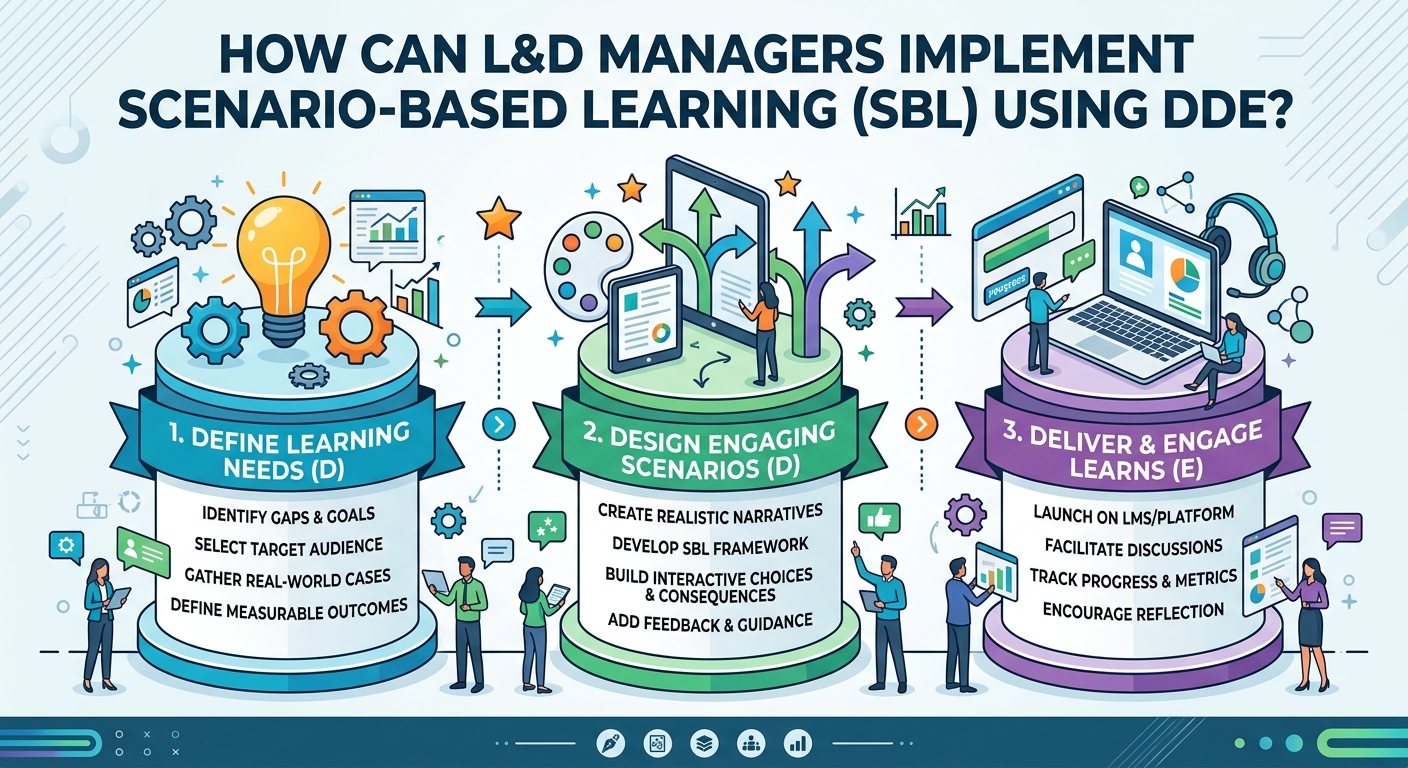
How Can L&D Managers Implement Scenario-Based Learning Using DDE?
In today's fast-evolving corporate landscape, the demand for effective, practical, and engaging employee training has never been higher. L&D managers face the constant challenge of bridging skill gaps, fostering critical thinking, and ensuring regulatory compliance across diverse industries. Traditional lecture-based training often falls short in preparing employees for real-world complexities. This is where Scenario-Based Learning (SBL) combined with a robust Design, Develop, Evaluate (DDE) framework emerges as a powerful solution.
For Vice Presidents, Directors, and Senior L&D Managers, understanding how to strategically implement SBL using DDE is crucial for driving measurable improvements in performance, engagement, and retention. This article will guide you through integrating these methodologies to create impactful learning experiences, from Compliance to Sales, Healthcare to Hospitality, and beyond.
What is Scenario-Based Learning (SBL)?
Scenario-Based Learning is an instructional strategy that places learners in realistic, relevant situations where they must make decisions, solve problems, and experience the consequences of their choices within a safe environment. Instead of passively receiving information, learners actively engage with challenges that mirror their actual job roles. This approach fosters:
- Critical Thinking: Learners analyze situations, weigh options, and predict outcomes.
- Decision-Making Skills: Repeated practice in making choices under pressure builds confidence and competence.
- Problem-Solving Abilities: Learners develop strategies to navigate complex, ambiguous situations.
- Empathy and Perspective: By stepping into different roles or observing various outcomes, learners gain a broader understanding.
- Engagement and Retention: Active participation and emotional connection to the narrative significantly improve knowledge retention.
SBL is particularly effective in industries requiring nuanced decision-making, such as compliance training in banking and finance, sales negotiation in retail, patient care protocols in healthcare, or safety procedures in oil and gas and mining.
Understanding DDE: Design, Develop, Evaluate
The DDE framework provides a structured, systematic approach to creating effective learning solutions. It ensures that SBL initiatives are not only creative but also purposeful, well-executed, and ultimately impactful.
Design Phase
This foundational stage involves understanding the learning need, defining objectives, and outlining the scenario's core elements. It's about answering "what" and "why."
- Needs Analysis: Identify specific skill gaps, performance issues, or compliance requirements. For instance, in insurance, it might be improving claims processing accuracy.
- Learning Objectives: Clearly define what learners should be able to do, know, or feel after completing the scenario. Objectives should be SMART (Specific, Measurable, Achievable, Relevant, Time-bound).
- Audience Analysis: Understand learner demographics, prior knowledge, motivation, and technological access.
- Scenario Blueprint: Outline the core challenge, key decision points, characters, setting, and potential branching paths. This is also where you consider the best format for delivering the scenario, whether it's a short, focused module or a more extensive simulation. Consider how Microlearning LMS elements can break down complex scenarios into digestible parts.
Develop Phase
Here, the blueprints come to life. This phase involves creating the actual learning content, interactions, and visual elements.
- Content Creation: Write engaging narratives, dialogues, and descriptions. Craft realistic challenges and consequences.
- Visual and Audio Assets: Develop or source graphics, videos, animations, and sound effects that enhance immersion and clarity.
- Interactive Elements: Program decision points, feedback mechanisms, and branching logic. This often requires specialized authoring tools or platforms. Modern training systems can incorporate interactive elements seamlessly. Consider tools that act as an AI Powered Authoring Tool to streamline this process.
- Platform Integration: Implement the scenario within your chosen digital learning environment, ensuring compatibility and optimal user experience. If your organization is looking for engaging ways to present learning, explore how a Gamified LMS can enhance this stage.
Evaluate Phase
The final, crucial stage assesses the effectiveness of the SBL initiative and identifies areas for improvement. It's about answering "how well did it work?" and "what can be done better?"
- Formative Evaluation: Gather feedback during development (e.g., pilot testing, peer reviews) to identify early issues.
- Summative Evaluation: Measure learning outcomes post-implementation. This includes analyzing learner performance within the scenario, knowledge assessments, and feedback surveys.
- Impact Assessment: Crucially, evaluate the scenario's impact on job performance, key business metrics (e.g., reduction in errors, increase in sales, improved compliance rates), and return on investment. This is especially vital for Risk-focused Training in highly regulated sectors.
- Iteration and Improvement: Use evaluation data to refine and enhance the scenario for future cohorts. This continuous improvement cycle is a hallmark of effective L&D. Leveraging insights from Adaptive Learning approaches can significantly refine scenario effectiveness over time.
The Power of SBL + DDE: A Synergistic Approach
When SBL is integrated with the DDE framework, L&D managers gain a powerful methodology for creating highly effective and strategically aligned training programs. DDE ensures that the creative energy of SBL is channeled into measurable outcomes, preventing scenarios from becoming mere "fun" exercises without real impact. It provides the rigor and structure necessary to scale SBL across an enterprise, ensuring consistency and quality.
Implementing SBL with DDE: A Step-by-Step Guide for L&D Managers
Step 1: Define Learning Objectives and Scenarios
Start with clarity. What specific behaviors, skills, or knowledge do you want to foster? For a sales team, it might be handling difficult customer objections. For healthcare, it could be communicating sensitive diagnoses. The scenario should directly address these objectives, presenting a clear problem statement that resonates with learners' daily challenges.
Step 2: Craft Engaging Narrative and Characters
Good scenarios tell a story. Develop compelling characters, realistic dialogue, and a believable setting. The narrative should immerse the learner, making them feel invested in the outcome. Ensure the scenarios reflect the complexities and ambiguities of real-world situations, rather than presenting clear-cut right/wrong answers. This is where the "Design" phase truly shines.
Step 3: Leverage Technology for Development
Modern digital learning environments and authoring tools are essential for developing and delivering interactive scenarios. These platforms can host complex branching narratives, track learner decisions, provide immediate feedback, and integrate multimedia elements. Consider platforms that offer robust analytics to monitor engagement and performance. The choice of platform directly impacts the feasibility and scalability of your SBL initiatives.
Step 4: Incorporate Feedback Loops and Iteration
During the "Develop" phase, integrate mechanisms for immediate, constructive feedback within the scenario. After a learner makes a decision, explain why it was effective or what the consequences might be. Post-scenario, provide a debriefing that summarizes learning points and offers opportunities for reflection. The "Evaluate" phase should then inform continuous improvements, treating your SBL programs as living assets.
Step 5: Measure Impact and ROI
Beyond completion rates, focus on measuring the impact SBL has on business outcomes. Are compliance violations decreasing? Is customer satisfaction improving? Are new employees onboarding faster? Link scenario performance data to real-world metrics. This data is invaluable for demonstrating the value of L&D to executive leadership and securing future investment.
Industry-Specific Applications
- Compliance (Banking, Finance, Insurance): Simulate ethical dilemmas, regulatory breach scenarios, or anti-money laundering investigations.
- Sales (Retail, Pharma): Practice objection handling, negotiation techniques, product pitching, or managing difficult customer interactions.
- Healthcare: Recreate patient consultations, emergency response protocols, difficult conversations with families, or diagnostic procedures.
- Hospitality: Train staff on guest conflict resolution, service recovery, or handling unique guest requests.
- Oil and Gas, Mining: Simulate safety incidents, equipment malfunction troubleshooting, or environmental emergency responses.
AI-Enhanced Scenario-Based Learning
Artificial intelligence is transforming L&D, offering exciting possibilities for SBL. Managers are increasingly asking:
Question: How can intelligent systems help L&D managers optimize the discoverability and effectiveness of their scenario-based training programs across a large organization?
Answer: By analyzing content metadata, learner interactions, and performance data, intelligent systems can recommend relevant scenarios, identify knowledge gaps, and personalize learning paths. This ensures content reaches the right learners at the optimal time, enhancing the impact of training by making it highly targeted and easily accessible.
Question: What role can advanced computational intelligence play in tailoring scenario-based learning to different regional or cultural contexts, especially for global organizations?
Answer: Computational intelligence can analyze vast datasets of cultural norms, communication styles, and regional regulations to suggest appropriate modifications for scenario narratives, characters, and decision outcomes. This ensures that training is culturally sensitive and contextually relevant, boosting engagement and understanding among diverse global teams.
Question: How might artificial intelligence assist in understanding learner intent and customizing scenario paths for more effective engagement and skill development?
Answer: By tracking learner choices, response times, and sentiment, AI can infer a learner's motivations, strengths, and weaknesses. This allows for dynamic adjustments to the scenario difficulty, branching paths, and feedback provided, creating a truly personalized learning journey that maximizes engagement and targets specific areas for development.
Key Takeaways for L&D Leaders
Implementing Scenario-Based Learning through the DDE framework is more than just a training methodology; it's a strategic investment in your workforce's capabilities. It equips employees with the practical experience needed to excel in complex, real-world situations, driving organizational resilience and growth. By embracing this approach, L&D managers can move beyond simply delivering content to truly shaping performance and fostering a culture of continuous development.
Conclusion
The synergy of Scenario-Based Learning and the DDE framework empowers L&D managers to create highly effective, engaging, and measurable training programs. By meticulously designing, developing, and evaluating each scenario, you can ensure that your employees are not just learning, but truly experiencing and mastering the skills essential for success in their roles and for your organization's future.


Comments
Post a Comment