How to Secure High Learner Buy-In Using the Multiple Intelligences Model
How to Secure High Learner Buy-In Using the Multiple Intelligences Model for Enterprise eLearning
In today's fast-paced corporate world, securing genuine learner buy-in is paramount for the success of any learning and development initiative. For L&D leaders across diverse sectors like Compliance, Sales, Banking, Pharma, and Hospitality, merely offering training isn't enough; employees must actively engage with, absorb, and apply the knowledge. The challenge often lies in catering to a workforce with varied learning preferences and cognitive strengths. This is where the Multiple Intelligences (MI) Model emerges as a powerful framework, transforming passive participation into enthusiastic engagement. By understanding and designing for these distinct intelligences, organizations can create a more effective, personalized, and impactful enterprise learning management strategy that elevates performance and drives business growth.
Understanding Learner Buy-In: The Core Challenge
Learner buy-in isn't just about attendance; it's about motivation, perceived relevance, and active participation. Without it, even the most meticulously designed courses housed within a state-of-the-art learning management system can fall flat. L&D professionals constantly grapple with:
- Time Constraints: Employees often feel overwhelmed by their primary responsibilities, viewing training as an additional burden.
- Irrelevance: Generic content fails to resonate with individual job roles or departmental needs.
- Disengagement: Monotonous formats lead to passive consumption rather than active learning.
- Lack of Personalization: A "one-size-fits-all" approach neglects diverse learning styles.
For industries where stakes are high, such as Finance, Healthcare, or Oil and Gas, ensuring that critical compliance training or new sales methodologies are fully embraced is not just beneficial—it's essential for mitigating risks and achieving strategic objectives. A robust learning content management system is key, but the content itself must be compelling.
The Multiple Intelligences Model: A Framework for Engagement
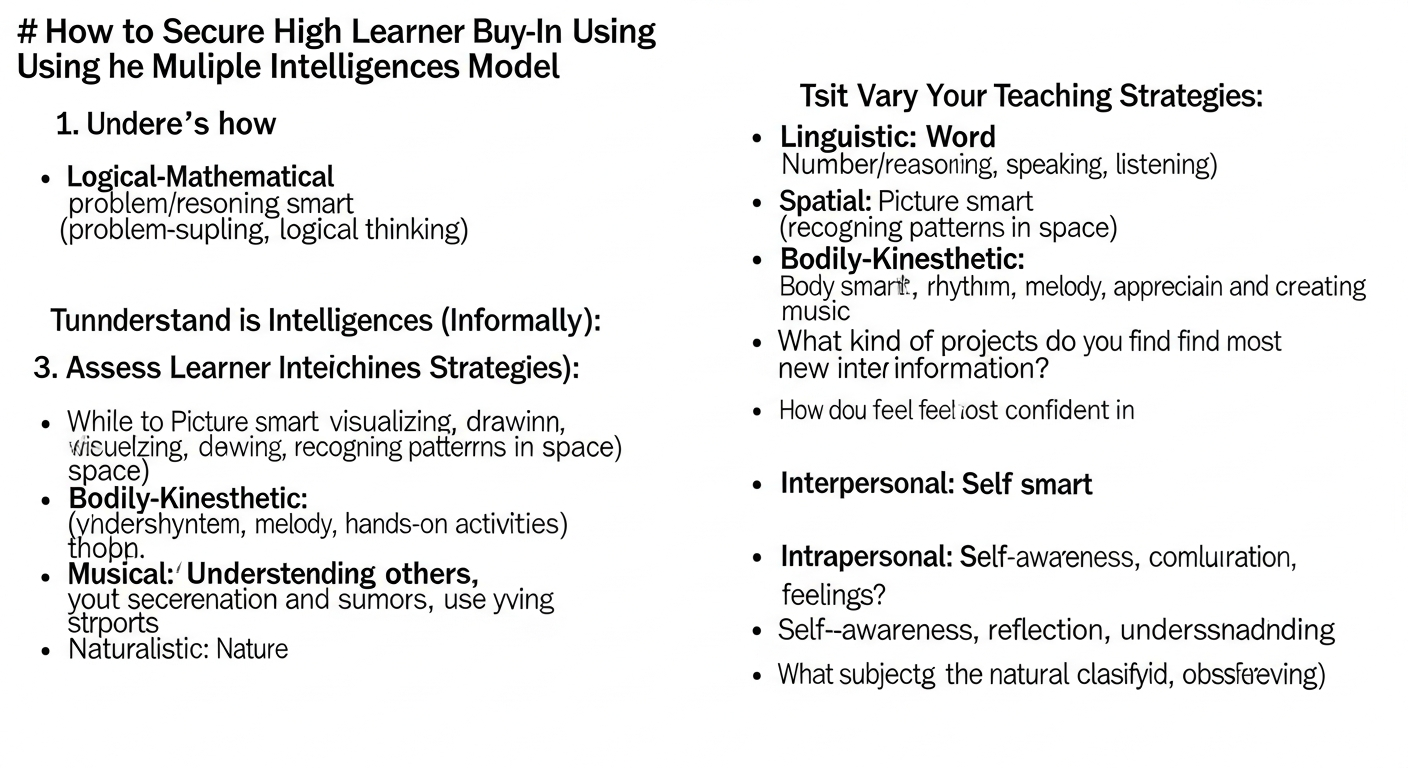
Developed by Dr. Howard Gardner, the Multiple Intelligences Model posits that intelligence is not a single, monolithic entity, but rather a spectrum of distinct intellectual capacities. Gardner initially identified seven, later expanding to eight (with a ninth often debated):
- Linguistic: Word smart (reading, writing, storytelling).
- Logical-Mathematical: Number/reasoning smart (problem-solving, patterns).
- Spatial: Picture smart (visualizing, graphic design).
- Bodily-Kinesthetic: Body smart (movement, hands-on activity).
- Musical: Music smart (rhythm, melody).
- Interpersonal: People smart (social interaction, collaboration).
- Intrapersonal: Self smart (self-awareness, reflection).
- Naturalistic: Nature smart (understanding natural world).
By designing learning management solutions that tap into these varied strengths, L&D teams can create learning experiences that genuinely connect with each individual, fostering deeper understanding and enthusiastic participation. This approach goes beyond traditional eLearning, providing a richer, more inclusive environment within any lms learning management system.
Leveraging Multiple Intelligences for High Buy-In
Integrating the MI model into your eLearning strategy within a modern learning management software can dramatically boost learner buy-in:
Linguistic Intelligence: The Power of Words
For individuals who excel with words, content should be rich in narrative. Incorporate compelling case studies, expert interviews, thought-provoking articles, and interactive quizzes that test comprehension through nuanced language. Use clear, concise explanations for complex regulations in Compliance training or product features in Sales training. A Microlearning LMS can deliver these bite-sized textual or audio narratives effectively.
Logical-Mathematical Intelligence: Patterns and Problem-Solving
Appeal to those who thrive on logic, numbers, and critical thinking. Design modules around data analysis, problem-solving simulations, decision-making scenarios, and financial modeling exercises. For Banking and Finance, this could involve analyzing market trends or risk assessment simulations. Present information in structured formats, demonstrating cause-and-effect relationships and logical progressions. This is especially vital for Risk-focused Training, where understanding patterns of vulnerability is crucial.
Spatial Intelligence: Visual Learning and Imagery
Visual learners grasp concepts best through images, diagrams, maps, and videos. Utilize infographics, animated explanations, interactive simulations, and virtual reality (VR) tours (e.g., for Hospitality or Manufacturing). Show, don't just tell. For Retail, this could be visual merchandising simulations; for Healthcare, anatomical diagrams or procedural videos. A cloud based learning management system can easily host and deliver rich media content.
Bodily-Kinesthetic Intelligence: Hands-On Engagement
Learners with strong bodily-kinesthetic intelligence learn by doing. While direct physical activity might be limited in eLearning, simulate it through interactive drag-and-drop exercises, virtual labs, role-playing scenarios (e.g., customer service in Hospitality), click-to-explore environments, and branching simulations that require active choices. Maximize interactivity to mimic physical engagement, even if it's just a mouse click or touch screen interaction.
Interpersonal Intelligence: Collaboration and Discussion
These learners thrive in social environments. Integrate features like discussion forums, collaborative project work, peer reviews, group assignments, and virtual breakout rooms into your LMS. For sales teams, this might involve peer coaching scenarios or group analysis of sales pitches. Encourage social learning to build a sense of community and shared understanding across your enterprise learning management ecosystem.
Intrapersonal Intelligence: Reflection and Self-Paced Growth
Self-aware and reflective individuals benefit from opportunities for independent study, journaling prompts, self-assessments, and personalized feedback. Offer flexible learning paths and encourage goal-setting. A well-designed learning management system allows learners to progress at their own pace, offering private reflection spaces and personalized learning journeys.
AI and the Multiple Intelligences: A Synergistic Approach
The advent of artificial intelligence offers unprecedented opportunities to further enhance learner buy-in by intelligently adapting to individual intelligences.
Q: How can artificial intelligence personalize learning paths based on diverse intelligences?
AI algorithms can analyze learner interactions, performance data, and even pre-assessment results to recommend content formats best suited to their dominant intelligence. For instance, if a learner excels in visual quizzes and interactive simulations, AI can prioritize such content. If another shows strength in textual analysis, it might suggest more case studies and articles. This intelligent tailoring transforms a generic course into a personalized journey, effectively acting as an Adaptive Learning engine that maximizes engagement and comprehension.
Q: What role does AI play in creating varied learning content for different intelligence types?
An AI Powered Authoring Tool can significantly assist L&D teams in generating diverse content at scale. Imagine AI suggesting turning a textual compliance policy into an interactive scenario for bodily-kinesthetic learners, or automatically generating infographics for spatial learners from a dense report. This capability accelerates content creation while ensuring a broader appeal across all intelligence types, making the learning content management system more dynamic and versatile.
Q: How can AI enhance engagement and motivation across multiple intelligences?
AI can power Gamified LMS features by tailoring challenges and rewards to resonate with different learner motivations. For logical-mathematical learners, AI might introduce complex puzzles or data-driven leaderboards. For interpersonal learners, it could facilitate team-based challenges or collaborative problem-solving within the learning management system. By understanding individual engagement triggers, AI can dynamically adjust the learning environment, fostering higher motivation and sustained buy-in for every user of your MaxLearn LMS.
Practical Implementation for L&D Leaders
To effectively leverage the Multiple Intelligences Model, L&D leaders should:
- Assess and Profile: Consider integrating optional pre-assessments or quizzes to help learners identify their preferred learning styles, or simply educate them on the different intelligences.
- Diversify Content Formats: Ensure each module or topic offers multiple ways to learn the same core concept. This might mean having a video, an interactive simulation, a textual case study, and a group discussion option for a single learning objective. A versatile LMS is crucial here.
- Utilize Modern Learning Management Solutions: Invest in a robust learning management system that supports rich media, interactivity, collaboration tools, and Adaptive Learning capabilities. A cloud based learning management system ensures accessibility and scalability.
- Embrace Microlearning: Deliver content in short, focused bursts. This naturally lends itself to diverse formats and appeals to varying attention spans, making it ideal for Microlearning LMS deployments across all industries, from Pharma to Mining.
- Focus on Real-World Application: Connect learning to practical scenarios relevant to the learner's role. For example, Risk-focused Training for Banking might include simulations of fraudulent transactions.
Conclusion
Achieving high learner buy-in is no longer an aspiration but a strategic imperative for L&D leaders aiming for impactful corporate training. By thoughtfully integrating the Multiple Intelligences Model into your eLearning strategy, supported by advanced learning management software and the power of AI, you can move beyond mere compliance to genuine engagement. This holistic approach ensures that every employee, regardless of their dominant intelligence, finds value, relevance, and enjoyment in their learning journey. Solutions like MaxLearn LMS provide the technological backbone to deliver such a dynamic and inclusive learning experience, driving not just knowledge acquisition, but sustained behavioral change and tangible business outcomes.


Comments
Post a Comment